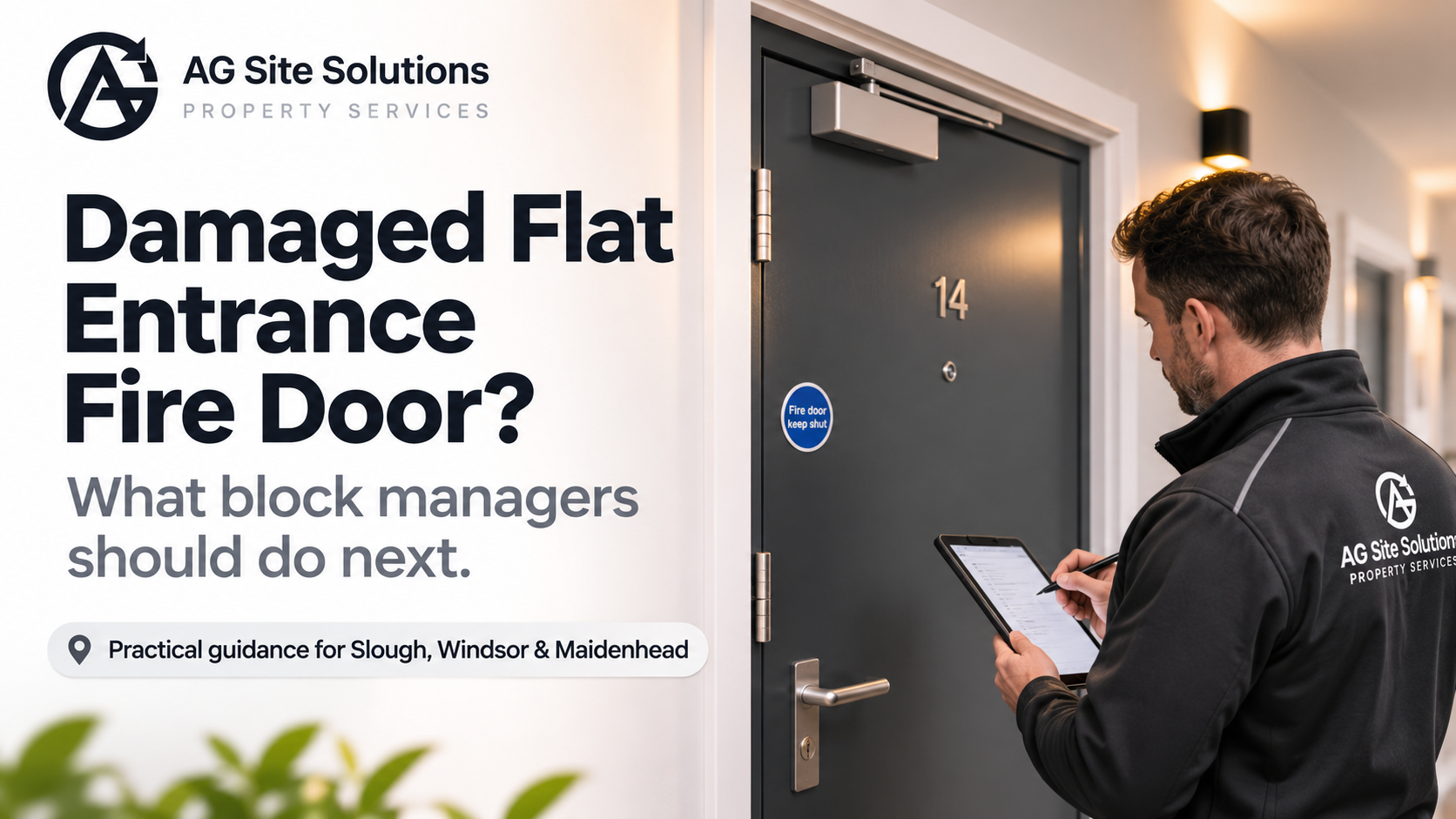
What should block managers do if a flat entrance fire door appears damaged or has been altered?
If you discover a damaged flat entrance fire door, record the concern, notify the person responsible for the building’s fire safety arrangements, arrange assessment by a competent fire-door professional and track any recommended work through to completion. Visible damage or an alteration alone does not establish the level of risk. An active emergency is different: if there is a fire or smoke suggesting a fire, follow the building’s emergency instructions and call 999.
Key takeaways
- Give the concern a traceable case reference, a named owner and a clear next action.
- Describe what was observed without labelling the door safe, unsafe or beyond repair.
- Make professional assessment an explicit handover, not an assumption hidden in a maintenance request.
- Keep assessment findings, work records and follow-up together before closing the case.
The cover sheet: make the concern traceable
For a block management team, the practical challenge is keeping the concern visible when staff, contractors or managing agents change.
Open a distinct case rather than leaving the report inside a general maintenance email. Record the building, flat reference, date reported, reporter’s description and person managing the next action. Link related messages to that case so the next colleague can understand it without reconstructing an inbox.
Notify the person responsible for the building’s fire safety arrangements and record that handover. If you are unsure who that is, raise the question with the building’s management contact rather than assuming an ordinary repair contractor will take responsibility.
> DO NOT USE THE REPORTING PROCESS DURING AN ACTIVE EMERGENCY — A maintenance case is for recording and managing a concern, not obtaining emergency help. If there is a fire or smoke suggesting a fire, follow the building’s emergency instructions and call 999; do not wait for an email response.
The evidence record: observations, not conclusions
Useful block manager fire door checks distinguish what someone noticed from what a specialist needs to assess.
- Visible splits, holes, dents or damage around the door or frame.
- Loose, missing or visibly damaged hinges, handles or closing equipment.
- A resident’s report that the door sticks or no longer closes as it previously did.
- Changes such as a new lock, letterplate, glazing or other fitting.
- Painted-over, loose or apparently missing strips around the door edges or frame.
These are reasons to raise a concern, not technical pass/fail criteria. Write “resident reports door catches at the bottom” rather than “door has failed”. For an altered flat entrance fire door, record what appears to have changed and whether that information came from observation, a resident or earlier records.
Useful evidence to attach
- [ ] An overview photograph identifying the relevant door.
- [ ] Closer photographs of the reported damage or alteration, where appropriate.
- [ ] The resident’s description, clearly marked as reported information.
- [ ] Relevant earlier photographs, assessment reports or work records.
- [ ] Access arrangements and any limitations on what could be observed.
Keep photographs focused on the concern rather than residents or personal belongings. Do not dismantle fittings, remove materials or attempt a repair to investigate the issue.
The assessment handover: ask for a clear decision
The handover should request assessment, not simply ask someone to make the door look better.
Arrange assessment by a competent fire-door professional through the person managing the building’s fire safety arrangements. Confirm that the proposed professional has relevant competence for the door and the assessment required; a general maintenance role alone should not be treated as evidence of that competence.
Send the case record and ask for written findings covering the assessment scope, limitations, recommended action and any further investigation needed. Ask the professional to explain the priority of the recommendations and any interim arrangements for the responsible person to consider.
Photographs support the handover but should not be presented as proof of fire-door performance. Avoid deciding in advance that a repair or replacement is necessary: the assessment should inform that decision.
The completion record: follow the recommendation through
A contractor booking is a step in the case, not its conclusion.
Record the assessment outcome, who is taking the decision forward and what action has been agreed. Where work is recommended, connect the work instruction to those recommendations so that the scope is clear.
- Keep unresolved questions visible, including access difficulties or missing records.
- Record any change to the proposed work and who reviewed it.
- Obtain documentation describing the work actually completed.
- Arrange any follow-up assessment or verification recommended by the professional.
- Record the basis for closure and any outstanding actions.
A message saying “job done” should not be your only record. Equally, an inspection or repair does not establish that the whole property is fully compliant. Keep the conclusion limited to the documented scope and findings.
The resident update: explain what happens next
A calm update can acknowledge the concern without giving an unsupported safety judgement.
Tell the resident that the report has been recorded, who is managing it and what the next action is. Explain any access request and ask them to report changes through the agreed contact. Avoid assurances such as “nothing to worry about” before professional advice is available.
Keep emergency instructions separate from routine reporting details. Our related guide, How can landlords set up an out-of-hours repair plan that tenants can actually use?, explores how to make repair contacts clearer.
Whether you manage a block in Slough or nearby Windsor or Maidenhead, a shared case record helps keep the conversation consistent. For fire door concerns in Slough, you are welcome to contact AG Site Solutions to discuss your enquiry. This is not an offer of specialist fire-door assessment or remedial work.
Reporting and assessment have different purposes
| Reporting a concern | Professional assessment |
|---|---|
| Describes observed or reported changes | Evaluates the door within an agreed assessment scope |
| Collects photographs and background records | Considers evidence and identifies limitations |
| Requests a decision | Provides findings and recommended action |
Keep each record within its scope.
Before handing the case to a colleague
- Can they identify the correct door?
- Is the current case owner clear?
- Are professional findings distinguishable from reported observations?
- Is the next action visible?
- Are unresolved questions still marked as open?
Contact AG Site Solutions with a brief description of your enquiry. We can discuss it with you without promising specialist fire-door assessment or remedial work.
Frequently asked questions
What if the report is anonymous?
Record the information available and identify the door if possible. Mark details you cannot confirm rather than filling in the gaps.
What if several residents report the same door?
Link their reports to one case while preserving each account. Note any differences for the assessor rather than choosing one version.
Should I include an unconfirmed date for an alteration?
Label it as approximate or unknown. Do not turn a resident’s estimate into a confirmed installation date.
What if the resident disputes causing the damage?
Keep attribution separate from the condition report. Record the concern without assigning blame.
What if the flat is empty?
Identify the authorised access contact and record the arrangements. Do not assume vacancy gives the management team unrestricted access.
What if the managing agent changes while the case is open?
Include the case in the handover and ask the incoming contact to acknowledge ownership of outstanding actions.
Can I close the case if the resident withdraws their complaint?
Do not treat withdrawal alone as evidence that the concern is resolved. Refer the existing record to the person managing the response.
Should I circulate photographs to every resident?
Keep detailed evidence with the people managing and assessing the concern. A general update need not include identifiable photographs of someone’s flat.