Energy Performance Certificate (EPC): The Ultimate 2026 Guide for UK Property Owners
If you think your current energy performance certificate is just a piece of paper to file away, a £30,000 fine might quickly change your mind. Recent shifts in UK law mean that compliance is no longer a "set and forget" task. It's a high-stakes requirement that dictates your property's marketability and legal standing. You likely feel the weight of these changing regulations. Juggling multiple inspectors and deciphering complex government jargon creates unnecessary friction.
This definitive guide cuts through the noise. Master the 2026 standards, from the new four-metric domestic system to the critical MEES "C" rating deadline. We provide the clarity you need to protect your investment and avoid costly penalties. We'll walk you through the legal essentials, explain how to improve your rating efficiently, and give you total peace of mind that your portfolio is fully compliant. Get the facts you need to move forward with confidence.
Key Takeaways
- Stay legally protected by mastering the new 2026 metrics and understanding exactly when your 10-year validity period requires an early renewal.
- Navigate the road to a "C" rating by 2030 with a clear breakdown of the MEES regulations and the SAP calculation process.
- Identify the critical differences between domestic and commercial assessments to ensure your property meets its specific legal obligations.
- Boost your final score by gathering evidence like FENSA certificates and insulation invoices before your assessor arrives on-site.
- Minimise administrative hassle by bundling your energy performance certificate with property photography or PAT testing for a faster result.
What is an Energy Performance Certificate (EPC) and Why Does It Matter in 2026?
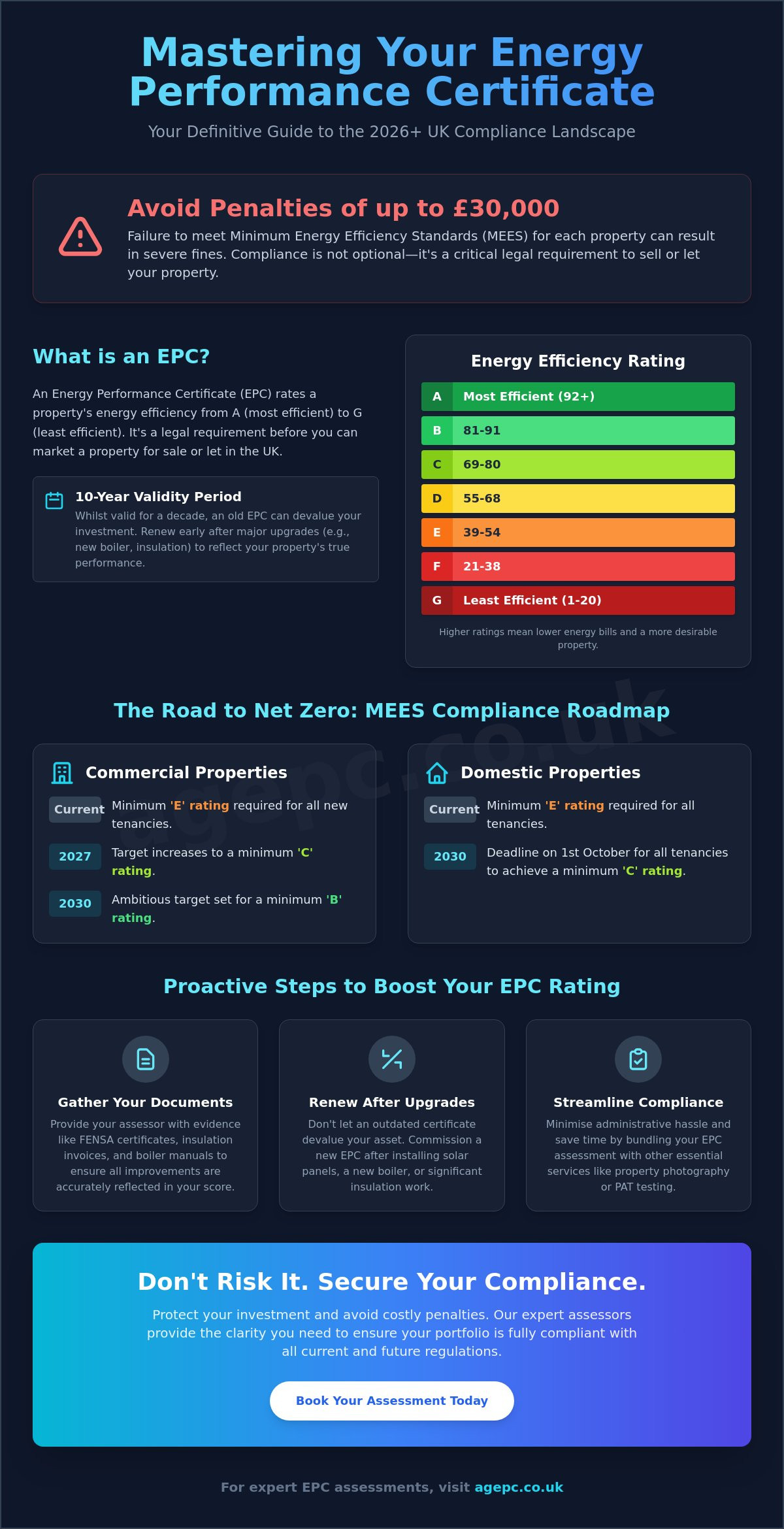
An Energy Performance Certificate (United Kingdom) is a standardised document that rates a property's energy efficiency on a scale from A to G. It provides a clear snapshot of energy costs and carbon emissions. In 2026, this document has evolved from a simple administrative hurdle into a critical compliance asset. You cannot legally market a property for sale or let without one. Compliance is non-negotiable. The government uses these ratings to drive the UK towards net-zero targets, making your certificate a key factor in your property's financial viability.
Your energy performance certificate remains valid for 10 years. However, a "valid" certificate isn't always a "sufficient" one. If you've installed a new boiler, added solar panels, or upgraded your insulation, your old rating is likely holding back your property's value. Renewing early ensures your score reflects your actual assets. In a market where buyers and tenants prioritise efficiency, an outdated "D" rating on a property that now performs like a "B" is a costly mistake. Don't let old data devalue your investment.
The Legal Framework: Selling, Letting, and Building
The law is clear. Residential homeowners must commissioned an EPC before a property is even put on the market. Landlords face even stricter scrutiny. Under current Minimum Energy Efficiency Standards (MEES), you cannot grant a new tenancy or renew an existing one if the rating is too low. Failure to comply is expensive. Fines for non-compliance have surged to £30,000 per property. Many owners previously relied on exemptions for heritage or listed buildings. As of 2026, these exemptions have been removed. Almost every building now requires a valid certificate to stay on the right side of the law.
How to Check if Your Property Already Has a Valid EPC
Finding your current status is a quick, digital process. Visit the official government EPC register and enter your postcode to retrieve existing records. When reviewing the document, focus on the "Expiry Date" rather than the "Assessment Date". If your certificate is nearing the end of its 10-year life, book a new assessment immediately to avoid a gap in coverage. If you find your property isn't listed or the data is lodged incorrectly, you'll need a fresh assessment to rectify the record. A missing certificate can stall a sale for weeks. Verify your status today to keep your transactions moving at speed.
Understanding EPC Ratings and the 2026 MEES Regulations
Your property's rating is a direct reflection of its operational efficiency. The scale runs from A to G, where an 'A' represents a high-performance building and a 'G' indicates a significant legal and financial liability. This grade is determined through the Standard Assessment Procedure (SAP). This calculation measures energy consumption per square metre, accounting for heating, lighting, and ventilation. In 2026, the link between your energy performance certificate and your property's market value is absolute. High-rated buildings command higher rents and attract premium tenants. Conversely, a poor rating devalues your asset and increases the risk of void periods.
The score isn't just about environmental impact; it's about the bottom line. Efficient properties have lower running costs, making them far more desirable in a competitive commercial market. If your building falls into the lower bands, you're likely seeing higher carbon emissions and inflated utility bills. These factors are now primary considerations for institutional investors and corporate tenants with their own ESG (Environmental, Social, and Governance) targets. Improving your grade is no longer optional; it's a strategic necessity to maintain your property's capital value.
Minimum Energy Efficiency Standards (MEES) Explained
Compliance is the most urgent priority for UK landlords. As of 2026, the minimum legal requirement for commercial tenancies remains an 'E' rating, but the window for upgrades is closing fast. The government's roadmap targets a minimum 'C' rating by 2027 and an ambitious 'B' rating by 2030 for all non-domestic spaces. For residential portfolios, the deadline to reach a 'C' rating for all tenancies is 1 October 2030. Ignoring these milestones is a massive financial risk. Local authorities are empowered to issue fines of up to £30,000 for commercial non-compliance. You can protect your revenue by booking a commercial energy performance certificate to identify exactly where your building stands today.
Environmental Impact and the Net Zero 2050 Goal
The UK's drive toward Net Zero by 2050 has fundamentally changed how properties are assessed. New 2026 metrics for domestic certificates now place a heavier emphasis on "Fabric Performance" and "Smart Readiness". This shift means that insulation quality and the ability to integrate with smart energy grids are now key drivers of your score. The assessment weighting has also moved decisively toward heat pumps and renewable energy sources. Future-proofing your property through these technologies is significantly cheaper than carrying out reactive, emergency upgrades when a lease renewal is blocked by a failed assessment. Proactive investment ensures long-term compliance and reduces your long-term maintenance burden.
Domestic vs Commercial EPCs: Key Differences for Owners
Choosing the right assessment is the first step toward compliance. Not all buildings are evaluated using the same criteria. A standard house requires a domestic assessment, whilst a warehouse or office block needs a non-domestic approach. The distinction isn't always about size. It's about how the building is used. If you own a small retail shop with a flat above it, you may actually need two separate certificates. One covers the commercial space, and the other covers the residential dwelling. Getting this wrong can lead to invalid documentation and potential legal friction during a sale or lease.
The qualifications of your assessor also differ significantly. Domestic Energy Assessors (DEAs) are trained specifically for residential properties. Non-Domestic Energy Assessors (NDEAs) hold higher-level certifications to handle complex commercial environments. Commercial assessments are naturally more technical. They require a deeper dive into building services and construction materials. Because of this complexity, a commercial energy performance certificate usually takes longer to produce and requires more extensive on-site data collection than a standard home visit.
Domestic Energy Assessments (DEA)
Residential evaluations rely on the Reduced Data Standard Assessment Procedure (RdSAP). This methodology is designed for speed and accuracy in existing homes. The assessor focuses on the "envelope" of the property. They examine loft insulation, wall construction, and window glazing. They also inspect heating controls and hot water cylinders. From October 2026, these assessments will include new headline metrics such as Fabric Performance and Smart Readiness. A domestic visit usually takes between 30 and 60 minutes. You can expect a fast turnaround, with most certificates lodged on the national register within 24 hours of the inspection.
Commercial Energy Assessments (NDEA)
Commercial properties use the Simplified Building Energy Model (SBEM). This is a more rigorous calculation that accounts for diverse energy uses. Unlike a home, a commercial building is divided into "zones" based on activity and lighting. The assessor must evaluate complex HVAC (Heating, Ventilation, and Air Conditioning) systems and high-output lighting arrays. To speed up this process, owners should provide technical data upfront. Having 2D or 3D floor plans and plant specifications ready significantly reduces the assessor's time on-site. This preparation ensures a more accurate model of your building's performance, which often results in a better final rating. Accurate data leads to better outcomes.
How to Prepare for Your Assessment and Improve Your Score
Preparation is the difference between a passing grade and a compliance failure. An assessor can only record what they physically see or what you can prove with documentation. If a feature is hidden behind a wall or tucked away in a locked cupboard, the assessor must use "assumed" values. These defaults are almost always the worst-case scenario for your rating. Providing documentary evidence is the fastest way to secure an accurate energy performance certificate and avoid the "assumed" data trap.
Gather your paperwork before the visit begins. You need FENSA certificates for double glazing, boiler service records, and invoices for any cavity wall or loft insulation. If you have installed renewable technology like solar panels or heat pumps, have the MCS certificates ready. These documents transform "assumed" data into "evidenced" facts. This simple step often jumps your score by several points without you spending a penny on physical upgrades. Accuracy is your best tool for compliance.
Physical access is equally vital. The assessor must inspect the loft, the boiler, and any hot water cylinders. A locked hatch or a cluttered utility room results in an incomplete survey or a lower rating based on guesses. Clear the path to these areas. Ensure all rooms are accessible and that any extensions or conversions are fully open for inspection. A smooth, frictionless visit leads to a faster result and a more reliable certificate.
Top 5 Quick Wins to Boost Your EPC Rating
You don't always need expensive retrofits to see a significant improvement. Focus on these high-impact, low-cost changes:
- 100% LED Lighting: Swap every old bulb for a modern LED equivalent. This is the cheapest way to gain points instantly.
- Loft Insulation: Ensure your insulation reaches the 270mm "sweet spot". Many older properties only have 100mm, which is a major score-killer.
- Pipe and Cylinder Lagging: Wrap your hot water tank and pipes. This prevents heat loss and shows the assessor you value efficiency.
- Modern Heating Controls: Install Thermostatic Radiator Valves (TRVs) on every radiator and a smart thermostat to manage usage.
- Draught Proofing: Seal gaps around windows, doors, and loft hatches to stop heat escaping.
Understanding the Recommendations Report
Every certificate comes with a tailored roadmap for your property. The recommendations report is divided into "cost-effective" measures and "further" measures. Prioritise your upgrades based on the "Payback Period" shown. A shorter payback means the upgrade pays for itself quickly through energy savings. Never ignore the "Potential Rating" section. This shows the maximum grade your property can achieve. Use this as your target to future-proof your asset against upcoming MEES changes. Ready to see where you stand? You can book your next energy performance certificate with our streamlined online platform.
Streamlining Compliance with AG Property Services
Efficiency is the core of our service. We act as a tech-savvy partner for property owners and managers across the UK. Managing multiple contractors for an energy performance certificate, safety checks, and marketing assets is a drain on your time. We solve this by providing a unified, professional platform. You get consistent results and a single point of contact for your entire portfolio. Our team balances high-speed delivery with grounded, authoritative expertise to remove the friction from property management.
Our approach combines technical accuracy with modern transparency. We understand that a delayed certificate means a delayed transaction. Our assessors work quickly to deliver results that are both legally robust and easy to understand. By choosing a national provider, you ensure that every property meets the same high standard of verification. We don't just provide a rating; we provide the peace of mind that your assets are fully protected against the latest 2026 regulations.
We also help you move beyond simple compliance to active conversion. High-quality 2D and 3D floor plans combined with professional property photography make your listings stand out. These assets help potential tenants or buyers visualise the space immediately. This reduces the time your property spends on the market. You get a valid certificate and a powerful marketing suite in one go. It's a logical, results-oriented solution for the modern landlord.
The One-Stop Shop Advantage for Landlords
Why book three separate visits when one will do? We specialise in bundled services that save you money and reduce tenant disruption. You can combine your energy performance certificate with Portable Appliance Testing (PAT) and professional property photography in a single appointment. This centralised approach keeps all your mandatory documentation in one digital place. You stay organised. Your tenants stay happy. Your administrative burden disappears. We handle the complexity so you can focus on your business.
Booking Your 2026 EPC Assessment
Our booking process is designed for the modern property owner. It is rapid, logical, and entirely digital. Once you secure your slot, our expert assessors handle the rest with minimal fuss. After the survey, we lodge your certificate directly on the national register, ensuring immediate compliance. You'll receive a notification as soon as the data is live and ready for use. Don't leave your legal standing to chance. Secure your property compliance today with AG Property Services.
Secure Your Property's Future Today
Mastering the 2026 energy standards doesn't have to be a source of stress. You now understand that a valid energy performance certificate is a strategic asset, not just a box to tick. By acting now, you avoid the risk of £30,000 fines and ensure your property remains attractive to high-quality tenants. Preparation and accurate documentation are your best tools for securing the highest possible rating. Don't wait for a deadline to force your hand; proactive compliance is always the most cost-effective path.
AG Property Services makes the process seamless. Our accredited national assessors provide fast 24-48 hour turnaround options to keep your transactions moving. Whether you need a standalone assessment or a comprehensive compliance package including PAT testing and professional photography, we've got you covered. We remove the friction from administrative tasks so you can focus on growing your portfolio. Book your professional EPC assessment now for total peace of mind. Take the first step toward a fully compliant, future-proofed property today.
Frequently Asked Questions
How long does an EPC last for a rental property?
An energy performance certificate is valid for 10 years from the date of issue. This applies to both domestic and commercial rental properties. You don't need a new one for every new tenancy if the existing certificate is still in date. However, if you've made significant energy efficiency improvements, renewing early is a smart move to reflect the property's true value and attract better tenants.
Can I sell my house if the EPC rating is a G?
Yes, you can legally sell a property with a 'G' rating. The Minimum Energy Efficiency Standards (MEES) currently restrict the letting of low-rated properties, not their sale. Be aware that a 'G' rating will likely affect your sale price and buyer mortgage approvals. Most lenders now require a higher rating before they'll release funds to a buyer, making an upgrade a practical necessity for a smooth transaction.
How much does a domestic EPC cost in 2026?
Pricing for an energy performance certificate depends on the size, type, and location of your property. Larger homes or those with complex layouts require more time on-site, which influences the final fee. We recommend checking our current rates for a precise quote tailored to your specific building. Investing in a professional assessment ensures your compliance is handled with speed and accuracy.
What happens if a landlord does not have a valid EPC?
Failure to provide a valid certificate is a serious legal breach. You cannot legally market, sell, or let your property without one. Local authorities can issue substantial fines for non-compliance. For commercial properties, these penalties can reach up to £30,000 per building. It's an expensive risk that's easily avoided with a proactive assessment from an accredited provider.
Is an EPC required for a commercial lease renewal?
Yes, a lease renewal is considered a "trigger event" that requires a valid certificate. If your existing document has expired, you must commission a new one before the new lease is signed. This ensures the building meets current MEES requirements. It also protects you from future compliance disputes with your tenants. Staying ahead of these renewals prevents delays in your rental income.
Can I carry out my own energy performance assessment?
No, you cannot perform your own assessment. All certificates must be produced by an accredited Domestic Energy Assessor (DEA) or Non-Domestic Energy Assessor (NDEA). These professionals are trained to use approved software and follow strict government guidelines. Only certificates lodged by an accredited assessor on the national register are legally recognised. This ensures the data is verified and legitimate.
How long does the actual EPC inspection take?
A standard domestic inspection usually takes between 30 and 60 minutes. Commercial inspections vary significantly based on the building's size and the complexity of its HVAC systems. A small retail unit might take an hour, whilst a large office block could require several hours on-site. Providing floor plans and technical data upfront helps our assessors complete the task faster and with greater accuracy.
What is the minimum EPC rating for commercial buildings in 2026?
The current legal minimum for commercial tenancies is an 'E' rating. However, the roadmap is shifting quickly. The government target is for all non-domestic buildings to reach a 'C' rating by 2027 and a 'B' rating by 2030. Owners should aim for these higher grades now to avoid the hassle of multiple retrofits in the coming years. Proactive upgrades protect your property's long-term market value.