

Can Landlords Rent Without an EPC? Legal Risks and Requirements for 2026
Your right to evict a non-paying tenant or avoid a £30,000 fine hinges entirely on a single piece of paper. You might be asking: Can landlords rent without an EPC in 2026? The answer is a definitive no. Letting a property without a valid Energy Performance Certificate isn't just a minor administrative oversight; it's a legal "off-switch" for your rental business. Without one, you're barred from serving a Section 21 notice and face immediate exposure to heavy local authority penalties.
We know that keeping up with shifting 2030 regulations feels like a constant struggle against a moving target. It's frustrating to manage property upgrades whilst trying to protect your margins. This guide provides the professional clarity you need to stay ahead. You'll learn exactly how to confirm your property's legal status, the specific risks of renting without valid paperwork, and the fastest way to secure a certificate to keep your investment safe and your eviction rights fully protected.
Key Takeaways
- Confirm why the answer to "Can landlords rent without an EPC" is a definitive no and understand the strict grace periods for commissioning a report before marketing.
- Avoid the "Section 21 trap" and protect your rental income from local authority fines that can reach up to £5,000 per property.
- Identify valid exemptions for listed buildings and short-term holiday lets to ensure you aren't over-complying where it isn't legally required.
- Prepare for the mandatory 2030 shift to Band C by learning how early energy upgrades safeguard your property’s future marketability.
- Discover how local, accredited assessments streamline your compliance process and get your property onto the market without unnecessary delays.
The Legal Reality: Can Landlords Rent Without an EPC in 2026?
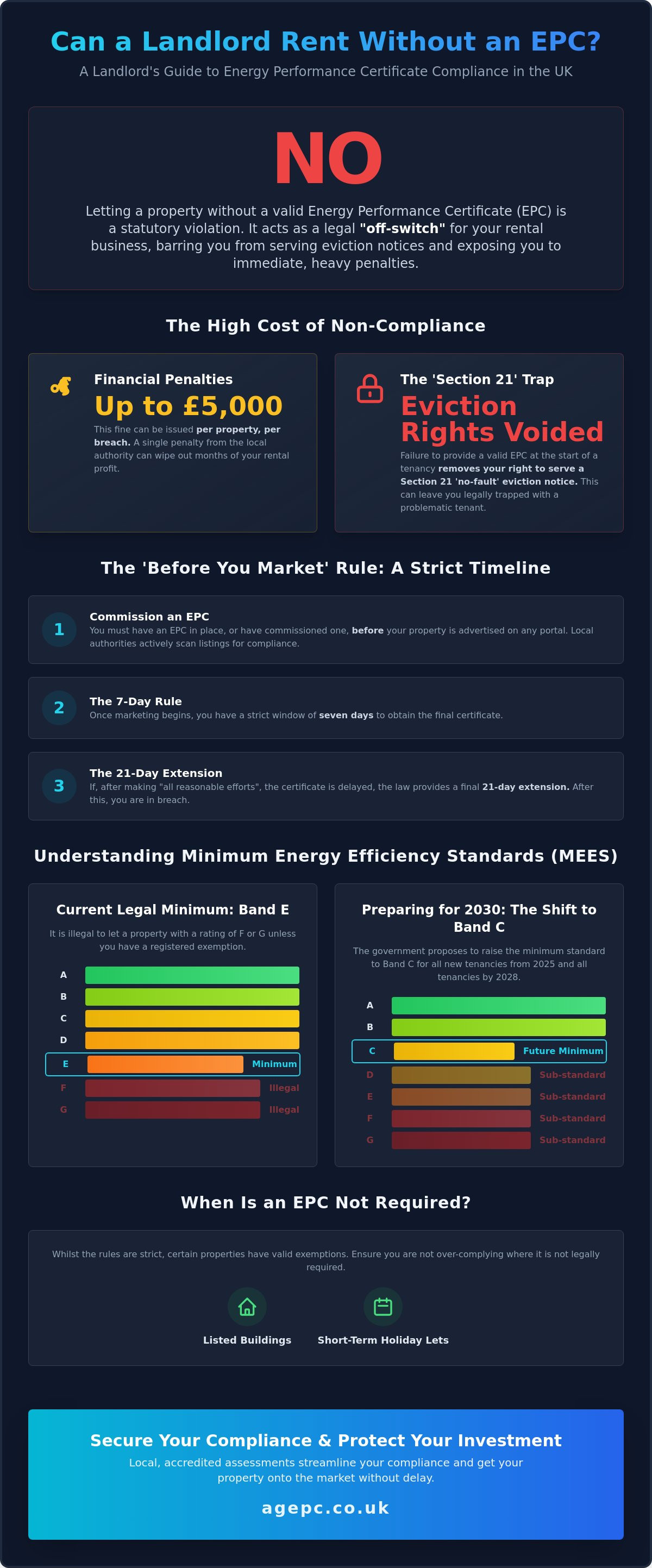
Under current UK law, the answer is a hard no. You cannot legally let or even market a property for rent without a valid Energy Performance Certificate (EPC). This document acts as the legal "on-switch" for your rental business. It must be made available to any prospective tenant free of charge at the earliest opportunity, typically during the first viewing. Failing to provide this document is not just a minor administrative oversight; it is a statutory violation that halts your ability to trade legally.
The question of whether can landlords rent without an EPC often arises during the rush to find new tenants, but skipping this step is a high-risk strategy. The law requires you to have the certificate in place before the property is advertised. This transparency allows tenants to factor energy costs into their budget before they sign a tenancy agreement.
The "Before You Market" Rule
Many landlords mistakenly believe they can wait until a tenant is secured before ordering an assessment. This is a costly assumption. You must have an EPC in place, or at least have commissioned one, before you upload a listing to any portal. Local authorities in areas like Slough and Reading are increasingly proactive. They use digital tools to scan listing portals for non-compliant advertisements that lack the mandatory energy rating display.
If you haven't received the final certificate yet, you must be able to prove you have commissioned one. The law provides two strict windows for this:
- The 7-Day Rule: You have seven days from the start of marketing to obtain the certificate.
- The 21-Day Extension: If you have made "all reasonable efforts" but the certificate is still delayed, you have a further 21 days to secure it.
Once these periods expire, you are in breach of the law. You cannot simply "sort it later" once the tenant moves in.
Band E: The Current Minimum Standard
As of 2026, the baseline for compliance remains Band E. If your property is rated F or G, it is classified as "sub-standard." It is illegal to rent out such a property unless you have a valid, registered exemption. The Minimum Energy Efficiency Standard (MEES) was introduced in April 2018 to ensure all privately rented properties meet a baseline level of thermal efficiency.
When you ask, can landlords rent without an EPC that meets this standard, the consequences are severe. Renting a Band F or G property without an exemption doesn't just invite fines; it prevents you from legally renewing existing tenancies. You must invest in the necessary upgrades, such as loft insulation or heating improvements, to reach Band E before a new tenant cross the threshold. Staying at the bare minimum is a temporary fix, but it is the only way to remain on the right side of the law today.
The High Cost of Non-Compliance: Fines and Legal Roadblocks
Financial risk is the most immediate threat to your rental business. Local authorities have the power to issue fines of up to £5,000 per property for EPC non-compliance. It is an expensive mistake. If you are still questioning, can landlords rent without an EPC, consider your bottom line. A single penalty can wipe out months of rental profit. These fines aren't just theoretical; they are active tools used by councils to improve housing standards across the UK.
The Section 21 Eviction Barrier
The most dangerous risk is losing legal control of your property. If you fail to provide a valid certificate at the start of a tenancy, you lose the right to serve a Section 21 notice. This is the "no-fault" eviction route. Without it, you are effectively stuck with a problematic tenant until a breach of contract can be proven under Section 8. It is a legal dead end that can take months to resolve in court.
Providing the document late doesn't always rectify the initial breach. You must get the paperwork right from the first day. Perfect compliance is the only way to safeguard your investment. This meticulous approach is also essential for avoiding tenancy deposit disputes Windsor. When your paperwork is flawless, your legal position is unshakeable.
Local Authority Enforcement in West London
Councils in Slough and Hounslow are significantly increasing their compliance checks. They now use the public EPC Register to cross-reference rental listings in real-time. It's incredibly easy for enforcement officers to spot offenders. There is no hiding in a digital-first market. Claiming "ignorance of the law" will not protect you from a penalty charge notice.
The official government guidance for landlords is clear about these obligations. If you ignore these rules, you invite scrutiny into every aspect of your property management. Beyond fines, non-compliance can void your landlord insurance. Most insurers require you to meet all statutory regulations to keep your policy valid. A missing EPC gives them a legitimate reason to reject a claim, leaving you personally liable for damages.
Your professional reputation is also at stake. Letting agents in Windsor and Maidenhead are increasingly wary of non-compliant landlords. They won't risk their own professional standing to market a property that lacks the necessary certification. Don't let a simple document derail your strategy. You can book a professional EPC assessment to ensure your property remains fully compliant and your eviction rights stay protected.
When is an EPC Not Required? Understanding Valid Exemptions
While the general law is strict, it isn't inflexible. There are specific scenarios where the standard rules do not apply. If you are wondering, can landlords rent without an EPC, you must first determine if your property falls into a narrow category of legal exemptions. These are not loopholes; they are formal recognitions that some buildings cannot meet modern standards without disproportionate harm or financial ruin. Navigating these requires precision, as an unregistered exemption is legally invisible to enforcement officers.
The "4-month rule" is a common carve-out for the leisure sector. Holiday lets that are used for less than four months a year, or under a licence to occupy, typically do not require a certificate. Similarly, temporary buildings with a planned use of two years or less are exempt from the requirements. For standard residential tenancies, however, the criteria for opting out are far more stringent and usually involve the physical or financial viability of the building itself.
Exemptions for Listed Properties
In historic pockets like Beaconsfield and Gerrards Cross, many landlords assume a Grade II listing is an automatic pass. This is a dangerous misconception. A listed status does not automatically mean you are exempt. Under UK Government EPC Regulations, listed properties only qualify for an exemption if the energy improvements would "unacceptably alter" their character or appearance.
You cannot make this call yourself. You need a professional assessment to document why specific upgrades, such as double glazing or external wall insulation, are impossible. If a planning officer confirms that the work would violate conservation rules, you then have the evidence needed to register. Without this paper trail, you remain liable for any non-compliance penalties.
Registering Your Exemption Correctly
Exemptions are never automatic. You must register them on the PRS Exemptions Register to make them legally valid. This public database allows local authorities to verify your status instantly. Most exemptions last for five years, providing a significant window of peace of mind. They are tied to the landlord rather than the property; if you sell the building, the new owner must either bring it up to standard or register their own claim immediately.
The "High Cost" exemption is a vital financial safeguard for landlords. If the cheapest recommended improvement exceeds £3,500 including VAT, you can register for relief. You must provide at least three separate quotes from qualified installers to prove the cost. Similarly, the "Devaluation" exemption applies if an independent surveyor confirms that the required works would reduce the property’s market value by 5% or more. This protects your capital investment from being undermined by aggressive retrofitting requirements.
Preparing for 2030: The Roadmap from Band E to Band C
The legal baseline is shifting. While Band E is the current requirement, the government has confirmed that all privately rented properties must reach Band C by October 2030. This isn't just a suggestion; it is a hard deadline for compliance. Many people still ask, can landlords rent without an EPC that meets these new standards? By 2030, the answer will be a definitive no for any property below a C rating. Acting now prevents your property from becoming a "stranded asset" that is legally unrentable in just a few years' time.
Upgrading early is a savvy business move. Properties with a C rating or higher often qualify for "green mortgages," offering interest rate discounts between 0.10% and 0.20%. In competitive hubs like Reading, a high energy rating is a powerful marketing tool. It attracts long-term tenants who are desperate to lower their utility bills during the ongoing cost-of-living crisis. High-efficiency homes don't just stay occupied; they command higher values. Moving a property from Band E to Band C can increase its market value by an average of 8.8%.
Why 2026 is the Year to Start Upgrading
Waiting until 2029 is a recipe for disaster. As the deadline nears, contractor availability will plummet and prices will skyrocket. Starting in 2026 allows you to spread the cost of improvements over several years. It also ensures you aren't part of the estimated 2.9 million landlords scrambling for retrofitting services at the last minute. For a broader perspective on your obligations, consult The Ultimate UK Property Compliance Roadmap 2026.
Focus on high-impact, low-cost wins first. These three upgrades offer the best return on investment:
- LED Lighting: A simple, immediate boost to your score for minimal outlay.
- Loft Insulation: Ensuring a thickness of 270mm is one of the most effective ways to trap heat.
- Heating Controls: Installing smart thermostats and thermostatic radiator valves (TRVs) gives tenants better control and improves efficiency.
Financing Energy Improvements
The financial burden is capped. Landlords are only required to spend up to £10,000 (including VAT) on energy efficiency improvements. If your property still doesn't reach Band C after this spend, you can register a "high-cost" exemption. You should also explore the Boiler Upgrade Scheme, which provides a £7,500 grant towards heat pump installations as of April 2026. Combining these upgrades with professional floor plans and photography makes your "Green" home stand out to premium tenants immediately. Investing in energy efficiency today secures your rental income and protects your capital for the next decade.
Securing Your Compliance: Professional EPC Assessments in the Thames Valley
Finding a local, accredited Domestic Energy Assessor (DEA) is the final step in securing your investment. You cannot afford to wait weeks for a national agency to find a slot. Speed is essential. Every day your property sits off the market while you wait for paperwork is a day of lost rental income. When you ask, can landlords rent without an EPC, the answer is a hard no, which means your marketing stops until the certificate is lodged on the national register.
The assessment process is designed to be fast and non-invasive. A typical visit lasts between 30 and 45 minutes, depending on the size of the property. The assessor will need access to all rooms, the boiler, and the loft space to verify insulation levels. They will examine your heating systems, window glazing, and lighting efficiency. It is a visual inspection only; there is no need to lift floorboards or drill into walls. Once the data is collected, it's uploaded to the central database, and your certificate is often generated within 24 hours.
AG Property Services streamlines this entire workflow for landlords across the Thames Valley. We understand that property management is stressful enough without juggling multiple contractors. We provide the technical expertise and local knowledge required to ensure your property meets all statutory requirements without the usual friction. Our assessors are familiar with the specific building styles in Slough and Reading, ensuring your rating is as accurate as possible.
Booking Your Slough or Reading EPC
We take a no-nonsense approach to property compliance. Our goal is to get your property legal and live as quickly as possible. This efficiency is why we are the preferred choice for landlords across Watford, Harrow, and Ealing. We don't just provide a document; we provide peace of mind. For a deeper look at what your rating means for your property's market value, explore our Domestic EPC services guide. It's the definitive resource for understanding compliance in the current year.
Beyond the EPC: A Complete Compliance Package
Smart landlords bundle their services to save time and reduce administrative headaches. You can combine your energy assessment with PAT testing for landlords in Reading to ensure all provided appliances are electrically safe. This creates a single point of contact for your essential safety certificates. It reduces the number of visits your tenants have to accommodate and ensures your files are always audit-ready.
To truly maximise your listing's performance, consider adding professional real estate photos to your package. High-quality imagery combined with 2D or 3D floor plans significantly increases click-through rates on portals like Rightmove and Zoopla. We offer a one-stop solution that covers everything from inventory reports to energy ratings. It is the most efficient way to protect your rights, satisfy local authorities, and attract the best possible tenants in a crowded market.
Secure Your Rental Strategy for 2026 and Beyond
The regulatory landscape is clear. You cannot afford to leave your compliance to chance. As we've explored, the answer to can landlords rent without an EPC is a firm no if you want to protect your eviction rights and avoid substantial financial penalties. Acting now to move from Band E towards the 2030 Band C target doesn't just satisfy local authorities; it actively increases your property's market value whilst attracting reliable, long-term tenants.
Don't let a missing certificate stall your next tenancy or expose you to legal risks. Our team of qualified and accredited assessors has been serving the Thames Valley for over 10 years, providing the expert oversight you need to stay ahead of changing rules. We pride ourselves on a rapid turnaround for urgent listings. This ensures your property is legal, compliant, and ready for market without any unnecessary delay.
Book your fast-track EPC assessment today with AG Property Services and gain total peace of mind. Your investment deserves the protection of professional, high-speed compliance. We're here to help you navigate every requirement with ease and confidence.
Frequently Asked Questions
Do I need a new EPC for every new tenancy?
No, you don't need a new certificate for every change of tenant. A single certificate is valid for 10 years and can be used for multiple tenancies during that period. If you have made significant energy improvements to the property, you might choose to commission a new assessment early to showcase a better rating to prospective renters.
How long does an EPC certificate last for a rental property?
An EPC remains valid for 10 years from the date it was issued. You can check the expiry date of your current certificate on the national EPC Register. Once it expires, you must obtain a new one before you can legally market the property for rent or sign a new tenancy agreement.
Can I be fined if my EPC expires during a tenancy?
You won't be fined if the certificate expires whilst a tenant is already living in the property. There is no legal requirement to renew an EPC mid-tenancy. However, you must have a valid certificate if you intend to market the property for a new tenant or if you need to serve a Section 21 notice to regain possession.
What is the minimum EPC rating for a rental property in 2026?
The current minimum legal requirement is Band E. This standard applies to all existing tenancies and any new agreements. If your property is rated Band F or G, it is considered sub-standard. You must carry out improvements to reach at least Band E or register a valid exemption to avoid local authority penalties.
Does a tenant have to be present for the EPC assessment?
No, your tenant doesn't need to be at home for the assessment. The assessor only needs access to the property, which can be provided by you or a letting agent. You must, however, provide the tenant with at least 24 hours' written notice before the visit to respect their legal right to quiet enjoyment of the property.
What happens if I cannot afford the improvements to reach Band E?
You can apply for a "High Cost" exemption if the cheapest recommended improvements exceed £3,500 including VAT. This allows you to rent the property legally for five years without meeting the Band E threshold. To qualify, you must upload three separate quotes from accredited installers to the PRS Exemptions Register as evidence of the cost.
Is an EPC required for a room-only rental (HMO)?
It depends on the tenancy structure. If you let individual rooms on separate contracts, an EPC for the whole building is generally not required for those specific tenancies. However, if the entire house is let to a group on a single joint contract, the answer to can landlords rent without an EPC is no; a valid certificate for the building must be provided.
How much does a landlord EPC cost in Slough or Reading?
Prices for an assessment in the Thames Valley typically range between £60 and £120. The final cost depends on the size and complexity of your property. Booking a local assessor ensures you receive a rapid turnaround, which is vital for getting your listing live and avoiding costly void periods between tenancies.
Important Information
The information provided in this article is for general guidance and informational purposes only and does not constitute legal, financial, or professional property advice. While AG Site Solutions aims to keep all content accurate and up to date, property regulations, landlord obligations, EPC requirements, and housing legislation may change over time. Readers should always seek professional advice or consult the relevant authorities before making decisions relating to property compliance, tenancy matters, Energy Performance Certificates (EPCs), landlord responsibilities, or legal obligations. Some articles may be created or assisted using AI-supported content tools and are reviewed and enhanced using real industry experience and property compliance knowledge. For professional assistance, quotations, or compliance support, please contact AG Site Solutions directly via agepc.co.uk