
How Long Does an EPC Last? Your 2026 Guide to Certificate Validity
Could a single expired document really trigger a fine of up to £30,000? For UK property owners, knowing exactly how long does an epc last is no longer just a box-ticking exercise; it's a vital part of risk management. You likely find it exhausting to keep track of certificate dates whilst the government introduces new standards like the 2026 Warm Homes Plan. It's a complex landscape that can lead to expensive mistakes if you aren't careful.
We'll give you the facts you need to stay compliant and avoid unnecessary costs. This guide explains the standard 10-year validity period and identifies the specific moments when you're legally required to commission a new assessment. We'll also cover the latest 2030 targets for rental properties and clarify if your recent home improvements have made your existing certificate effectively worthless. Expect a clear, no-nonsense breakdown of the rules so you can move forward with confidence.
Key Takeaways
- Confirm exactly how long does an epc last to ensure your property remains legally compliant for the full 10-year term.
- Identify the specific triggers, such as major structural modifications or new tenancies, that necessitate an immediate certificate renewal.
- Navigate the 2030 roadmap for landlords to move from the current "E" rating to a mandatory "C" rating without stress.
- Protect yourself from fines of up to £30,000 by verifying your certificate's expiry date before listing a property for sale.
- Discover how an updated EPC serves as a powerful marketing tool to attract energy-conscious buyers and tenants in the Thames Valley.
How Long Does an EPC Last in 2026? The 10-Year Rule Explained
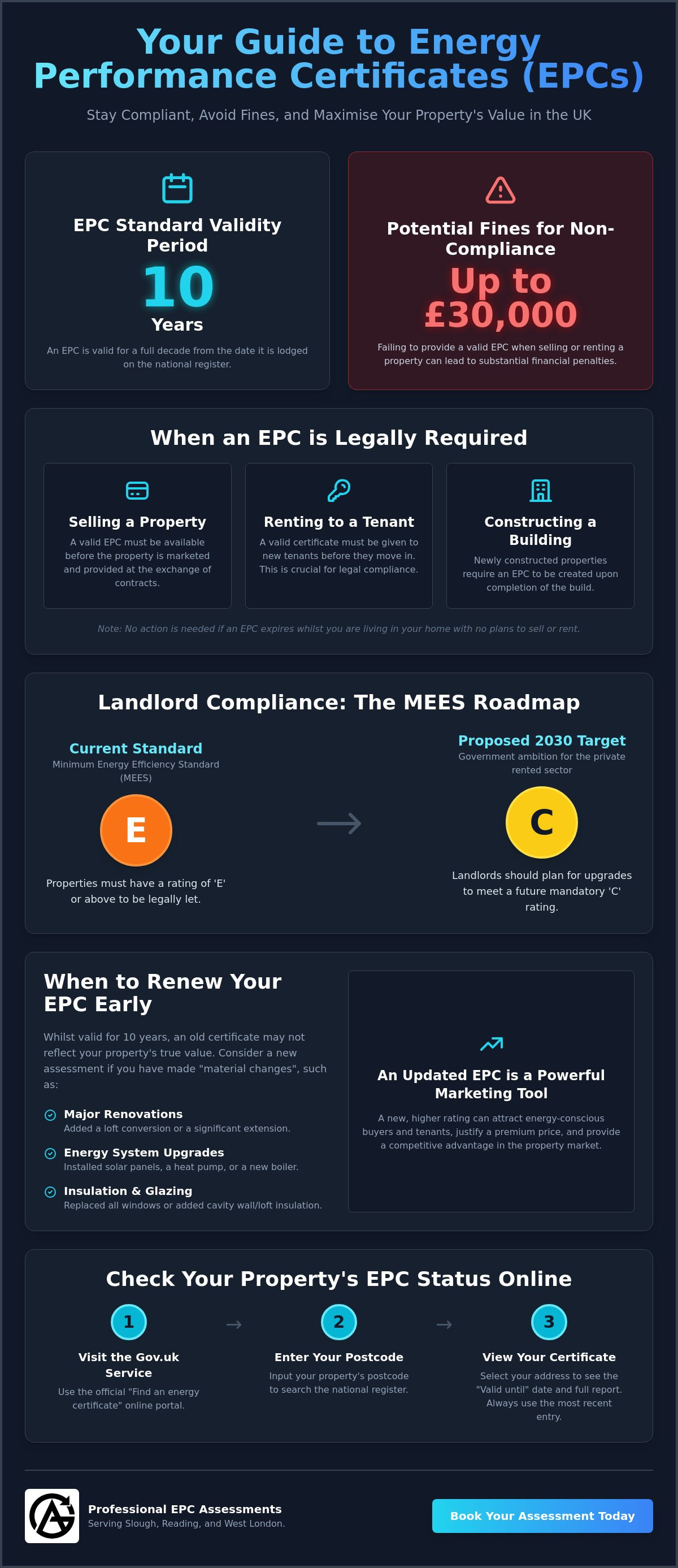
Understanding exactly how long does an epc last is the first step in avoiding regulatory headaches. An Energy Performance Certificate (United Kingdom) is a legal requirement for selling, renting, or building property in the UK. It provides a snapshot of a building's energy efficiency and carbon emissions. Once issued, these certificates remain valid for exactly 10 years from the date of issue.
Many homeowners ask how long does an epc last because they fear sudden fines. Rest assured, if your certificate expires whilst you're simply living in your home, you don't need to act. You aren't legally required to renew it immediately. The obligation only returns when you decide to market the property for sale or let it to a new tenant. It's an efficient system designed to ensure transparency at the point of transaction without burdening long-term homeowners.
When Does the 10-Year Clock Start?
The validity period doesn't start when the assessor visits your home. Instead, the 10-year clock begins the moment the accredited assessor lodges the report on the national database. It's a property-bound document. This means the certificate stays with the building, not the individual owner. If you buy a house with eight years remaining on its EPC, you inherit those years. You don't need a new assessment until that decade expires or you make significant changes to the property's structure.
Finding Your Expiry Date Online
Checking your status is rapid and straightforward. Use the official "Find an energy certificate" service to verify your data. Follow these steps:
- Enter your postcode into the central register.
- Select your address from the generated list.
- View the "Valid until" date at the top of the certificate.
If your property isn't listed, the certificate has likely expired or was never commissioned. Occasionally, you might see multiple entries for one address. Always rely on the most recent date; the newest report automatically supersedes all previous ones. This ensures you're looking at the most accurate data for your property's current state.
Mandatory Triggers: When You Must Renew Your EPC Early
While the standard decade provides a useful buffer, specific events often override the 10-year rule. If you're marketing a property for sale in Slough, Reading, or West London, you must have a valid certificate before the property is listed. Waiting until the point of exchange is a common mistake that can delay your transaction. For landlords, the stakes are even higher. You must provide a valid copy to tenants before they move in; failing to do so makes any future Section 21 notice legally invalid. It's a simple administrative step that prevents massive legal headaches later.
Savvy property owners often choose to get a new energy certificate even if their old one hasn't expired. This is a strategic move. If you've recently installed solar panels, a heat pump, or high-grade insulation, your old "D" rating might be masking a current "C" or "B". Highlighting these improvements via a fresh assessment is a favourite tactic for sellers looking to justify a premium price. If you're unsure of your current status, you can book a professional assessment to ensure your marketing reflects your property's true efficiency.
The Impact of "Material Changes"
Major renovations technically render an old certificate inaccurate. If you've completed a loft conversion, added a significant extension, or replaced all your glazing, the energy profile of the building has changed. An outdated report won't account for the increased floor area or improved thermal retention. This discrepancy can lead to confusion during the survey process or issues with mortgage lenders who offer "green" products. Updating your records ensures your data remains legitimate and useful.
Selling vs Renting Requirements
The timing for compliance differs slightly depending on your goals. For a house sale, the EPC must be valid at the point of exchange of contracts. For rentals, the certificate must be valid at the exact moment the tenancy agreement begins. If your certificate expires mid-tenancy, you don't need to renew it immediately; you only need a new one when you sign a new contract with either the existing tenant or a new arrival. Knowing exactly how long does an epc last in these specific scenarios prevents legal friction and keeps your property business moving.
Landlord Compliance: Minimum Ratings and the 2030 Roadmap
For landlords, the question of how long does an epc last is often secondary to the rating it carries. Under the current minimum energy efficiency standard landlord guidance, you cannot legally let a property with a rating of F or G. All private rentals must achieve at least an E. Whilst your certificate might be valid for a full decade, the shifting regulatory landscape means a "valid" certificate with a poor rating is essentially a liability. Local authorities in high-demand areas like Reading are increasingly proactive in enforcing these standards.
The government's Warm Homes Plan, published in January 2026, has accelerated the transition to greener housing. By 1 October 2030, all privately rented properties must reach a minimum EPC rating of C. This isn't a distant suggestion; it's a hard deadline for both new and existing tenancies. The financial risks are substantial. Serious breaches of the upcoming C-rating requirement can result in fines of up to £30,000 per property. To ensure you aren't caught out, check our full property compliance checklist to stay ahead of these changes.
Exemptions and the PRS Register
Some properties may be exempt from meeting the C-rating target. Listed buildings in Windsor or properties where improvements would exceed the £10,000 cost cap for the 2030 standard often qualify for an exemption. However, these aren't permanent. You must register any exemption on the national PRS Register every five years. This requirement exists independently of how long does an epc last, meaning your exemption could expire years before your actual certificate does.
Improving Your Rating Before Expiry
Many proactive landlords in Hemel Hempstead and St Albans are already upgrading boilers and insulation. They want to avoid the inevitable rush and price hikes as the 2030 deadline approaches. Investing in upgrades now doesn't just ensure compliance; it protects your asset value and makes your property more attractive to quality tenants. If you need specific advice on which works yield the best results, read our guide to domestic epcs for practical improvement tips. Ready to verify your current standing? Get an expert EPC assessment today to plan your route to a C rating.
Booking Your EPC Assessment in Slough, Reading, and West London
Transitioning from understanding how long does an epc last to actually securing a new certificate should be a frictionless process. In high-demand markets like Harrow or Ealing, speed is essential for maintaining momentum in a sale or let. Most local assessments are completed within 48 hours of booking. This rapid turnaround ensures your property is market-ready without unnecessary delays. Choosing an accredited assessor who understands the diverse property types across the Thames Valley is the most efficient way to guarantee accuracy and peace of mind.
To maximise your property’s appeal, consider a streamlined approach. Bundling your certificate with professional real estate photos Reading is a smart way to prepare your listing. It removes the stress of coordinating multiple site visits and ensures your marketing materials are comprehensive from day one. Preparation is key to a smooth visit. Having the following items ready will significantly speed up the process:
- Clear access to the boiler and hot water cylinder.
- Certificates for any recent double-glazing installations.
- A clear path to the loft hatch for insulation checks.
- Paperwork for any recent wall or floor insulation upgrades.
What to Expect During the Assessment
The assessment is a non-invasive visual inspection of your property’s heating, insulation, and lighting systems. It’s a methodical check designed to be as unobtrusive as possible. The assessor requires access to all rooms, including the loft and any extensions, to gather the necessary data for the report.
Why Local Expertise Matters
Local knowledge is a significant asset in the Thames Valley. Assessors familiar with specific building styles in places like High Wycombe can identify energy-saving features that a generic provider might overlook. This expertise leads to a more precise and legitimate rating. By using a provider that offers 2D and 3D floor plans and inventory reports alongside the EPC, you centralise your property management tasks. It’s a modern, tech-enabled solution for a busy market. Knowing how long does an epc last gives you the timeline; local expertise gives you the results you need.
Stay Ahead of 2030 Compliance
A valid certificate is your legal baseline. Whilst the answer to how long does an epc last is ten years, your strategic window is often much shorter. The 2030 shift to a mandatory "C" rating for all rental properties means waiting until the final moment is a high-risk gamble. Proactive updates protect your rental income and boost your asset's market value today.
AG Property Services has provided peace of mind across Slough, Reading, and the West London corridor since 2012. Our accredited domestic and commercial assessors deliver rapid results and comprehensive compliance packages. From PAT testing to detailed property inventories, we offer a modern, one-stop solution for every landlord and homeowner. Don't let expiring paperwork or changing regulations stall your progress.
Book your fast, professional EPC assessment with AG Property Services today and secure your property's energy future. We are ready to help you navigate the regulations with speed, accuracy, and total transparency. Your path to a compliant, energy-efficient property starts here.
Frequently Asked Questions
Do I need a new EPC if I change my boiler?
You don't legally need a new EPC immediately after changing a boiler unless you're selling or letting the property. However, a modern boiler significantly improves your energy rating. Getting a fresh assessment captures this value and makes your property more attractive to future buyers or tenants. It's a strategic move that confirms your recent investment in energy efficiency and ensures your records are up to date.
Can I sell my house if the EPC expires during the sale?
No, you cannot complete a house sale with an expired certificate; it must be valid at the point of exchange. If your certificate expires whilst your property is on the market, you must commission a new one to remain compliant. Checking how long does an epc last before listing your home prevents last-minute delays that could jeopardise your completion date and frustrate your buyers.
What is the penalty for not having a valid EPC in 2026?
As of June 2026, the penalty for failing to provide a valid EPC when selling a property is up to £5,000. For landlords, the current penalty for failing to meet the Minimum Energy Efficiency Standard (MEES) is also £5,000 per property. Under the 2026 Warm Homes Plan, these fines are set to increase significantly. Serious breaches regarding the upcoming 2030 C-rating mandate could reach up to £30,000.
How long does a commercial EPC last compared to a domestic one?
Both commercial and domestic Energy Performance Certificates last for exactly 10 years from the date of issue. The primary difference lies in the complexity of the assessment rather than the duration of the certificate. Whether you manage a retail unit in Slough or a semi-detached house in Reading, you should track your expiry date to ensure you aren't caught out by the 10-year limit during a transaction.
Does a 10-year-old EPC still accurately reflect my home energy costs?
A 10-year-old EPC rarely reflects current energy costs or performance accurately. Energy prices have shifted dramatically since 2016, and assessment methodologies have become more rigorous, with a transition to the Home Energy Model expected in late 2027. If you've made any improvements, an old certificate might show a lower rating than your home actually achieves. Understanding how long does an epc last helps you decide when a voluntary renewal is better for your property's market positioning.
Important Information
The information provided in this article is for general guidance and informational purposes only and does not constitute legal, financial, or professional property advice. While AG Site Solutions aims to keep all content accurate and up to date, property regulations, landlord obligations, EPC requirements, and housing legislation may change over time.
Readers should always seek professional advice or consult the relevant authorities before making decisions relating to property compliance, tenancy matters, Energy Performance Certificates (EPCs), landlord responsibilities, or legal obligations.
Some articles may be created or assisted using AI-supported content tools and are reviewed and enhanced using real industry experience and property compliance knowledge.
For professional assistance, quotations, or compliance support, please contact AG Site Solutions directly via agepc.co.uk