
The Definitive Guide to Domestic EPCs: Compliance, Ratings, and Value in 2026
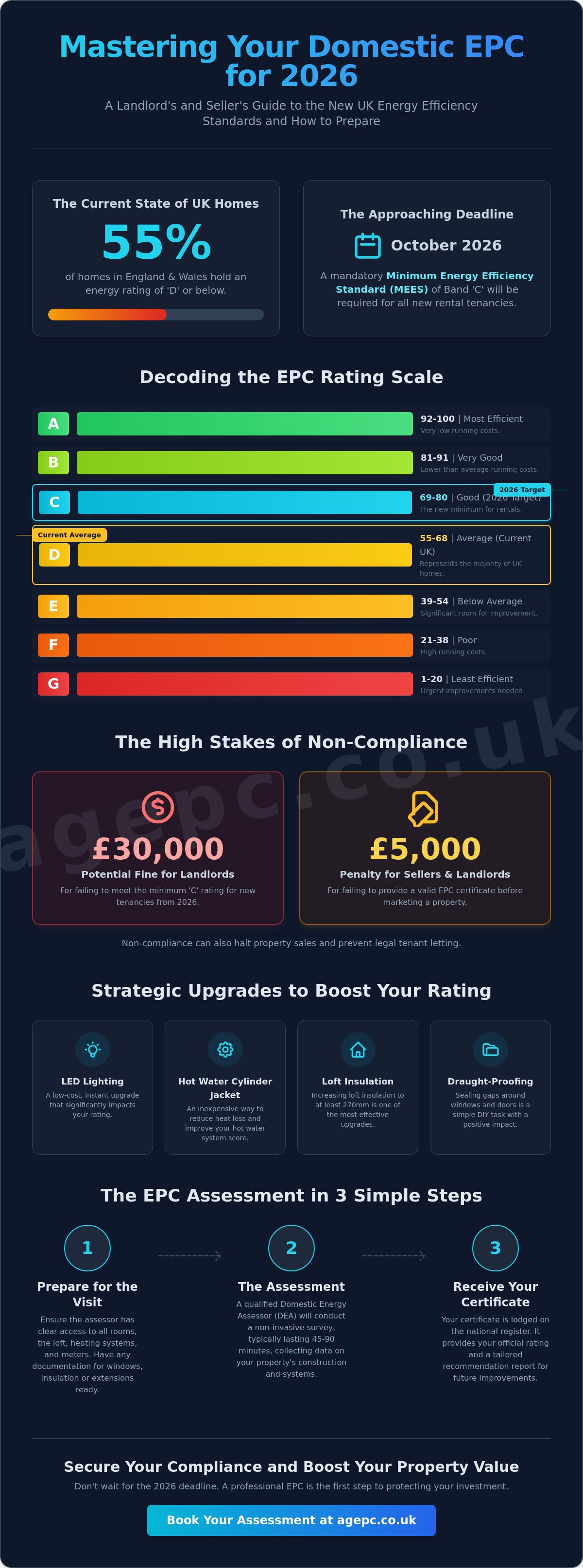
Did you know that over 55% of homes in England and Wales currently hold an energy rating of 'D' or below? With the October 2026 reforms fast approaching, that "average" score could soon become a significant legal liability. Securing a domestic epc is no longer just a box-ticking exercise. It's a critical step in protecting your investment against new, stricter standards.
We understand the stress of navigating changing MEES regulations and the fear of failing minimum requirements. You want a smooth property transaction without administrative delays or the threat of a £30,000 fine. It's a complex landscape, but it doesn't have to be a bottleneck for your sale or let. You deserve a process that's fast, transparent, and professional.
This guide ensures you master every aspect of the 2026 requirements. You'll learn how the new four-metric assessment works, from fabric performance to smart readiness. We provide a clear roadmap to improve poor ratings and boost your property value. Expect a straightforward breakdown of legal compliance that gets your certificate delivered quickly and keeps your transaction on track.
Key Takeaways
- Navigate the 2026 MEES requirements with confidence by understanding the mandatory Band C target for all rental tenancies.
- Prepare for your domestic epc assessment with a clear checklist to ensure the 45-90 minute visit is efficient and successful.
- Identify strategic, low-cost upgrades such as cylinder jackets and LED lighting to instantly improve your property's efficiency rating.
- Decode the A to G scale and technical SAP methodologies to understand exactly how your home's energy performance is measured.
- Save time and reduce administrative stress by bundling your energy assessment with professional floor plans and inventory reports.
What is a Domestic EPC and Why is it Mandatory in 2026?
A domestic epc is a legal document that rates the energy efficiency of a property on a scale from A to G. It provides a snapshot of energy costs and carbon emissions. Since the October 2026 reforms, this assessment has evolved into a multi-metric system. It now tracks fabric performance, heating system efficiency, and smart readiness alongside traditional cost data. This Energy Performance Certificate (EPC) is mandatory for almost every residential property in the UK.
Most certificates remain valid for 10 years. However, you shouldn't simply wait for the expiry date. If you renovate or install a new heating system, an early assessment is vital. It ensures your property's listed rating matches its actual performance. You must have a valid certificate whenever a property is built, sold, or rented. Failure to produce one during these legal triggers can halt your transaction entirely.
Exemptions do exist, but they're narrow. Listed buildings may be exempt if the required improvements would unacceptably alter their appearance or character. Temporary structures used for less than two years and certain holiday lets also fall outside the scope. For the vast majority of UK homeowners, compliance is a non-negotiable requirement that removes friction from the selling process.
The Legal Framework for UK Landlords and Sellers
Non-compliance carries heavy financial risks. Local authorities can issue fines of up to £5,000 if you fail to provide a certificate before marketing your home. For landlords, the stakes are even higher. Under the updated regulations, failing to meet the minimum 'C' rating for new tenancies starting in 2026 can result in penalties of up to £30,000. These standards are strictly overseen by the Ministry of Housing, Communities and Local Government (MHCLG).
Compliance is also a prerequisite for legal contracts. Solicitors require a valid domestic epc to exchange contracts on a sale. Without it, your "Right to Rent" documentation for new tenants will be incomplete. Proactive compliance ensures your property stays on the market without legal friction or administrative delays.
Benefits Beyond Compliance: Why Ratings Matter
High efficiency scores are a powerful marketing tool. They signal to buyers that a home is well-maintained and affordable to run. This transparency builds trust and can lead to faster sales. Many UK lenders now offer "green" mortgages. These products provide lower interest rates for properties in higher EPC bands, making your home more attractive to savvy buyers who want to save on long-term costs.
For landlords, a high rating is a tenant retention strategy. It lowers utility bills, which reduces the risk of rent arrears and makes the property more desirable. You attract premium tenants who value sustainability whilst simultaneously lowering your property's carbon footprint. It's a strategic roadmap for long-term property value and environmental responsibility.
Decoding Your Certificate: Understanding Ratings and Recommendations
Your domestic epc isn't just a colourful chart. It's a data-driven breakdown of your property's energy economy. The A to G scale provides an immediate visual indicator; 'A' represents the pinnacle of efficiency, while 'G' indicates significant room for improvement. While the average rating for existing UK dwellings is currently a 'D', the 2026 regulations make moving toward a 'C' more than just a suggestion. You can view your current certificate on the official UK government EPC register to see exactly where your property sits on this scale.
Assessors use two primary methodologies to calculate these scores: SAP (Standard Assessment Procedure) and RdSAP (Reduced Data SAP). New builds require a full SAP assessment. Existing homes use RdSAP, which relies on a set of verified assumptions based on the property's age and construction type. These calculations generate the estimated energy costs shown on your front page. It's vital to remember that these figures aren't a mirror of your actual utility bills. They assume standard occupancy and heating patterns to allow for a fair comparison between different properties, regardless of individual habits.
The "Recommendations" page is perhaps the most valuable part of the document. It provides a strategic roadmap for future improvements. Each suggestion includes an estimated cost of installation and the potential annual savings you could achieve. This section removes the guesswork, allowing you to prioritise upgrades that offer the best return on investment.
The Numerical Rating: SAP Points Explained
The headline letter corresponds to a numerical score between 1 and 100. Points are awarded for every efficient feature, from high-grade loft insulation to modern condensing boilers and low-energy lighting. Your certificate displays two columns: "Current" and "Potential." The "Potential" score is what you could achieve by following every recommendation listed. Often, a single point is the difference between a 'D' and a 'C' rating. If you're looking to bridge that gap quickly, you might consider booking a professional assessment to identify the most cost-effective upgrades for your specific layout.
Environmental Impact and Heat Demand
Beyond the cost-based rating, your certificate tracks environmental performance. The CO2 emission rating measures your home's impact on the planet, which is increasingly important for eco-conscious buyers. You'll also see a figure for "Primary Energy Use." This represents the energy required to generate and deliver power to your home, reflecting the efficiency of the building fabric itself. Finally, the heat demand section lists the kilowatt-hours (kWh) required for space and water heating. This data is essential if you're planning to install a heat pump, as it helps engineers size the system correctly for your home's specific requirements.
The EPC Assessment Visit: What to Expect and How to Prepare
A domestic epc assessment is a streamlined, professional process designed to be as unobtrusive as possible. For a standard three-bedroom house, the visit typically lasts between 45 and 90 minutes. Larger or more complex properties may take slightly longer. Many homeowners worry about disruption; however, the inspection is entirely non-invasive. Assessors are prohibited from lifting floorboards, moving heavy furniture, or drilling into walls. They rely on what they can see and measure to build an accurate profile of your home.
The process of getting a new energy certificate requires the assessor to build a comprehensive evidence pack. They will take multiple photographs of your heating system, insulation, and windows. These images are not just for notes; they are a mandatory requirement for the national register. If an assessor cannot physically see a feature or verify it with paperwork, they are forced to select "unknown" in their software. This default setting usually applies the worst-case scenario for that property age, which can significantly drag down your final score.
A Room-by-Room Checklist for Homeowners
Providing clear access is the most effective way to ensure an accurate result. Assessors must inspect every room in the property, including converted basements or extensions. If a room is locked, the assessment may be invalid. Ensure your loft hatch is accessible and a ladder is available. The assessor needs to measure the thickness of your loft insulation to award the correct points. Similarly, make sure your boiler is easy to reach. The assessor needs to find the data plate to identify the specific model and its efficiency percentage. They will also check your windows for double glazing date stamps and air gaps.
Evidence You Should Have Ready
Physical evidence often tells only half the story. If you have installed "hidden" energy measures, paperwork becomes your most valuable asset. Keep a folder of certificates ready to show the assessor during their visit. This includes documentation for cavity wall or solid wall insulation, which is often impossible to verify visually. If you have recently replaced windows, have your FENSA or CERTASS certificates to hand. For those with renewable technology, MCS certificates for solar panels or heat pumps are essential. This documentation ensures the assessor can record the exact specification of your upgrades rather than relying on conservative estimates.
Strategic Improvements: Boosting Your Rating and Property Value
Improving your domestic epc rating is no longer a choice; it is a financial necessity. The 2026 regulations have shifted the focus from simple compliance to aggressive efficiency targets. While a Band E rating was previously the minimum standard for rentals, the goalposts have moved. Landlords must now target a minimum of Band C for new tenancies starting in 2026. This change requires a proactive approach to property maintenance and upgrades.
Success begins with "Quick Wins." These are low-cost modifications that provide an immediate boost to your SAP score. Replacing all remaining halogen bulbs with LED lighting is one of the most cost-effective moves you can make. Adding a thick lagging jacket to your hot water cylinder is another high-impact, low-cost improvement. These small changes can often provide the handful of points needed to tip a property from a high D into a solid C rating.
For more substantial gains, focus on the building fabric. Increasing loft insulation to the recommended 270mm depth is a medium-term priority that significantly reduces heat loss. High-impact investments such as Solar PV panels, air-source heat pumps, and external wall insulation offer the greatest long-term rewards. While the initial outlay is higher, these measures future-proof your asset against rising energy costs and stricter future legislation. Ensure your property meets the new 2026 standards by booking a professional domestic EPC today.
MEES Compliance for Landlords
The Minimum Energy Efficiency Standards (MEES) are becoming increasingly rigorous. Currently, the "cost cap" rule means landlords are not required to spend more than £3,500 (including VAT) on energy efficiency improvements. If the property still does not reach the required rating after this spend, you can register an "all relevant improvements made" exemption. However, this cap is expected to rise toward £10,000 by 2030. Simply aiming for Band E is no longer a safe harbour. It leaves your property at risk of becoming a "stranded asset" that is legally un-lettable within just a few years.
The ROI of Energy Efficiency
Energy efficiency is a primary driver of property value in the current UK market. Higher EPC ratings correlate directly with higher sale prices, as buyers look to avoid future renovation costs and high utility bills. For landlords, efficient properties experience significantly shorter "void periods" because they are more attractive to quality tenants. The Green Premium is the measurable increase in a property's market value directly attributed to its high energy efficiency rating compared to similar, less efficient homes. Investing in your domestic epc score is a proven method for protecting your equity and ensuring long-term rental yields.
Streamlining Your Property Compliance with AG Property Services
Compliance shouldn't be a hurdle that slows down your property goals. We understand that sellers and landlords are often juggling tight deadlines and complex legal requirements. That's why we've designed a service that prioritises speed, legitimacy, and comprehensive coverage. Our fast-track domestic epc assessments provide a rapid turnaround, ensuring your property is ready for the market without unnecessary delays. You receive a professional, accurate certificate delivered with the efficiency your schedule demands.
Trust is built on expertise. Our assessors are fully accredited and insured, providing you with peace of mind that every data point is verified and compliant with the latest 2026 standards. We don't just provide a document; we provide a reliable partnership that values your time. By choosing a tech-enabled service, you remove the friction of traditional administrative tasks and secure a valid certificate quickly.
Bundled Services for Landlords and Agents
Managing multiple contractors is a logistical headache. We solve this by offering a "one-stop shop" for all your property compliance needs. Organising your PAT testing alongside your domestic epc saves significant time and reduces the cost of individual call-out fees. It allows you to handle all mandatory safety and energy requirements in a single, coordinated visit. This efficiency is vital for maintaining momentum during a tenancy changeover.
This integrated approach extends to property inventory reports. These reports protect your investment by providing a clear, professional record of the property's condition at the start of a tenancy. By combining these essential services, you remove the stress of multiple appointments and ensure your legal obligations are met in one go. It is a methodical, professional solution for the modern property market.
Visual Marketing: Photography and 3D Floor Plans
A valid certificate is essential for legality, but visual appeal is what secures a tenant or buyer. We complement our technical assessments with professional property photography and high-quality 2D and 3D floor plans. These tools provide a complete marketing package that makes your listing stand out. High-resolution imagery and accurate layouts help prospective occupiers visualise the space before they even step through the door. This transparency builds trust and ensures you attract serious enquiries, reducing the time your property spends on the market.
Ready to Book Your Assessment?
Our booking process is designed for maximum convenience. We offer a simple online system that connects you directly with a local professional assessor. You get clear communication and a service that adapts to your needs, whether you're a homeowner or a large-scale letting agent. Don't let administrative tasks hold you back. Get your Domestic EPC booked today with AG Property Services and experience a faster, more professional route to compliance.
Future-Proof Your Property for 2026 and Beyond
The standards for UK property compliance are shifting rapidly. With the October 2026 reforms and the mandatory Band C target for rentals, staying ahead of regulations is your best strategy for protecting asset value. You now understand how to decode your certificate and which "Quick Wins" provide the best ROI for your score. Proactive upgrades don't just ensure legal compliance; they attract premium tenants and lower long-term running costs.
Compliance doesn't have to be stressful. You can streamline your entire journey by choosing a partner that offers national UK coverage and comprehensive compliance and marketing bundles. Our accredited professional assessors ensure every domestic epc is accurate and delivered with a rapid turnaround. Whether you need floor plans, professional photography, or PAT testing, a bundled approach saves you time and removes the friction of multiple site visits.
Secure your Domestic EPC and property compliance today. Your journey toward a more efficient, valuable property starts with a single, professional assessment.
Frequently Asked Questions
How long does a domestic EPC assessment take?
A standard assessment usually takes between 45 and 90 minutes. This timeframe depends on the size and complexity of your home. The assessor needs this time to measure every room, inspect the heating system, and verify insulation levels in the loft. Larger properties or those with multiple extensions may require additional time to ensure all data is captured accurately.
What is the minimum EPC rating for renting a property in 2026?
For new tenancies starting in 2026, the minimum required rating is a 'C'. This is a significant step up from the previous 'E' requirement. Landlords must meet this new standard to remain compliant with the updated Minimum Energy Efficiency Standards (MEES). Failing to reach this rating can result in penalties of up to £30,000 per property.
Can I sell my house with an expired EPC?
No, you cannot legally market or sell a property with an expired certificate. A valid domestic epc must be available to potential buyers from the first day the property is listed for sale. If your certificate has passed its 10-year validity period, you must commission a new assessment before your estate agent can begin marketing the home.
How much does a domestic EPC cost in the UK?
The cost of an energy assessment varies based on the size, location, and complexity of the building. Larger detached homes generally require more time for data collection than small studio flats. It is best to check for current rates based on your specific postcode and property type to get an accurate quote for your assessment.
Will the assessor need to look in my loft or cellar?
Yes, the assessor must inspect the loft and any accessible cellar spaces to provide an accurate rating. They need to measure the depth of your loft insulation and identify the type of floor construction. If these areas are locked or inaccessible, the assessor is forced to record "unknown" values. This often results in a lower score because the software assumes the worst-case scenario for the property's age.
What happens if my property gets a low EPC rating?
If your property receives a low rating, you will receive a detailed list of recommendations to improve its efficiency. For homeowners, this provides a roadmap for reducing utility bills. For landlords, a rating below the legal minimum means you must invest in improvements up to the £3,500 cost cap or register a valid exemption before you can legally let the property to new tenants.
Is an EPC required for a house in multiple occupation (HMO)?
Yes, a domestic epc is generally required for an HMO, though the specific requirements depend on the tenancy setup. In most cases, a single certificate for the entire building is sufficient. However, if individual units are self-contained with their own entrance and facilities, they may require separate assessments. It is vital to check the specific requirements for your building type to ensure full compliance.
Can I reuse an EPC from a previous owner?
You can reuse an existing certificate as long as it is still within its 10-year validity period. You can easily check the expiry date on the official government register. However, if the previous owner or you have made significant energy improvements, such as installing a new boiler or solar panels, it's often beneficial to get a new assessment to reflect the property's improved value.