

Renters’ Rights Act 2026: Why Professional Inventories are Now Mandatory for Landlord Survival
What if the only thing standing between you and a failed possession claim is a set of time-stamped, professional photographs? Since the Renters’ Rights Act took full effect on 1 May 2026, the legal landscape for landlords has shifted permanently. The abolition of Section 21 means "no-fault" evictions are gone. To regain possession now, you must provide objective, irrefutable evidence under the revised Section 8 framework. In this high-stakes environment, the renters reform bill landlord inventory has evolved from a simple deposit tool into your most critical legal defence.
We know the transition to rolling periodic tenancies and the arrival of the new Landlord Ombudsman feels like an administrative minefield. It's a stressful time to be a landlord, especially in high-demand areas like Slough where possession claims are nearly three times the national average. Just as you monitor the health of your investments, taking time for personal wellbeing is vital, and Ready Health provides accessible ways to stay on top of your physical condition. This article promises to show you how to "bulletproof" your property management against the Decent Homes Standard and avoid expensive deposit disputes. You'll learn a clear strategy to ensure your documentation is robust enough to survive legal scrutiny and protect your rental income for the long term.
Key Takeaways
- Understand why Assured Periodic tenancies make high-quality documentation your primary tool for regaining possession in a post-Section 21 market.
- Learn how a comprehensive renters reform bill landlord inventory proves compliance with the Decent Homes Standard and protects against damp or mould claims.
- Discover a strategic approach to mid-term inspections to catch property issues early and maintain a healthy, compliant rental home.
- Realise why independent, third-party reports carry significantly more weight when resolving disputes through the new Landlord Ombudsman.
- Explore how local expertise in Slough and Reading ensures your property compliance is fast, accurate, and fully "bulletproofed" for 2026.
The Renters’ Rights Act 2026: A New Compliance Landscape for Landlords
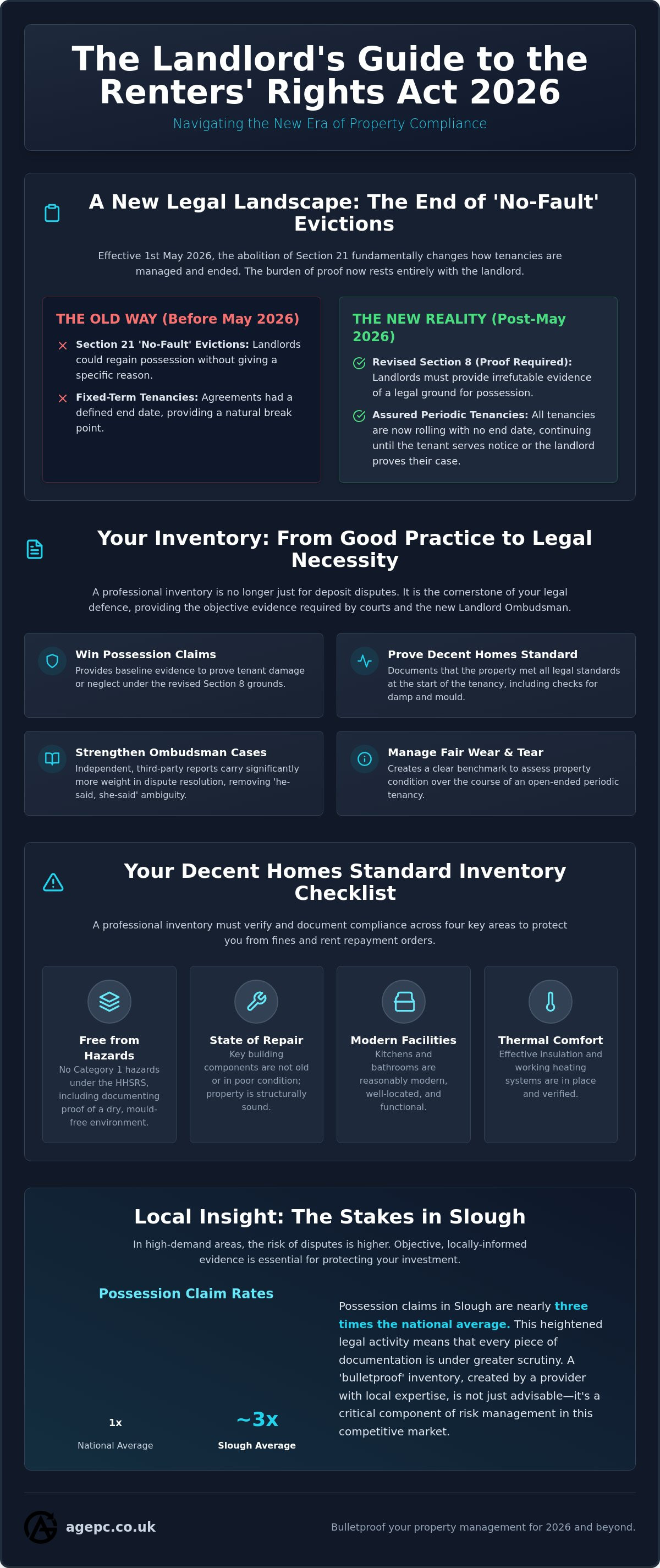
1 May 2026 marked a total reset for the private rented sector. The Renters’ Rights Act 2025 has effectively ended the era of "no-fault" evictions. Fixed-term tenancies are now a thing of the past. Every new and existing agreement has automatically converted into an Assured Periodic tenancy. This means there is no fixed end date. The tenancy rolls on until the tenant gives two months' notice or you prove a legal ground for possession in court. The power dynamic has shifted. You need a new strategy to stay protected.
The Death of "No-Fault" Evictions and the Rise of Evidence
Landlords can no longer regain possession without a specific reason. You must now navigate a revised Section 8 framework where every claim requires concrete proof. If a tenant neglects your property or causes significant damage, you have grounds for possession. However, you must prove the condition at the start of the tenancy to win your case. In 2026, the burden of proof shifts entirely to the landlord to justify the end of a tenancy. This is why a professional renters reform bill landlord inventory is no longer optional. It is the baseline evidence required by the courts and the new Landlord Ombudsman. Without it, your possession claim is likely to fail.
The 31st May 2026 Deadline for Existing Tenants
Compliance isn't just about how you end a tenancy; it's about how you manage the transition. By 31 May 2026, you were legally required to provide all existing tenants with a government-produced Information Sheet. This document explains their new rights under the rolling tenancy structure. Non-compliance is expensive. You could face heavy fines or find yourself legally barred from increasing the rent. To ensure you haven't missed any critical steps, consult The Ultimate UK Property Compliance Roadmap 2026.
The Act also introduces a national Private Rented Sector Database and a mandatory Landlord Ombudsman. These bodies will track landlord behaviour and resolve disputes. A detailed renters reform bill landlord inventory acts as your primary defence against complaints. It provides an independent, third-party record of the property’s state, removing any "he-said, she-said" ambiguity. Speed and accuracy in documentation are now your best tools for survival.
Why Property Inventories are Critical Under the New Reform Rules
Compliance in 2026 is no longer a "check-box" exercise. Under the new regime, the quality of your documentation determines your legal safety. The official government guidance makes it clear: properties must meet the Decent Homes Standard from the very first day of the tenancy. Without a detailed renters reform bill landlord inventory, you have no way to prove your property was compliant at move-in. If a tenant later claims the property was sub-standard, you are vulnerable to rent repayment orders or Ombudsman fines.
Awaab’s Law has also intensified the focus on damp and mould. You must act quickly to resolve these issues. Professional inventory reports now include high-resolution photography to document a dry, healthy property at the start. This protects you from claims that pre-existing damp was ignored. As tenancies shift to an open-ended periodic structure, the "fair wear and tear" debate becomes more complex. How do you distinguish between five years of careful use and six months of neglect? A professional baseline is the only way to settle these arguments fairly.
Proving Compliance with the Decent Homes Standard
The Decent Homes Standard requires your property to meet four key criteria. It must be free from Category 1 hazards, be in a reasonable state of repair, have modern facilities, and provide effective thermal comfort. A professional inventory clerk doesn't just list furniture. They verify:
- The presence and condition of working heating systems.
- Visible signs of damp-proofing and ventilation.
- The state of kitchens and bathrooms to ensure they meet modern requirements.
Integrating Portable Appliance Testing (PAT) alongside your inventory ensures your electrical safety is also verified and documented from day one.
The Role of Independent Evidence in Dispute Resolution
The new Landlord Ombudsman is designed to be fast and tenant-friendly. DIY inventories often crumble under this scrutiny. They lack the impartiality and technical detail required to win a case. Time-stamped, high-resolution photography provided by an independent third party carries significantly more weight. It removes the bias that judges and adjudicators look for in "home-made" reports. For a deeper look at protecting your assets, see our guide on Avoiding Tenancy Deposit Disputes in Windsor. A professional renters reform bill landlord inventory ensures your evidence is "bulletproof" before a dispute even begins.
Managing Inventories for Assured Periodic Tenancies
The transition to open-ended tenancies removes the traditional "renewal" point. You no longer have a fixed-term expiry to trigger a property inspection or a condition review. This creates a significant risk. If a tenant can leave with just two months’ notice at any time, you have a very narrow window to identify damage and process deposit claims. According to the House of Commons Library research, this shift is central to the new legislative framework. To survive, you must move from a "one-off" inventory mindset to a strategy of continuous documentation.
A rolling tenancy requires a rolling record of condition to protect the property’s capital value. You don't need a new tenancy agreement to update your records. Professional clerks can provide "Condition Updates" that append to your original renters reform bill landlord inventory. This keeps your evidence current without the administrative burden of starting from scratch. It ensures that when that two-month notice finally arrives, your check-out report is compared against a recent, accurate baseline rather than a document that is several years out of date.
Step-by-Step: The 2026 Inventory Cycle
Managing property condition in a periodic world requires a methodical approach. Follow this three-step cycle to maintain total oversight:
- Step 1: Conduct a comprehensive Check-in. This must include high-resolution professional photography and detailed descriptions of every room.
- Step 2: Schedule six-monthly "Condition Updates". These track fair wear and tear and identify any unauthorised changes or neglect early.
- Step 3: Issue "Interim Reports" immediately if maintenance issues are reported. Documenting the repair process proves you are a responsible, compliant landlord.
Evidencing Rent Increases and Property Improvements
Rent increases are now strictly controlled via the Section 13 process. You can only increase rent once per year to market rates. If you have upgraded the property, you must prove these improvements to justify a higher rent. A detailed inventory update, supported by 2D or 3D floor plans, provides the evidence you need. It shows the Landlord Ombudsman exactly what has changed, from new flooring to upgraded kitchen facilities. Secure your property’s future. Book your professional property inventory report today to establish your baseline.
Documentation is your most effective shield against rent disputes. By maintaining a clear, chronological record of the property's evolution, you remove the guesswork from the Section 13 process. This proactive management style doesn't just protect your deposit. It protects your yield and your long-term investment strategy in an increasingly regulated market.
Professional Inventory Services: Protecting Landlords in Slough and Reading
Local expertise is your strongest asset in the volatile South East rental market. In Slough, where possession claims reached 22.5 per 10,000 households in 2024, the margin for error is non-existent. You cannot rely on generic templates or DIY documentation. Ensuring your renters reform bill landlord inventory is professional and impartial is the only way to navigate these local pressures safely. We understand the specific demands of the Slough, Windsor, and Reading markets. Our reports provide the legitimacy required to stand up in court or before the new Landlord Ombudsman.
We provide a streamlined compliance solution. You can combine your Property Inventory Report with a Domestic EPC and PAT testing in a single visit. This "one-stop" approach removes the friction of multiple appointments. It saves you time. It ensures every corner of your legal obligation is covered by a single, reliable partner. By outsourcing the administrative burden, you reduce the stress of the 2026 transition and focus on your investment strategy. For landlords with commercial properties, especially those with interests in the West Country, ensuring your premises are professionally maintained by specialists like That's Cleaning is another essential step in protecting your asset’s value.
The AG Property Services Advantage
We bridge the gap between high-quality property marketing and strict legal compliance. Our reports don't just protect you; they present your property in the best possible light. We provide:
- Independent, accredited clerks who are fully briefed on the 2026 legislative shifts.
- Professional Property Photography and 2D or 3D Floor Plans included to document condition with total clarity.
- Rapid turnaround times across our service area, from High Wycombe to Ealing.
- Detailed, time-stamped evidence that carries maximum weight in deposit disputes.
Next Steps: Securing Your Portfolio for 1st May 2026
The 1st May 2026 deadline is a firm cut-off for the old rules. You must act now to audit your current tenancies. Do you have a professional, third-party inventory for every property in your portfolio? If not, you are exposed. A "Compliance Health Check" is the fastest way to identify gaps in your documentation, from expired EPCs to missing PAT records.
Don't wait for a dispute to discover your evidence is insufficient. Establish your baseline today. Book your professional inventory report with AG Property Services today and ensure your business is ready for the new era of the private rented sector. Our no-nonsense approach delivers the speed and accuracy you need for total peace of mind. A robust renters reform bill landlord inventory is no longer just a tool. It is your primary defence for survival in 2026.
Future-Proof Your Portfolio for 2026
The 1 May 2026 deadline has passed. The rules of the game have changed. You must now prove property condition to regain possession under the revised Section 8 framework. A professional renters reform bill landlord inventory is the only way to meet the Decent Homes Standard and satisfy the Landlord Ombudsman. Independent third-party reports carry significantly more weight in disputes than DIY documentation. They provide the legitimacy you need to protect your rental income. Managing open-ended periodic tenancies requires a new, proactive approach to documentation. It's no longer about a single check-in; it's about a continuous record of care.
AG Property Services is your local compliance partner across Slough, Reading, and Windsor. We offer a streamlined one-stop shop for EPCs, PAT testing, and professional inventories. This removes the friction of managing multiple contractors. Our expert team ensures your documentation is accurate, rapid, and legally robust. Don't leave your investment to chance in this new regulatory landscape. Ensure your 2026 compliance with a professional inventory report from AG Property Services today. You've worked hard to build your portfolio. We'll help you protect it with confidence.
Frequently Asked Questions
Do I need a new inventory for existing tenants before May 2026?
Yes, it is highly recommended to conduct a fresh audit if your current records are outdated. All existing tenancies automatically convert to periodic agreements on 1 May 2026. This transition is the perfect time to establish a professional baseline. Without an accurate record of the property’s current state, you won't be able to prove damage or neglect under the new Section 8 possession grounds.
Can I still use a DIY inventory under the Renters’ Rights Act?
Technically yes, but it is no longer advisable in a professionalised market. The new Landlord Ombudsman and the courts prioritise independent, third-party evidence over "home-made" documents. A professional renters reform bill landlord inventory provides the impartial legitimacy required to win disputes. DIY reports often lack the technical detail and time-stamped verification needed to survive legal scrutiny.
How does the abolition of Section 21 affect my deposit protection?
It shifts the focus entirely to evidence-based claims for deposit retention. Since "no-fault" evictions are gone, you must prove a specific breach of contract to justify any deductions or possession claims. Your inventory is now your primary shield. It provides the "before and after" proof required to successfully claim for damages at the end of a long-term periodic tenancy.
What happens if my property does not meet the Decent Homes Standard in 2026?
You risk severe financial penalties and rent repayment orders. Local authorities have increased powers to fine landlords who fail to provide safe, modern, and warm housing. A professional inventory documents that your property met these criteria at move-in. This protects you from opportunistic claims that the property was sub-standard from the start of the agreement.
How often should I carry out inspections during a periodic tenancy?
Aim for a standardised inspection every six months. Because periodic tenancies have no fixed end date, you need a routine to track fair wear and tear. Regular "Condition Updates" prevent minor maintenance issues from becoming expensive legal liabilities. This proactive approach ensures your documentation remains current, even if a tenant stays in the property for several years.
Will the Landlord Ombudsman accept my own photos as evidence?
Personal photos are often dismissed as biased or insufficient by adjudicators. The Ombudsman requires high-resolution, time-stamped evidence that is clearly linked to a professional report. Independent photography provided by an accredited clerk carries significantly more weight. It removes any suspicion of digital manipulation and provides an objective record that both parties can trust during a dispute.
Important Information
The information provided in this article is for general guidance and informational purposes only and and does not constitute legal, financial, or professional property advice. While AG Site Solutions aims to keep all content accurate and up to date, property regulations, landlord obligations, EPC requirements, and housing legislation may change over time. Readers should always seek professional advice or consult the relevant authorities before making decisions relating to property compliance, tenancy matters, Energy Performance Certificates (EPCs), landlord responsibilities, or legal obligations. Some articles may be created or assisted using AI-supported content tools and are reviewed and enhanced using real industry experience and property compliance knowledge. For professional assistance, quotations, or compliance support, please contact AG Site Solutions directly via agepc.co.uk