
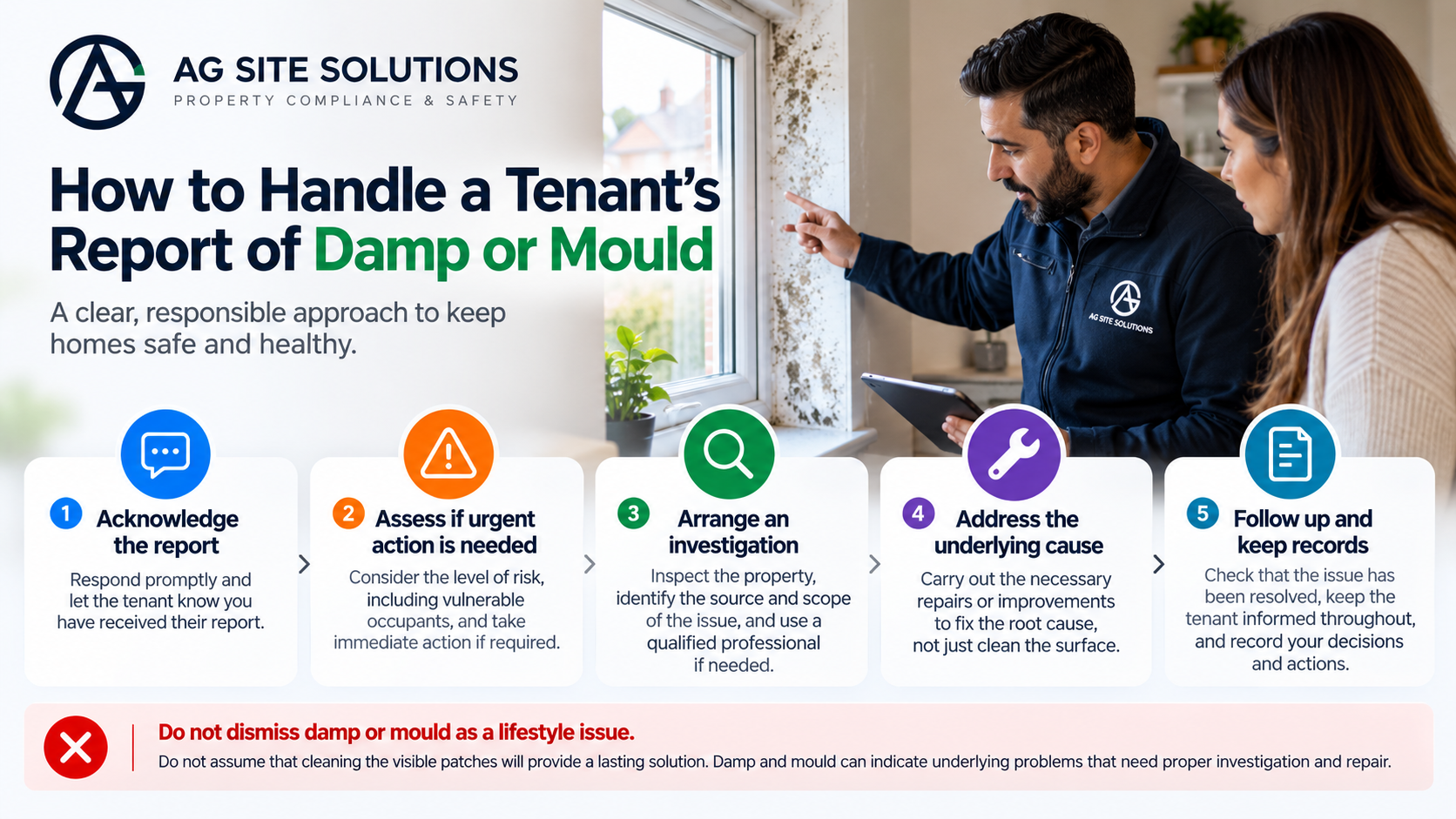
What should landlords do when a tenant reports damp or mould?
Acknowledge the tenant’s report, assess whether urgent action is needed, arrange an investigation, address the underlying cause and follow up afterwards. Keep the tenant informed and record your decisions. Do not dismiss damp or mould as a lifestyle issue, or assume that cleaning the visible patches will provide a lasting solution.
Key takeaways
- Photographs help you understand a report, but should not become a condition for investigating it.
- Consider the building, heating and ventilation together rather than assuming the tenant caused condensation.
- Social housing response deadlines should not be treated as a universal timetable for private landlords.
- If mould returns, revisit the diagnosis rather than simply repeating the cleaning.
A tenant has reported damp or mould: what should you do first?
Start by taking the report seriously and explaining what you will do next.
For a tenant reporting mould, a useful acknowledgement confirms who is handling the issue and when they will receive an update. Ask which rooms are affected, when it appeared, whether it is spreading and whether there is an active leak. Request photographs if available, without delaying action while waiting for them.
Ask sensitively whether anyone’s health is affected or whether the household includes someone particularly vulnerable. Government guidance identifies children, older people and people with certain existing health conditions as groups at greater risk. Do not require medical evidence before investigating.
> LOOK BEYOND THE VISIBLE PATCH — An active leak near electrical fittings, a potentially unsafe ceiling or serious reported illness needs urgent attention through the appropriate emergency, repair or healthcare route. Do not leave an immediate safety concern waiting for a routine inspection.
Arrange an investigation into the underlying cause
Mould is a sign to investigate, not a diagnosis in itself.
Arrange an assessment by someone competent to investigate the suspected problem. Depending on the findings, this might require a suitable repair contractor or a damp and building-defects specialist. Photographs alone may not explain what is happening.
- Check plumbing, roofs, gutters and external defects for possible water entry.
- Consider condensation alongside insulation, cold surfaces and the building’s condition.
- Check whether heating, extract fans and ventilation are present, working and usable.
- Review previous reports and repairs, particularly where the problem has returned.
Government damp and mould guidance warns against blaming tenants’ lifestyles. Normal activities produce moisture; the investigation should consider whether the home can manage it adequately.
What are landlords’ damp and mould responsibilities in England?
Repair duties and fitness for habitation are relevant, but the circumstances matter.
GOV.UK’s repairs guidance explains landlords’ responsibilities for matters including the structure, exterior, heating and sanitary installations. The Homes Act guide for landlords explains the duty, for tenancies within its scope, to keep homes fit for human habitation. Serious damp or mould can be relevant to that assessment.
Do not reduce landlord damp and mould responsibilities to a single deadline. Government health guidance recommends prompt investigation and action, with urgency informed by the problem and occupants’ circumstances. Obtain professional advice where the necessary response or your legal position is unclear.
> PRIVATE RENTING IS NOT SOCIAL HOUSING — The government’s Awaab’s Law guidance for social landlords concerns social housing requirements. Do not copy its response deadlines into a private tenancy as though they automatically apply. Check the scope and commencement of any relevant private-sector rules using current official guidance.
Agree access and keep the tenant informed
A clear plan makes investigation and repairs easier to organise.
Explain who needs to attend, the purpose of the visit and which areas need inspection. Offer workable arrangements and follow the applicable notice and access requirements. Do not treat a notice as permission to enter against the tenant’s wishes.
If access is difficult, record your attempts, ask about barriers and offer alternatives. Keep the issue open rather than marking it resolved. Seek appropriate advice if access remains unavailable, particularly where there may be a serious hazard.
For routine inspection boundaries, see What Should Landlords Check During a Mid-Term Tenancy Inspection Without Overstepping Tenants’ Privacy? A reported defect should not simply wait until the next scheduled visit.
Address the cause, not just the visible mould
Cleaning may form part of the response, but it does not replace necessary repairs.
Use the findings to agree appropriate repairs and safe mould treatment. Government guidance recommends addressing the underlying causes and using qualified professionals where appropriate. Ask the contractor about precautions, room use and any further work needed before redecoration.
Practical advice about using ventilation and heating can help, but should be realistic and supportive. Check that the equipment works and discuss difficulties the tenant raises. Advice to open windows or turn up the heating is not a substitute for fixing defects.
Keep records, follow up and know when to escalate
Finishing a repair is not the same as confirming that the problem has been resolved.
Keep a clear case record
- [ ] The original report, photographs and affected locations.
- [ ] Risk concerns, inspection findings and reasons for decisions.
- [ ] Access arrangements, contractor instructions and tenant updates.
- [ ] Completed work, outstanding actions and follow-up findings.
Agree follow-up appropriate to the findings and ask whether damp, odours or mould have returned. Recurrence calls for renewed investigation. Where the diagnosis is uncertain or repairs are unsuccessful, seek specialist input rather than repeating cosmetic treatment.
At AG Site Solutions, we can help landlords in Slough, Windsor and Maidenhead arrange mid-term property inspections and tenancy reports. These are not substitutes for specialist damp investigations. Our Inventory, Check-In and Check-Out Reports in Bracknell: Which Do Landlords Need? guide explains the different reporting stages.
Turn the report into an action plan
- Assign responsibilityName the person coordinating the response.
- Agree the next actionTell the tenant what is being arranged.
- Confirm the outcomeCheck the findings and keep outstanding work visible.
Before booking the investigation
- Share the affected locations and any photographs.
- Explain previous repairs or recurring symptoms.
- Confirm access arrangements and relevant safety concerns.
Speak to AG Site Solutions about mid-term inspections and tenancy reports. For a reported damp problem, arrange the appropriate specialist investigation separately.
Frequently asked questions
Does an EPC show whether a home has a damp problem?
An EPC assesses energy performance; it is not a damp diagnosis. Do not use an EPC rating to dismiss a tenant’s report.
Should I provide a dehumidifier?
Ask the investigating professional whether one would help temporarily. Agree its practical use with the tenant, without treating it as a replacement for repairs.
What if the suspected leak comes from another flat?
Contact the relevant owner, managing agent or freeholder and coordinate investigation. Keep your tenant informed while responsibility for the source is established.
Should I contact my insurer?
Check your policy and notification requirements if the damage may be covered. Keep the insurance enquiry separate from assessing immediate safety and necessary action.
Can an inventory prove that the tenant caused mould?
An inventory can record condition at a particular point, but does not establish the cause of later mould by itself.
Can the tenant contact the council?
Yes. GOV.UK explains that tenants can approach their council about housing conditions. Respond constructively to any enquiry and provide your investigation and repair records.
What if the tenant is about to move out?
Do not set the report aside. Arrange suitable access and investigate before assuming the property is ready for another household.
What if I disagree with the contractor’s diagnosis?
Ask for the evidence and reasoning in writing. Consider an independent specialist opinion where findings conflict or the proposed work does not explain the recurring problem.
Sources
Author and review
Keep these distinctions clear
- Needs investigationVisible mouldAppearance alone does not establish the cause.
- Not a complete repairCleaningUnderlying causes also need addressing.