When Do Landlords Need PAT Testing?
When Do Landlords Need PAT Testing?
When do landlords need PAT testing? Learn when it applies, what the law expects, and how often landlords should arrange checks for rentals.
A new tenancy is due to start on Friday, the inventory is booked, the EPC is sorted, and someone suddenly asks about the kettle, toaster and lamps. That is usually when the question lands - when do landlords need PAT testing, and is it actually a legal requirement?
The short answer is that PAT testing is not a blanket legal requirement for every rental property in the way a petrol safety check is. But if a landlord provides electrical appliances in a let property, they have a legal duty to make sure those items are safe. PAT testing is one of the clearest and most practical ways to show that duty has been taken seriously.
For landlords and agents, the real issue is not whether every property must have a PAT certificate by default. It is whether you can demonstrate that any appliance you supply is safe for tenants to use. If you cannot, you are taking an avoidable compliance risk.
When do landlords need PAT testing in practice?
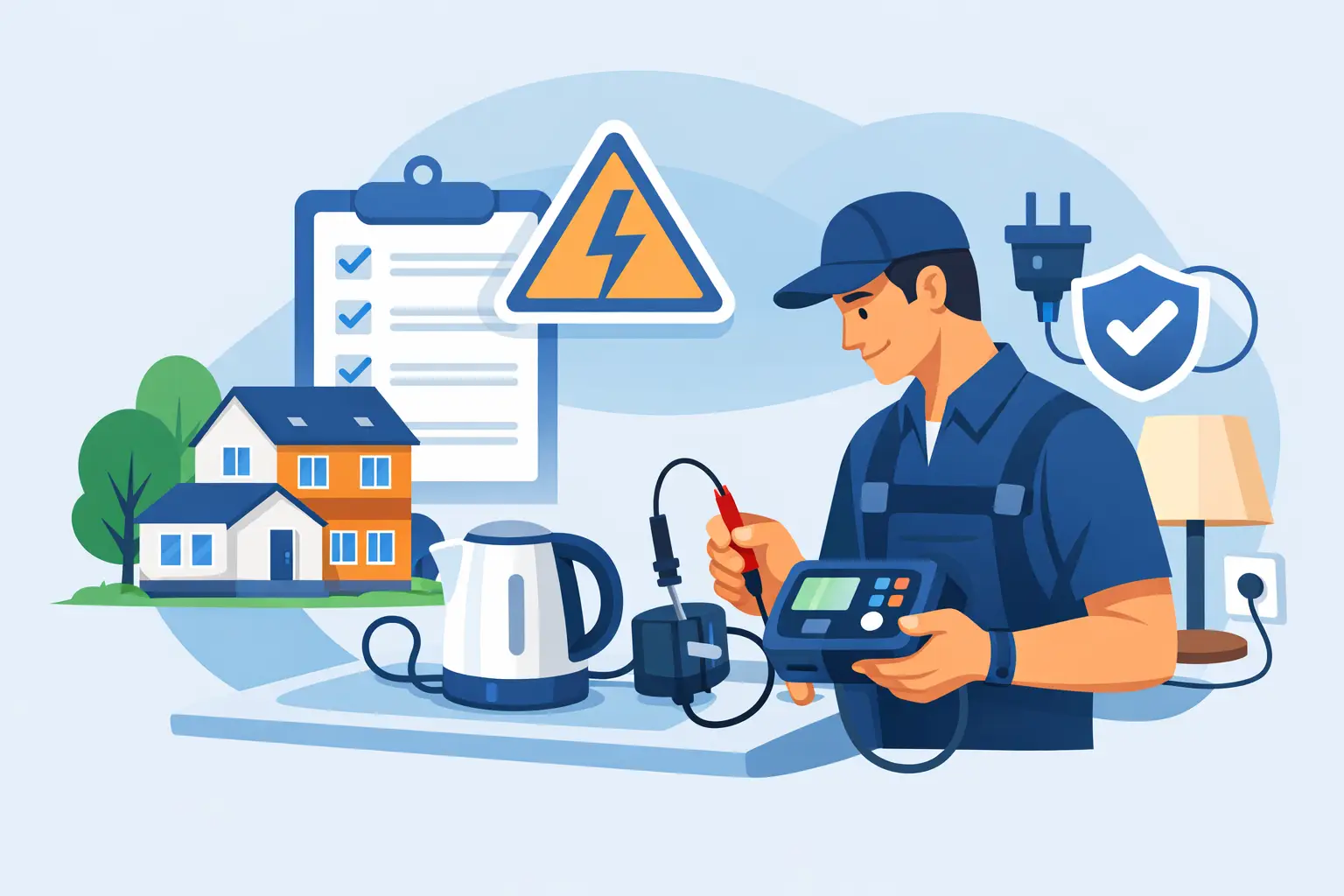
Landlords need PAT testing when they provide portable electrical appliances as part of a tenancy and need a reliable way to evidence electrical safety. That includes obvious items such as kettles, microwaves, lamps and extension leads, but it can also cover white goods and other plug-in equipment supplied with the property.
The law focuses on safety, not on PAT testing by name. In England, landlords must ensure the electrical installation is safe, and any electrical appliances they provide are safe at the start of the tenancy and maintained in a safe condition during it. So while the legislation does not usually say, "you must PAT test every year", PAT testing is often the most efficient route to proving compliance.
This matters more in furnished and part-furnished lets, HMOs, short-term accommodation and managed portfolios where appliances are supplied as standard. The more items you provide, the stronger the case for a structured testing programme.
PAT testing is about evidence as much as safety
Many landlords assume a quick visual check is enough. Sometimes it may be, especially for low-risk items in a low-turnover property. But there is a difference between believing an appliance looks fine and having a dated record from a competent person showing it was inspected and tested.
If a tenant reports a fault, or worse, an appliance causes a shock, fire or injury, paperwork becomes very important very quickly. A PAT record helps show that the landlord acted responsibly, used a repeatable process and did not simply rely on guesswork.
For letting agents and portfolio landlords, that record is also useful operationally. It reduces back-and-forth, supports file audits and makes it easier to show a consistent compliance process across multiple properties.
Which landlords are most likely to need it?
If you let an unfurnished property and provide almost no electrical items beyond fixed installations, your PAT testing needs may be limited. The electrical installation itself still needs attention under the Electrical Safety Standards in the Private Rented Sector regulations, typically through an EICR, but PAT testing may not be a major issue if there are no portable appliances supplied.
If you provide appliances, the position changes. Furnished landlords are the clearest example. A flat with a supplied fridge freezer, washing machine, microwave, floor lamps and a television carries a different level of risk from an empty property with no landlord-owned plug-in items.
HMOs deserve extra care because appliance use is heavier, occupant turnover is often higher and shared equipment gets more wear. A toaster in a family tenancy may get moderate use. The same toaster in a five-bedroom HMO may be in constant use and far more likely to suffer damage.
Short lets and serviced accommodation also sit in a higher-risk category. Frequent occupation means more handling, more opportunities for misuse and more reason to keep testing intervals tight.
How often should landlords arrange PAT testing?
This is where a lot of confusion comes from. There is no universal annual rule for every property and every appliance. Frequency should be based on the type of appliance, how often it is used, the kind of tenancy and the condition of previous test results.
That said, annual PAT testing is a sensible benchmark for many rented properties, particularly where landlords supply several appliances or manage HMOs. It is easy to schedule, easy to evidence and generally aligns with the way agents prefer to manage recurring compliance.
In lower-risk settings, some appliances may not need testing every 12 months if visual inspections are carried out and previous results have been satisfactory. In higher-risk properties, waiting longer may not be sensible. A practical approach is to assess the property, look at what is supplied, and set an inspection schedule that can be justified if challenged.
A good rule for landlords is this: test at the start of a new tenancy if supplied appliances have not been checked recently, test more often in high-use environments, and do not leave long gaps without any documented inspection process.
What appliances are covered?
PAT testing usually applies to portable electrical appliances and plug-in items supplied by the landlord. That includes kettles, toasters, lamps, extension leads, vacuum cleaners, televisions, microwaves and many white goods with plugs.
It does not usually apply to tenant-owned appliances. If the tenant brings their own air fryer, desk lamp or coffee machine, that is not generally the landlord's responsibility. The key distinction is ownership and supply. If you provide it as part of the tenancy, you should be satisfied it is safe.
There can be grey areas. Built-in appliances may fall into a broader electrical safety discussion rather than standard PAT testing, depending on how they are connected and installed. This is one reason a one-size-fits-all answer rarely works. Properties differ, and so do appliance types.
Is PAT testing a legal requirement for landlords?
Strictly speaking, not in every case. There is no single rule saying all landlords must PAT test all rental properties every year. But landlords do have legal duties under consumer protection and landlord safety law to ensure supplied electrical equipment is safe.
That is why PAT testing is widely treated as best practice and, in many settings, the sensible standard to follow. It provides a straightforward, recognised way to meet your wider obligations. If you are ever asked how you knew a supplied appliance was safe, a current PAT record is a much stronger answer than "it seemed fine".
For agents managing stock on behalf of landlords, that distinction is important. The law may not prescribe PAT testing by name in every instance, but from a risk management point of view, relying on informal checks alone is often a false economy.
What happens if landlords do not PAT test?
The risk is not usually an instant fine simply for not having a PAT certificate. The bigger issue is exposure if an appliance is unsafe and you have no proper inspection trail. That can lead to disputes, enforcement issues, insurance complications and reputational damage.
For agents, it can also create avoidable friction at tenancy start. If a tenant spots damaged cables, missing labels or questionable appliances on move-in day, the property immediately feels less professionally managed. Small compliance gaps have a habit of becoming bigger operational problems.
PAT testing is relatively low-cost compared with the cost of dealing with an electrical incident, tenant complaint or delayed let. For most landlords, that makes it a straightforward preventative step rather than an optional extra.
A practical approach for landlords and letting agents
The most efficient way to handle PAT testing is to treat it as part of a wider property compliance process rather than a one-off box-ticking exercise. Check what appliances are supplied, record them properly, arrange testing at sensible intervals and keep certificates accessible.
This works especially well when coordinated with other property tasks such as inventories, inspections and electrical compliance checks. For busy landlords and agents, combining services reduces admin, shortens booking time and helps keep files current without chasing multiple contractors. That is exactly why many property professionals prefer using one operational provider such as AG Site Solutions when preparing a property for let.
If you manage several properties, consistency matters just as much as the test itself. A repeatable process across the portfolio is easier to audit, easier to delegate and easier to defend if questions come up later.
When do landlords need PAT testing before a tenancy starts?
Before a new tenancy starts is one of the most sensible points to arrange PAT testing, especially if appliances are included and there has been a recent change of occupier. It gives you a clean compliance record, reduces the chance of disputes and helps ensure the property is ready for occupation.
It is also a useful checkpoint after maintenance works, appliance replacement or a long void period. If the property has been empty, items may have deteriorated, been moved or been damaged without anyone noticing.
For high-turnover lettings, building PAT testing into the standard pre-tenancy workflow is often the simplest option. It keeps the process predictable and avoids last-minute scrambling when keys are due to be released.
Landlords do not need to overcomplicate this. If you supply portable electrical appliances, you need to be able to show they are safe. PAT testing is not always prescribed, but it is often the clearest, quickest and most defensible way to do that - especially when time is tight and the tenancy needs to start without delay.