
How to Prepare for a PAT Test in Reading: The 2026 Landlord & Business Checklist
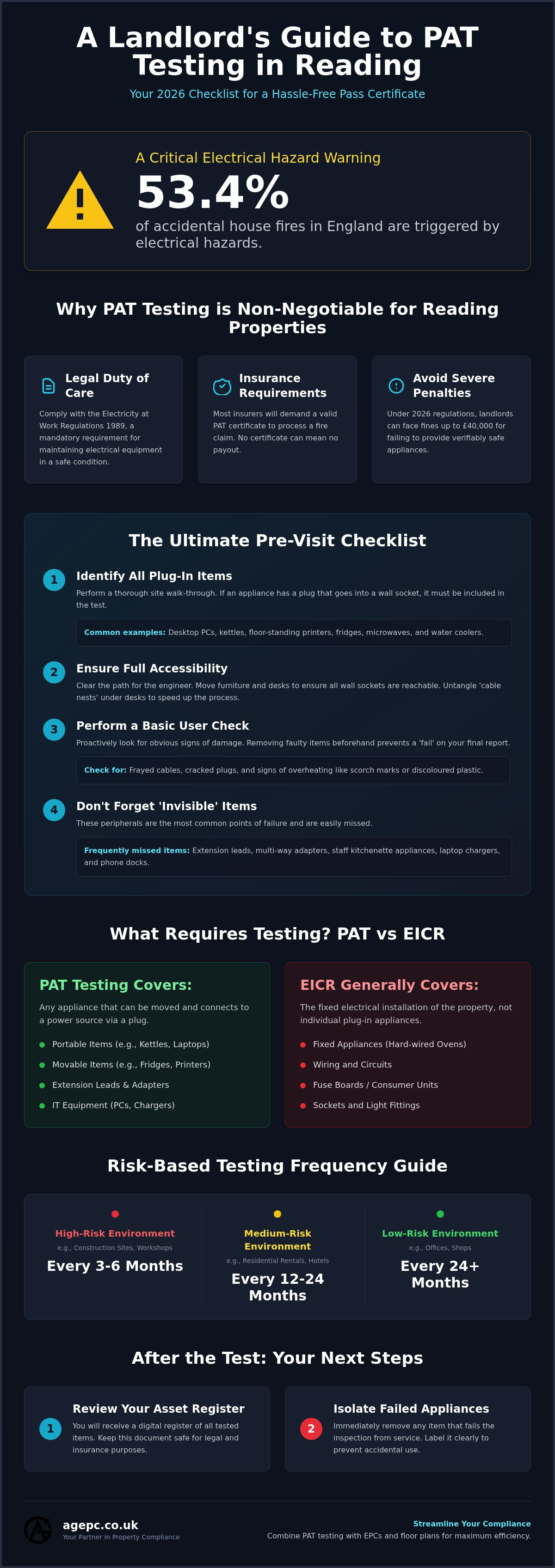
Did you know that 53.4% of accidental house fires in England are triggered by electrical hazards? For Reading landlords and business owners, this is more than just a statistic; it is a significant risk to your property and your reputation. Learning how to prepare for a PAT test Reading properties require is the first step toward total peace of mind. It turns a mandatory safety chore into a streamlined operational strategy that protects your assets.
We understand the common frustrations. You likely worry about business downtime, the confusion of identifying which items need testing, or the anxiety of failing an inspection. It often feels like a massive administrative hurdle that interrupts your actual work. We are here to remove that friction. Our 2026 checklist ensures you meet the latest legal standards, including the new requirements for social tenancies, without the usual stress.
This guide provides a clear, step-by-step path to securing your pass certificate with zero fuss. You will discover exactly which appliances to check, how to organise your space for the engineer, and what documentation you need for full legal compliance. Let's get your property safe, compliant, and certified today.
Key Takeaways
- Understand your legal duty of care under the Electricity at Work Regulations and the latest 2026 requirements for social housing tenancies.
- Learn how to prepare for a PAT test Reading landlords and businesses need by identifying all plugged-in items and clearing access to wall sockets.
- Reduce operational downtime by coordinating specific power-down windows and communicating the schedule to your team 48 hours in advance.
- Manage post-test documentation effectively by reviewing your digital Asset Register and immediately isolating any appliances that fail inspection.
- Streamline your property compliance by combining PAT testing with other essential services like EPCs and professional floor plans for maximum efficiency.
Understanding PAT Testing Requirements in Reading for 2026
What is PAT testing? At its core, it is a routine inspection of your electrical gems to ensure they remain safe for use. This process is a vital part of your legal duty of care under the Electricity at Work Regulations 1989. These regulations mandate that any electrical equipment with the potential to cause injury must be maintained in a safe condition. It is not a suggestion. It is a professional requirement for every business owner and landlord in the Thames Valley.
Reading Borough Council has strengthened its stance on HMO electrical safety for 2026. They now demand rigorous evidence of appliance safety before granting or renewing licences. The scope is specific. It covers portable items like kettles and laptops, but it also includes movable items such as floor-standing printers or fridges. If the item has a plug, it requires an inspection. Fixed appliances, such as hard-wired ovens, are typically covered by your EICR rather than a PAT test. Distinguishing between these categories is the first step when you learn how to prepare for a PAT test Reading inspectors will approve.
Why Landlords and Businesses in Reading Cannot Ignore PAT
Commercial premises in Green Park and the town centre face strict insurance requirements. Most providers will reject a fire claim if you cannot produce a valid PAT certificate. Testing provides the proof of maintenance they demand. For landlords, the risks are even more severe. New 2026 regulations mean failing to provide safe appliances can result in penalties of up to £40,000. PAT is a non-negotiable element of your wider property compliance framework. It keeps your tenants safe and your business protected from litigation.
Determining Testing Frequency for Your Sector
Frequency is not one-size-fits-all. It is based on a risk assessment of your specific environment. High-impact environments, such as construction tools used in Reading town centre developments, require frequent testing every few months. Conversely, standard office equipment might only require a check every two years. For residential rentals, a 12 or 24-month interval is the standard benchmark. Your risk-based approach ensures you do not over-test low-risk items whilst staying fully compliant in high-risk areas. This strategic planning is essential for those looking at how to prepare for a PAT test Reading properties need for total safety.
The Ultimate Pre-Visit Checklist: Preparing Your Appliances
Efficiency is the cornerstone of a successful inspection. When considering how to prepare for a PAT test Reading businesses often overlook the simplest step: the site walk-through. Start by identifying every single item with a plug. If it draws power from a socket, it requires an assessment. This includes everything from the obvious desktop PC to the hidden water cooler in the corner. Clear the path for the engineer. Move furniture, slide out appliances, and ensure every wall socket is easily reachable. If an engineer spends thirty minutes moving your filing cabinets, you're losing valuable operational time.
Perform a basic user check before the professional arrives. Look for frayed cables, cracked plugs, or signs of overheating like discoloured plastic. Removing obviously damaged equipment from service now prevents a "fail" result on your final report. According to Health and Safety Executive (HSE) guidance, regular maintenance is a legal necessity, but your proactive checks are the first line of defence. For a seamless experience, you might consider booking professional PAT testing services alongside your other compliance needs to keep your property running smoothly.
The 'Invisible' Items People Often Forget
It's rarely the main computer that fails; it's the peripherals. Extension leads and multi-way adapters are the most frequent fail points in Reading offices. These items are often buried under desks or daisy-chained together, creating a significant fire risk. Don't forget the staff kitchenette. Kettles, microwaves, and even the office toaster need testing. In modern hot-desking environments, ensure laptop chargers and phone docks are gathered in one place. These small, portable gems are easy to miss but vital for total compliance.
Accessibility and Cable Management
Untangle your "cable nests" before the engineer knocks on the door. Knotted wires under desks slow down the testing process and can hide physical damage to the cable insulation. If you have equipment stored at height, such as projectors or high-mounted TVs, bring them down to floor level safely. Engineers need physical access to the plug and the appliance itself to perform the required tests. Finally, clear a small, dedicated workspace. Providing a table or a clear section of a counter allows the engineer to set up their testing station and process your items with maximum speed.
Minimising Disruption: Operational Prep for Reading Offices
Reading is a hub for high-growth tech firms and bustling retail centres. Managing a PAT visit in a high-density office requires more than just clearing desks. It requires a strategy. Send an internal memo 48 hours before the engineer arrives. This gives your team time to save work and prepare for brief interruptions. Planning for 'power-down' windows is essential. Rotate testing by department so your entire operation never goes dark at once. If you are unsure how to prepare for a PAT test Reading office managers often find that assigning a single on-site liaison is the most efficient choice. This person guides the engineer through different zones, ensuring no room is missed.
Hybrid work is the standard for 2026. Don't forget your remote staff. Ask them to bring their laptops, monitors, and chargers into the Reading office on the scheduled day. It ensures every company asset is verified and safe, keeping your insurance valid for equipment used off-site. For a rapid, friction-free compliance experience, you can book your professional PAT test to fit around your peak business hours.
Handling Business-Critical Equipment and Servers
Business-critical equipment like servers requires a delicate touch. Identify 'always-on' systems early. Professional engineers use 'soft-test' procedures to check these gems without causing data loss or hardware damage. Ensure backup systems are active before any planned power-downs. Label these plugs clearly. It prevents accidental disconnection during the rush of a busy testing day. This proactive labelling saves time and prevents costly IT restarts.
Tenant Communication for Reading Landlords
For landlords in the Thames Valley, communication is a legal mandate. Provide the statutory 24-hour notice to tenants for access to communal and private areas. Use this as an opportunity to ask tenants about faulty appliances or flickering lights. Following electrical safety guidance for landlords helps maintain a positive relationship whilst meeting your obligations. For a deeper dive into your specific duties, see our Reading Landlord Compliance Guide to ensure your property remains fully legal in 2026.
After the Test: Certificates, Reports, and Next Steps
Your engineer has finished the physical inspection. Now, the focus shifts to your documentation. You will receive a comprehensive Asset Register. This is a digital log of every appliance tested, its specific location, and its pass or fail status. This document is your primary shield against liability. Store your PAT certificate where it is easily accessible for insurance audits or council inspections. Understanding how to prepare for a PAT test Reading landlords and businesses find effective means knowing how to manage the data that follows the visit.
Display your compliance proudly. A valid certificate proves you have met your legal duty of care. It provides peace of mind for staff and tenants alike. AG Property Services streamlines this by providing clear, professional reports that satisfy all legal requirements. We also automate your compliance cycle by tracking your renewal dates, ensuring you never miss a deadline. This proactive approach removes the administrative burden from your shoulders.
What Happens if an Item Fails?
A 'fail' result is not a disaster; it is a successful hazard identification. You must act immediately to maintain safety. Start the quarantine process by removing the faulty item from service or labelling it clearly as 'Do Not Use'. Some issues are minor. An engineer can often perform remedial works on-site, such as replacing a blown fuse or a damaged plug. This gets your equipment back in action instantly. For larger faults, compare the cost of repair against replacement. Making cost-effective decisions keeps your business budget on track whilst ensuring total safety.
Integrating PAT into Your Property Safety Strategy
Compliance is most efficient when it's consolidated. Combining your PAT testing with a professional EPC assessment saves significant time and reduces the number of visitor interruptions to your property. It's a holistic approach to property health. Maintaining a clear digital trail of safety records protects you from future litigation and simplifies the renewal process. When you are ready to book your next PAT testing session, we ensure the transition is seamless. We help Reading property owners stay safe, legal, and fully operational with zero friction.
Secure Your Compliance and Peace of Mind
Electrical safety is an ongoing responsibility that demands precision and foresight. By mastering how to prepare for a PAT test Reading properties require, you have already removed the biggest hurdles to a successful inspection. You now know how to audit your appliances, communicate with your team, and manage your post-test documentation with confidence. Compliance isn't a burden when you have a clear strategy and a reliable partner.
We are ready to help you cross the finish line. Our accredited local engineers provide a fast, professional service tailored to the Reading business community. We offer same-day digital certificates and comprehensive property compliance packages that include EPCs and floor plans. This streamlined approach saves you time and ensures your property remains fully legal for 2026 and beyond.
Book your Reading PAT test with AG Property Services today and experience a friction-free path to safety. Let's get your property certified so you can focus on what you do best.
Frequently Asked Questions
Do I need to unplug everything for a PAT test in my Reading office?
Yes, appliances must be disconnected for the electrical tests to occur. You don't need to unplug everything yourself before we arrive; the engineer handles this during the inspection. We work through your office systematically to minimise disruption. For critical IT systems, we coordinate with your liaison to ensure 'soft-tests' happen during agreed windows. This is a key part of learning how to prepare for a PAT test Reading business managers find most effective.
How long does a PAT test take for a standard 3-bedroom rental property?
A standard 3-bedroom rental property typically takes 45 to 90 minutes. The exact time depends on your appliance volume. Fully furnished lets with white goods and lamps take longer. Unfurnished properties are much faster to process. Ensure our engineers have clear access to all wall sockets. This speeds up the visit significantly. You get your pass certificate issued sooner with zero fuss and minimal interruption.
Is PAT testing a legal requirement for landlords in Reading Borough Council?
It is a legal requirement to ensure provided equipment is safe. PAT is the recognised method for doing so. Reading Borough Council requires valid testing for all HMO licences. From May 2026, these requirements are even stricter for existing social tenancies. Even for standard lets, it proves you've met your duty of care. Non-compliance is risky. It can lead to penalties of up to £40,000 and void your insurance.
What happens if a tenant brings their own faulty appliance into the property?
Landlords are legally responsible for the safety of appliances they supply, not those owned by the tenant. However, a tenant's faulty device still poses a fire risk to your building. We recommend including a clause in your tenancy agreement requiring tenants to maintain their own equipment. Having your own items tested provides a clear audit trail. It proves your provided appliances were safe and compliant if an incident occurs.
Can my own staff perform PAT testing if they are 'competent'?
Staff can perform testing if they are deemed 'competent' through training. Most Reading firms choose accredited professionals instead. It avoids conflicts of interest and equipment costs. Professional testing provides an impartial safety record. This is often an insurance requirement. It ensures your business stays protected. Legitimate, third-party verification holds up under scrutiny and reduces your liability whilst saving your internal team valuable time.
Do brand new electrical items need to be PAT tested immediately?
New electrical items usually only require a visual inspection for their first year. They are assumed safe from the manufacturer. However, you should still record them in your Asset Register. When you learn how to prepare for a PAT test Reading properties require, remember to include new items in your next audit. This maintains a complete digital trail for your insurance and ensures your long-term legal compliance is never in doubt.
Important Information
The information provided in this article is for general guidance and informational purposes only and does not constitute legal, financial, or professional property advice. While AG Site Solutions aims to keep all content accurate and up to date, property regulations, landlord obligations, EPC requirements, and housing legislation may change over time.
Readers should always seek professional advice or consult the relevant authorities before making decisions relating to property compliance, tenancy matters, Energy Performance Certificates (EPCs), landlord responsibilities, or legal obligations.
Some articles may be created or assisted using AI-supported content tools and are reviewed and enhanced using real industry experience and property compliance knowledge.
For professional assistance, quotations, or compliance support, please contact AG Site Solutions directly via agepc.co.uk