What repair liabilities should a small business check before signing a commercial lease?
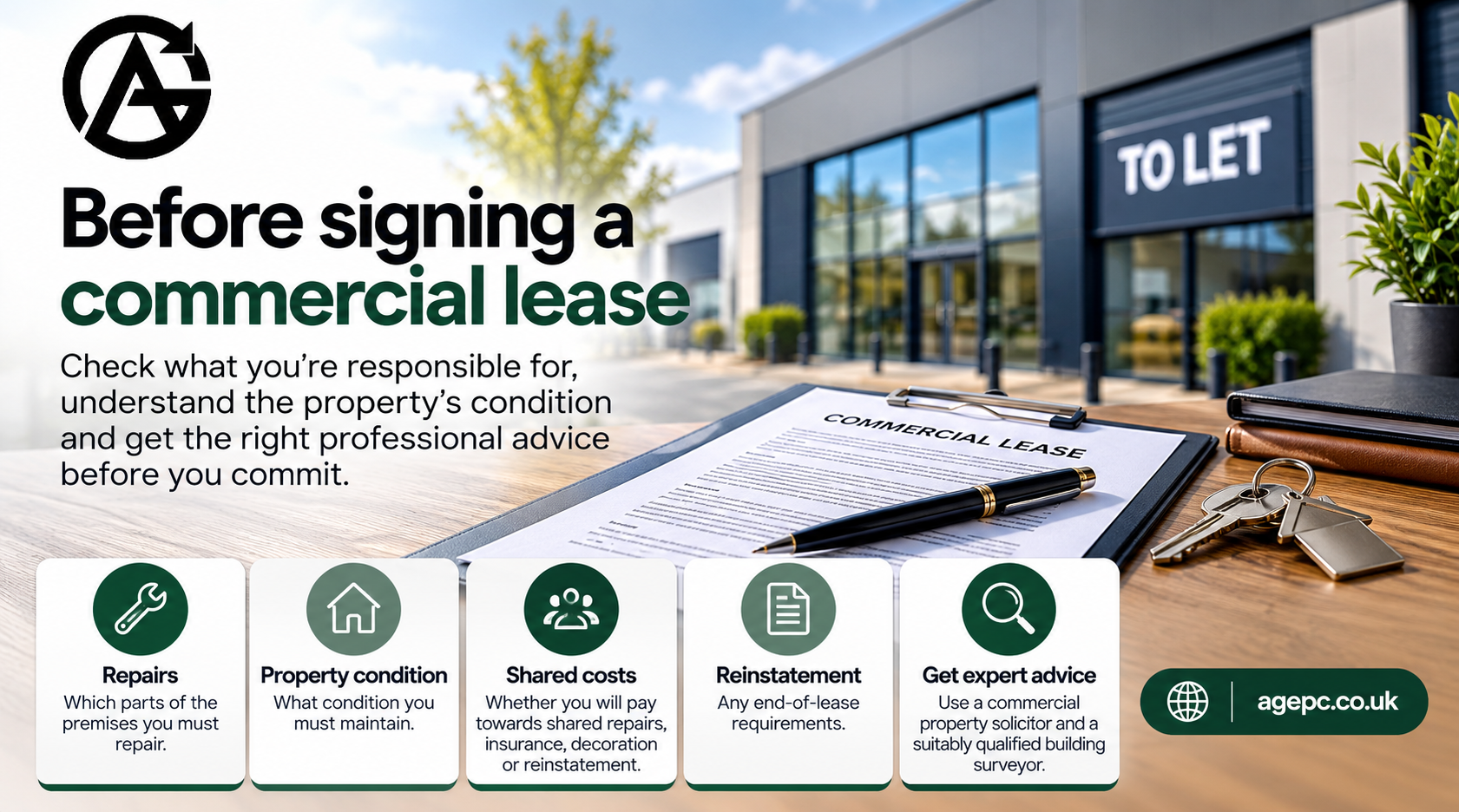
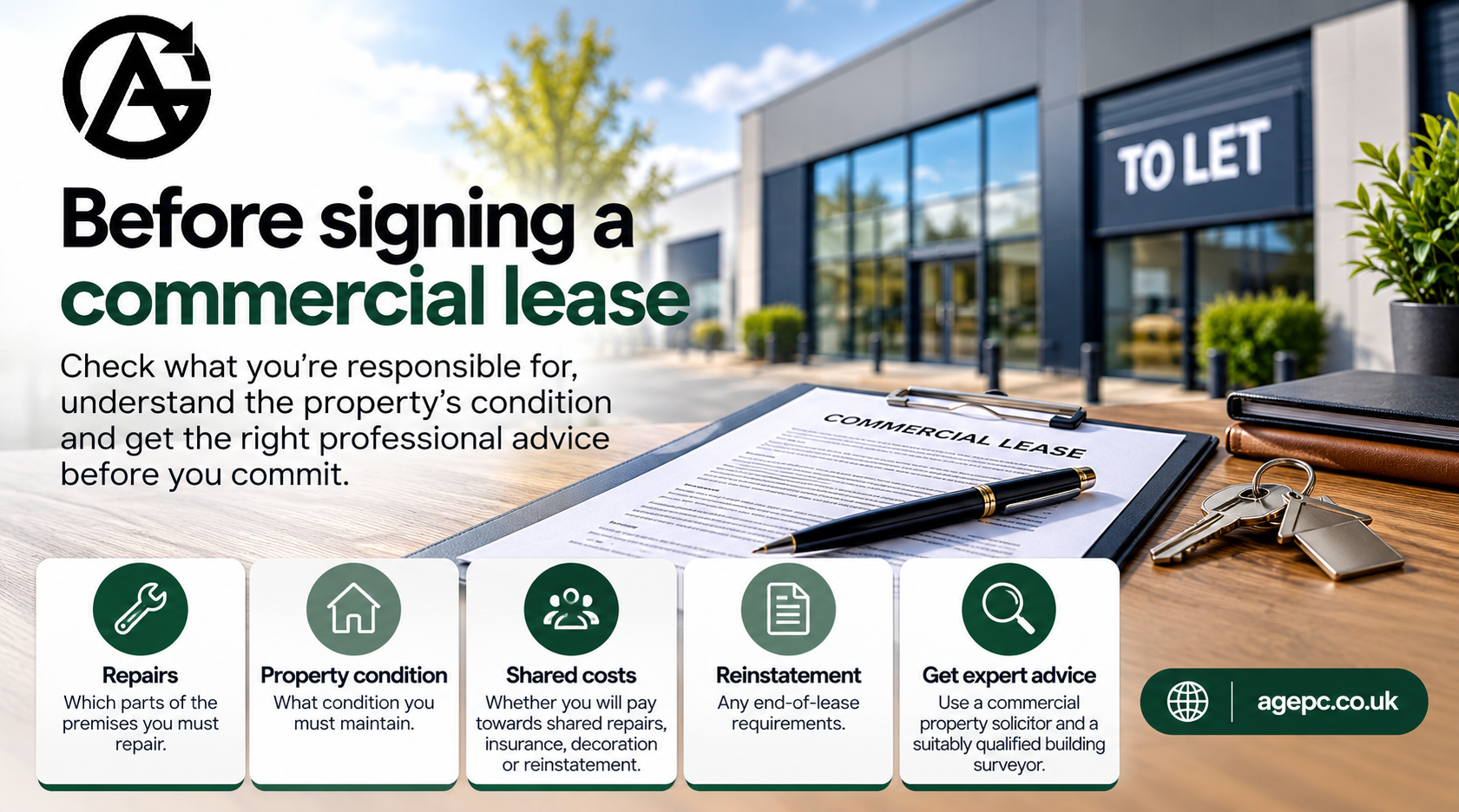
Before signing a commercial lease, check exactly which parts of the premises you must repair, what condition you must maintain, and whether you will also pay towards shared repairs, insurance, decoration or reinstatement. Read those clauses alongside evidence of the building’s current condition. For a small business taking premises in Slough or nearby, the practical next step is to have a commercial property solicitor review the lease and a suitably qualified building surveyor assess the condition before you commit.
Key takeaways
- The lease plan and definition of the premises matter as much as the repair clause.
- Existing defects should be investigated before you accept a repairing obligation.
- A schedule of condition needs an effective link to the lease wording, not just photographs.
- Shared-building repairs and reinstatement can create exposure beyond your own unit.
Before signing, check your commercial lease repair liabilities: exactly which parts of the premises you must repair, what condition you must maintain, and whether you will also pay towards shared repairs, insurance, decoration or reinstatement. Read those clauses alongside evidence of the building’s current condition. For a small business taking premises in Slough or nearby, the practical next step is to have a commercial property solicitor review the lease and a suitably qualified building surveyor assess the condition before you commit.
Key takeaways
- The lease plan and definition of the premises matter as much as the repair clause.
- Existing defects should be investigated before you accept a repairing obligation.
- A schedule of condition needs an effective link to the lease wording, not just photographs.
- Shared-building repairs and reinstatement can create exposure beyond your own unit.
Identify the premises and commercial lease repair obligations
Start with what you are taking, not simply the address or advertised floor area.
Compare the lease plan with the definition of the premises, sometimes called the demise. Ask whether it includes the roof, structure, shopfront, windows, drains, plant or external areas. A self-contained workshop in Slough and an office within a shared Windsor building need different questions. GOV.UK’s business tenancy guidance explains that repair responsibilities depend on the lease.
A full repairing and insuring lease generally places responsibility for repairs and building insurance on the tenant, directly or through payments to the landlord. Do not treat the label as a complete explanation: ask your solicitor to identify precisely what the wording transfers. The RICS leasing code provides a useful framework for these negotiations.
- Repair: addressing defects or deterioration.
- Maintenance: routine upkeep and servicing.
- Decoration: finishes, painting and presentation.
- Reinstatement: removing alterations or restoring an agreed layout or condition.
These are practical distinctions, not universal lease definitions. Check each obligation separately rather than assuming that an exclusion from one also limits the others.
Check condition before agreeing to repair
An attractive viewing does not establish the condition you are agreeing to take responsibility for.
Ask a suitably qualified building surveyor to investigate the premises with the proposed repairing obligations in mind. Flag staining, cracking, damaged windows, roof concerns and ageing equipment. Give the surveyor the draft lease or your solicitor’s summary of its boundaries.
Do not assume that defects predating your occupation are excluded. Ask your solicitor whether the wording could require you to remedy existing disrepair. RICS’s leasing code recommends that repairing obligations reflect the lease length and premises’ condition, with appropriate limitations negotiated where needed.
> A SCHEDULE OF CONDITION NEEDS CONTRACTUAL EFFECT — A photographic and written schedule records condition. Ask your solicitor to ensure that the lease expressly uses it to limit the relevant obligations, and your surveyor to confirm that its coverage is adequate. Attaching photographs alone is not a substitute for agreeing the limitation.
Investigate service charges and shared repairs
Your exposure may extend beyond repairs inside your own unit.
For an office in Reading or a unit on a shared estate near Uxbridge, examine the service-charge provisions alongside the direct repair clause. Ask which roof, lift, drainage, car-park or communal-area works the landlord proposes to recover through the charge, and how your share is calculated.
- Request recent service-charge accounts and the current budget.
- Ask about planned major works and any reserve or sinking fund.
- Check proposed treatment of replacement, improvement and management expenditure.
- If negotiating a cap, clarify exclusions, increases and which payments it covers.
The RICS leasing code recommends service-charge estimates and disclosure of known irregular expenditure. Treat this as a negotiation checklist, not an automatic spending limit or a promise about future charges.
Understand insurance and damage provisions
Read the insurance clauses together with the repairing obligations.
Identify who arranges building insurance and who pays the premium and excess. Request policy details and ask how exclusions, tenant improvements and damage caused by your activities are treated. Do not assume that building cover includes your stock, equipment or business interruption.
Following the issues identified in the RICS leasing code, ask your solicitor what happens after insured or uninsured damage: who restores the premises, whether rent and service charges remain payable, and what termination provisions apply if restoration does not happen. Check the actual wording rather than relying on “the landlord insures it”.
Review alterations and end-of-lease liabilities
Think about removing your fit-out before agreeing to install it.
For proposed partitions, signage, cabling or other alterations, ask what consent is needed and whether removal could be required. Have your solicitor review any licence for alterations alongside the lease. Check decoration clauses separately, including required finishes and any end-of-term requirements.
Dilapidations concerns alleged breaches of lease obligations relating to a property’s condition. Depending on the lease, a claim may involve repair, decoration and reinstatement. The official Dilapidations Protocol addresses commercial property claims at tenancy termination, including schedules of alleged breaches and quantified demands.
A demand is not automatically the amount payable. Section 18 of the Landlord and Tenant Act 1927 limits damages for breaches of repairing covenants in specified circumstances. Its application needs legal advice; do not assume that every category of an exit claim is treated identically.
Resolve uncertainties before signing
Bring the documents, condition findings and proposed business use together.
Your commercial lease checklist
- [ ] Obtain the draft lease, plan, heads of terms and relevant alteration documents.
- [ ] Mark the boundaries and every direct or shared repair obligation.
- [ ] Arrange condition advice from a suitably qualified building surveyor.
- [ ] Agree any schedule of condition and have its contractual effect checked.
- [ ] Request service-charge accounts, budgets and planned-works information.
- [ ] Review insurance, damage, decoration and reinstatement provisions.
- [ ] Have agreed exclusions and landlord works recorded in the appropriate documents before committing.
Ask your solicitor to identify unclear obligations and your surveyor to explain the physical issues behind them. This applies equally to a Bracknell shop, High Wycombe workshop or West London office: make decisions using the particular property and lease, not a standard checklist alone.
Related reading
For separate questions about electrical equipment, read Who is Responsible for PAT Testing in Rented Properties and Communal Areas — and How Often Should It Be Done? This does not replace a review of your commercial lease.
AG Site Solutions: before you commit
Four checks to discuss with your professional advisers
- DefineIdentify the premises and shared areas.
- InspectEstablish condition with a building surveyor.
- ClarifyReview repair, insurance and exit wording.
- DocumentRecord negotiated protections before signing.
Repair liabilities: checks before you commit
- Compare the lease plan with the premises definition: check whether the roof, structure, windows, drains and external areas fall within your responsibility.
- Give a suitably qualified building surveyor the draft lease or a summary of its boundaries, and ask them to investigate existing defects.
- Ask your solicitor whether you could have to remedy disrepair that predates your occupation.
- Check that any schedule of condition covers the relevant areas and that the lease expressly gives the agreed limitation effect.
- Request service-charge accounts, the current budget and details of planned major works; check your share and any proposed cap’s exclusions.
- Confirm who pays insurance premiums and excesses, who restores damage, and whether rent and service charges continue during restoration.
- Review alteration consents, decoration requirements and any obligation to remove your fit-out at the end of the lease.
- Have your solicitor document agreed exclusions and landlord repair commitments before you sign.
Need an EPC, floor plan or PAT testing alongside your premises preparations? Contact AG Site Solutions to discuss suitability and availability. For lease advice or a building survey, appoint a commercial property solicitor or suitably qualified building surveyor separately.
Frequently asked questions
Is a short lease a reason to skip professional advice?
No. Ask advisers to assess the obligations against the proposed term rather than assuming a short occupation means limited exposure.
Does a rent-free period compensate for taking on repairs?
Evaluate the incentive and proposed works together with your advisers. Do not treat a rent concession as an agreed limitation on repair obligations.
What if the landlord promises to fix something verbally?
Give your solicitor the details and ask for the commitment to be documented appropriately before you rely on it.
Should I check a break clause alongside repair liabilities?
Yes. Ask your solicitor to explain its conditions and what liabilities could remain after exercising it.
What if I am asked to provide a personal guarantee?
Obtain advice on its scope, including whether it covers repair-related liabilities, before signing.
What if I plan to transfer the lease later?
Have your solicitor review the assignment provisions and any potential continuing obligations rather than assuming a transfer ends your exposure.
Are business rates part of this repair review?
Keep them as a separate item in your occupation-budget checks. Ask your adviser to distinguish rates, rent, service charges and other proposed payments.
Can an EPC or PAT test replace a building survey?
No. They serve different purposes and do not establish the building’s overall condition or full property compliance.