
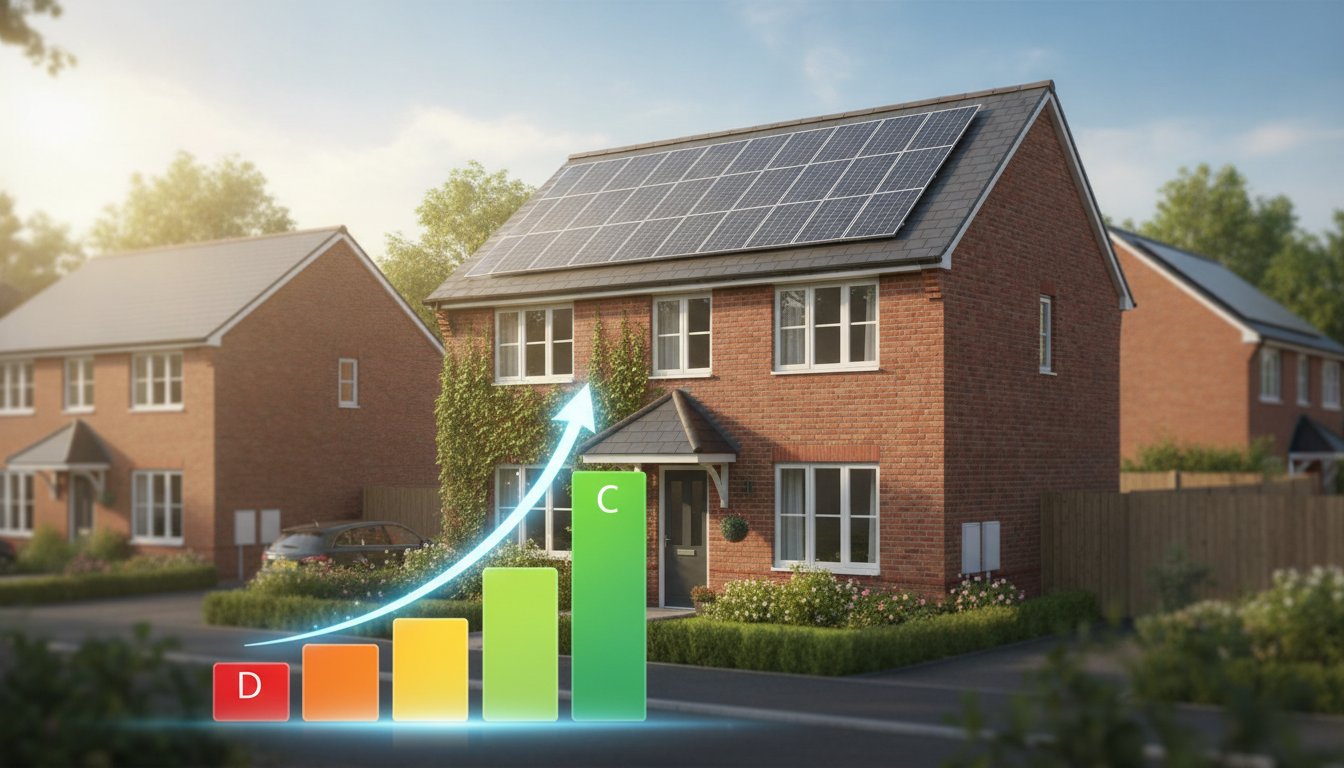
Do Solar Panels Improve EPC Ratings? A Comprehensive 2026 Guide
What if one upgrade could jump your property from a 'D' to a 'C' rating, instantly securing your rental income for the next decade? It is the most common question we hear: do solar panels improve EPC ratings enough to justify the cost? With the government mandating a 'C' rating for all tenancies by October 2030, the clock is ticking. You might feel overwhelmed by SAP 10.2 technicalities or fear spending thousands without seeing a tangible result on your certificate.
We know you need clarity, not jargon. This guide delivers exactly how solar PV impacts your Energy Performance Certificate and what you must do to guarantee a higher rating. We will outline the specific points boost solar provides and provide the essential document checklist for your assessor. You will get a clear path to landlord compliance whilst the 0% VAT incentive still applies. We cover everything from the Home Energy Model transition to the practical steps needed to turn sunlight into a better score. Let's make your property efficient and compliant without the friction.
Key Takeaways
- Do solar panels improve EPC ratings? Yes, they are one of the most effective ways to boost your score and can often move a property from a high 'D' to a solid 'C'.
- Learn how a typical 4kWp system affects your rating and why solar is now essential for meeting the 2030 landlord compliance mandate.
- Avoid common pitfalls by ensuring your assessor has the correct MCS certificates; without evidence, the software uses default values that penalise your score.
- Organise your technical documentation and ensure clear access to the inverter to guarantee every bit of generation is captured during the assessment.
- See why solar installations are becoming a key differentiator in property values, providing both regulatory compliance and a competitive edge for sellers.
Do Solar Panels Improve EPC Ratings? The Big Picture
Do solar panels improve EPC ratings? The direct answer is yes. Solar Photovoltaics (PV) are one of the most reliable ways to increase your score quickly. Many property owners mistakenly believe the rating only reflects carbon footprints. In reality, an Energy Performance Certificate (United Kingdom) measures the modelled cost of running your home. Because you are generating free electricity on-site, you buy less from the grid. This reduction in energy expenditure is what the assessment software rewards. It is a logical, data-driven calculation that turns sunlight into a higher band on your certificate.
The Standard Assessment Procedure (SAP) is the engine behind these calculations. It uses complex formulas to estimate how much energy your property consumes based on its size, layout, and features. Solar panels act as a significant credit against your consumption. By slashing the predicted annual fuel bill, you climb the points ladder. It is a streamlined, efficient way to secure a better rating whilst reducing your environmental impact. In 2026, where energy prices remain a central concern for tenants and buyers, this cost-efficiency is a major asset.
How EPC Ratings are Calculated in 2026
The A-G scale is a 100-point system where every point counts. In 2026, the SAP 10.2 methodology is the standard for domestic assessments. It rewards properties that integrate renewables because they lower the strain on the national grid. The government has shifted its focus. It now prioritises homes that can store and use their own energy. This means your EPC rating isn't just about the panels; it's about how they integrate with your home's total energy profile. High-speed assessments now look for evidence of self-consumption to verify these gains.
The Difference Between Solar PV and Solar Thermal
Solar PV generates electricity for lights, appliances, and heating systems. Solar Thermal specifically heats water. Whilst both are beneficial, Solar PV typically offers a higher points boost on a standard report. Electricity costs more than gas per unit. Therefore, the cost-saving logic of PV carries more weight in the final calculation. if you want the highest possible rating, PV is the priority. However, combining both can lead to an "A" rating, especially in modern builds designed for maximum efficiency. Understanding this distinction helps you prioritise your budget for the best possible return on your rating.
Calculating the Impact: How Many Points Can You Gain?
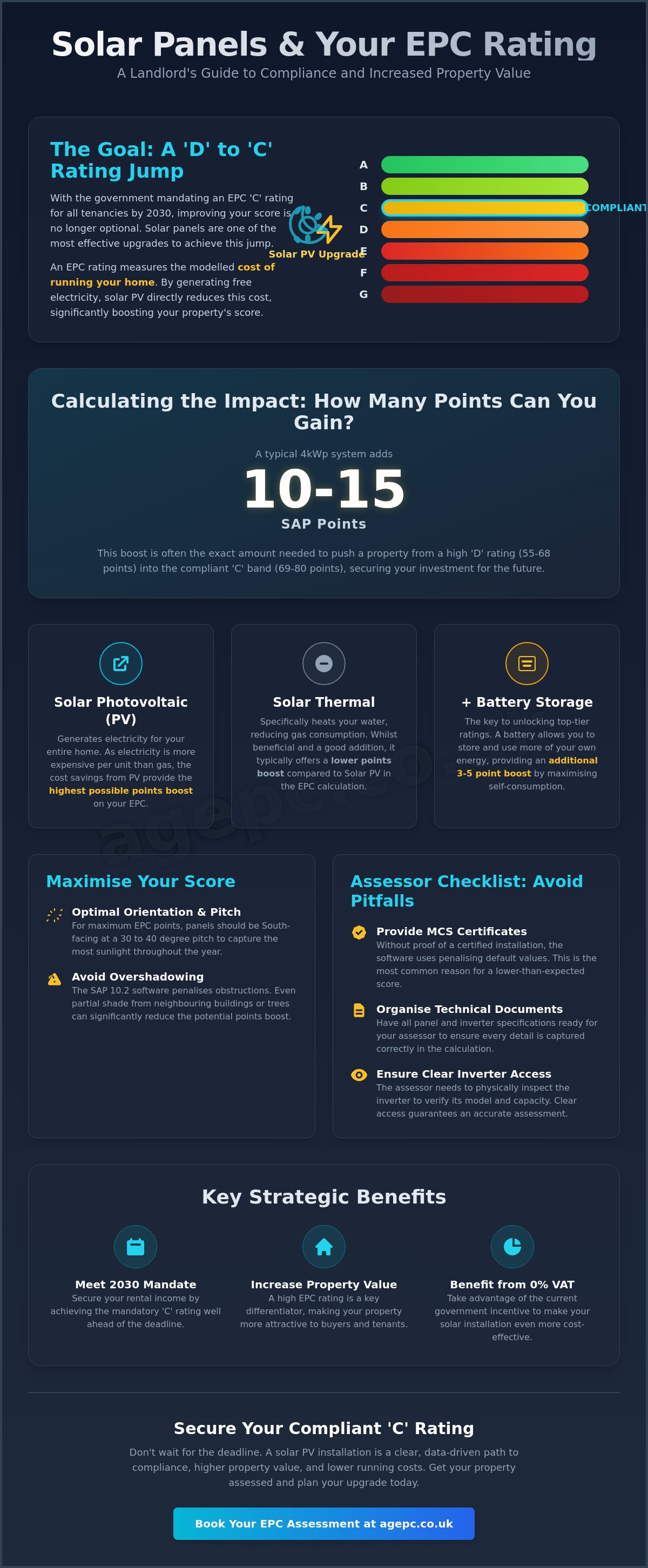
Do solar panels improve EPC ratings by a specific, predictable margin? For a standard semi-detached house, a 4kWp system typically adds between 10 and 15 points to the total score. This is often the exact boost required to trigger a "Band Jump." If your property currently sits at a high 'D' rating with 67 or 68 points, these panels can push you into a solid 'C' territory. It is a strategic move for landlords. With the 2030 deadline approaching, crossing the 70-point threshold is the difference between a compliant asset and a legal liability.
Larger arrays do not always result in linear point increases. The SAP software calculates gains based on the property's modelled demand. Once you exceed what the home is expected to use, the software assumes the surplus is exported to the grid. Exported energy is valued lower in the "cost-efficiency" metric than energy consumed on-site. Therefore, doubling the number of panels will not double your EPC points. It is about finding the "sweet spot" for your specific roof size and energy needs. If you want to establish your current baseline before investing, you can book a domestic EPC assessment to see exactly where you stand.
Orientation and Overshadowing Factors
The SAP 10.2 methodology is incredibly precise about placement. South-facing panels at a 30 to 40 degree pitch provide the maximum EPC point contribution. In densely populated urban areas like Wembley or Harrow, overshadowing is a common hurdle. Neighbouring buildings or mature trees can block light for several hours a day. The assessment software penalises these obstructions. Even partial shade can significantly reduce the modelled energy output, which in turn limits the potential points boost on your final certificate.
The Role of Battery Storage in EPC Scores
Battery storage is becoming a vital component for high-tier ratings. It allows the EPC calculation to account for a higher percentage of "self-used" energy. Without a battery, the software assumes a large portion of your solar generation is "wasted" by being sent back to the grid during the day. Adding storage can provide an additional 3 to 5 points. This is frequently the deciding factor for properties aiming for an 'A' or 'B' rating. It shifts the energy balance, making your home appear much more cost-effective in the eyes of the assessor.
Why Solar Panels Might Not Boost Your Score (Common Pitfalls)
You spent thousands on an installation. You expected a significant jump in your score. Instead, the rating stalled or even dropped. This is the "Reddit problem" where homeowners share stories of failed improvements. Do solar panels improve EPC ratings? Usually, yes. However, the result depends entirely on the evidence provided. If an assessor cannot see it or prove it, they cannot count it. It is a strict, evidence-based process that leaves no room for verbal assurances.
The danger lies in "Assumed" data. Assessors are governed by strict conventions. Without technical paperwork, the software defaults to conservative values. These defaults are often the worst-case scenario for your property. An older EPC might have also contained errors. If a previous assessor guessed your system size incorrectly, a new, accurate assessment under the more rigorous SAP 10.2 methodology might show a lower score. This isn't a failure of the panels. It is a correction of previous inaccuracies.
Changing SAP versions play a major role. SAP 2012 was more lenient in certain areas. SAP 10.2, the 2026 standard, is far more precise about how energy is used and exported. If you want to avoid a disappointing result, you must be proactive. Organise your files before the assessor arrives. This ensures the software reflects the true performance of your system rather than a generic, penalised estimate.
The Importance of MCS Certification
The Microgeneration Certification Scheme (MCS) certificate is your most important document. It proves the system was installed by a qualified professional to specific standards. Assessors need this to verify the total kilowatt-peak (kWp) of your array. Lost your paperwork? You can usually find a copy on the MCS installation database. Without this certificate, uncertified "DIY" solar installations are frequently ignored by the assessment software. The system simply treats them as if they don't exist to maintain data integrity.
Documentation Gaps and "Default" Penalties
Assessors must take specific photos for their audit trail. They need clear shots of the panels, the inverter, and any battery storage. If your inverter is tucked away in an inaccessible loft or hidden behind heavy storage, the assessor cannot verify the system. Providing your "Export MPAN" or the original commissioning report is a high-speed way to resolve these gaps. This documentation confirms the system's capacity and integration. It removes the need for "default" entries and secures the maximum points for your rating.
Strategic Benefits: EPC C Mandates and Property Value
The 2030 Roadmap has changed the game for UK property owners. Reaching a 'C' rating is no longer a choice; it is a legal requirement for all tenancies by 1st October 2030. Do solar panels improve EPC ratings enough to meet this standard? For many older properties in the South East, they are the most efficient route to compliance. Landlords face a £10,000 spending cap to reach this target. Investing in solar often provides a more reliable points boost than expensive structural changes. It secures your rental income and prevents your property from becoming unlettable.
Market trends in Slough and Reading show a clear shift in buyer behaviour. Efficiency is now a top priority. A high EPC score reduces "void periods" because tenants are increasingly wary of high energy bills. Modern buyers are also hunting for "Green Mortgages." These products offer lower interest rates for homes with high energy ratings. By installing solar, you make your property more affordable to own and easier to finance. It is a dual benefit that protects your capital and improves liquidity in a competitive market.
Solar Panels for Landlords in the South East
Meeting the Minimum Energy Efficiency Standards (MEES) is a high-speed challenge. In areas like Berkshire and Buckinghamshire, many properties are solid-wall builds. External wall insulation is disruptive and costly. Solar PV offers a "bolt-on" solution that achieves similar point gains without the mess. You can use our guide on Domestic EPCs to map out your 2030 compliance strategy. Planning now allows you to take advantage of the 0% VAT rate before it reverts to 5% in March 2027. If you are ready to verify your current standing, order your property assessment today to get an expert baseline.
Increasing Resale Value in Competitive Markets
First impressions matter on portals like Rightmove and Zoopla. A "C" rating acts as a psychological green light for buyers. It suggests a well-maintained, modern home. In high-value areas like Windsor and Beaconsfield, solar is a key differentiator. Buyers in these markets expect tech-enabled, sustainable living. We recommend using professional property photography to highlight your solar array and battery storage. Showing these features clearly signals that the property is future-proofed. It justifies a premium price and attracts serious, eco-conscious offers faster than unoptimised listings.
Preparing for Your Assessment: The Homeowner Checklist
Success on assessment day depends on preparation. You have invested in the technology; now you must ensure it is recorded accurately. Do solar panels improve EPC ratings? Only if the assessor has the data required to bypass conservative software defaults. Start by organising your MCS certificate and commissioning paperwork. These documents are the primary evidence for system capacity. Keep your installer invoice handy to confirm the total kilowatt peak (kWp) of the array. This prevents the assessor from having to estimate panel wattage based on size alone, which often leads to a lower score.
Don't stop at solar. Highlight every recent energy improvement you have made. Have you upgraded to LED lighting throughout? Did you top up the loft insulation to 300mm? These smaller changes work alongside your solar PV to nudge your score higher. Once the site visit is complete, request a draft review of the certificate. This allows you to verify that the solar data was entered correctly before the final lodgement. It is a simple step that ensures total accuracy and peace of mind.
What the Assessor Needs to See
- Panel Visibility: The assessor must confirm the presence of panels. If they aren't visible from the ground, provide high-quality photos taken during the installation process.
- Inverter Access: Ensure clear access to the inverter, usually found in the loft or garage. The assessor needs the make and model to verify efficiency ratings.
- Diversion Switches: If you have a system that diverts excess solar to your hot water immersion heater, point it out. This adds another layer of cost-efficiency to the energy model.
Booking Your Local Assessment
Choosing a local expert for your domestic EPC provides a significant advantage. Local assessors understand regional housing stock and common construction types. This knowledge leads to more accurate data entry and faster turnaround times. You can streamline your entire marketing process by combining your assessment with professional property photos. Using a one-stop provider for EPCs, floor plans, and photography removes friction. It ensures your property is compliant, documented, and ready for market in the shortest possible time. Efficiency is our priority; let us handle the administration whilst you focus on your next move.
Future-Proof Your Property Today
Solar PV is the most effective "bolt-on" upgrade for any property owner facing the 2030 compliance deadline. Do solar panels improve EPC ratings? Absolutely, provided you have the technical paperwork to prove it. By securing your MCS certificates and providing clear access for your assessor, you turn a complex installation into a tangible points boost. This strategic move doesn't just meet legal mandates. It actively increases resale value and attracts eco-conscious tenants in competitive markets like Reading and Windsor.
Don't leave your rating to chance or default software values. Our accredited domestic and commercial assessors provide a high-speed, professional service with a fast turnaround for Slough and the surrounding areas. We offer comprehensive property marketing packages to give you a complete one-stop solution. Book your expert EPC assessment in Slough, Reading, or Windsor today and secure your property's future. Efficiency starts with an accurate baseline; let's get yours right the first time.
Frequently Asked Questions
How many points does solar add to an EPC rating?
A standard 4kWp solar installation typically adds between 10 and 15 points to a domestic EPC score. The exact increase depends on your property's total floor area and roof orientation. For a semi-detached home, this boost is often the deciding factor in moving from a 'D' to a 'C' rating.
Can I get an EPC C rating with solar panels alone?
It depends on your current baseline. If your property is already at a high 'D' rating, solar panels are often enough to cross the 69-point threshold into band 'C'. However, for older 'E' or 'F' rated homes, you will likely need to combine solar with improved insulation or glazing to meet the 2030 landlord mandates.
Do I need to show the assessor my solar panel receipts?
Yes, providing technical documentation is vital. The assessor needs to verify the total kilowatt peak (kWp) of the system to ensure the software calculates the maximum benefit. Whilst receipts are helpful, an MCS certificate is the gold standard for evidence. Without proof, the software uses conservative "default" values that may result in a lower score.
What happens if my solar panels were installed before MCS existed?
The assessor will enter the system as "non-certified" and use default values based on the panels' age and surface area. This usually results in a lower points boost than a modern, certified system. If you have the original manufacturer's data sheets, show them to your assessor. This can help them enter more accurate performance data into the energy model.
Does a solar battery improve my EPC score more than panels alone?
Yes, adding a battery typically provides an additional 3 to 5 points on your certificate. The SAP 10.2 methodology rewards battery storage because it increases the amount of "self-consumed" energy. By reducing the amount of electricity you export to the grid, the modelled cost of running the home drops, which naturally improves the rating.
Can solar panels actually lower an EPC rating?
No, the technology itself cannot lower your score. However, many homeowners ask: do solar panels improve EPC ratings only to find their new certificate has a lower score than an old one. This is usually due to the shift from SAP 2012 to the more rigorous SAP 10.2 methodology or a lack of evidence for the new assessment.
Is it worth getting solar panels just for an EPC band jump?
It is currently one of the most efficient ways to achieve compliance. With the 0% VAT incentive on energy-saving materials available until March 2027, solar is a high-speed solution for landlords. It provides a reliable points jump whilst future-proofing the property against rising energy costs and stricter rental regulations.
How long does a solar-inclusive EPC assessment take?
A standard domestic assessment usually takes between 30 and 45 minutes. Having your solar documentation and clear access to the inverter ready will keep the process moving quickly. The assessor only needs a few extra minutes to photograph the system components to satisfy the mandatory audit requirements for renewable energy features.
Important Information
The information provided in this article is for general guidance and informational purposes only and does not constitute legal, financial, or professional property advice. While AG Site Solutions aims to keep all content accurate and up to date, property regulations, landlord obligations, EPC requirements, and housing legislation may change over time. Readers should always seek professional advice or consult the relevant authorities before making decisions relating to property compliance, tenancy matters, Energy Performance Certificates (EPCs), landlord responsibilities, or legal obligations. Some articles may be created or assisted using AI-supported content tools and are reviewed and enhanced using real industry experience and property compliance knowledge. For professional assistance, quotations, or compliance support, please contact AG Site Solutions directly via agepc.co.uk