

How to Improve EPC Rating UK: The 2026 Landlord and Seller Guide
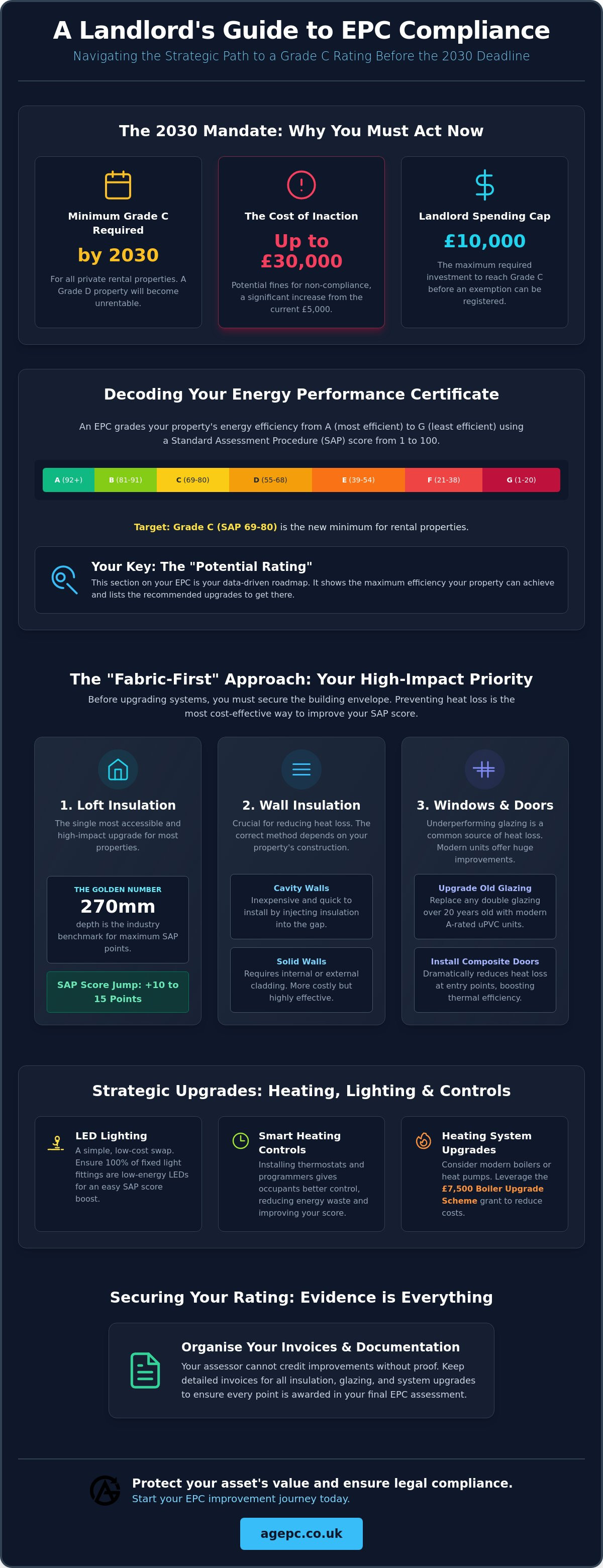
By 2030, a Grade D property won't just be inefficient; it will be unrentable. With the government's mandate for a minimum EPC Grade C fast approaching, landlords and sellers across Berkshire and Buckinghamshire are facing a significant compliance hurdle. You might feel overwhelmed by the prospect of a £10,000 spending cap or confused by the 2026 shift to new energy metrics. Learning how to improve EPC rating UK is no longer an optional "green" project. It's a tactical financial necessity to protect your property's market value and avoid potential fines of up to £30,000.
We're here to remove the friction from this process. This guide delivers a clear, cost-effective roadmap to help you achieve a higher grade without wasting capital on low-impact renovations. You'll learn how to leverage the £7,500 Boiler Upgrade Scheme, why the "fabric-first" approach is the most efficient path to a Grade C, and how the new Home Energy Model changes your assessment. We've simplified the complex regulations into actionable steps. Expect lower energy bills, full legal compliance, and a more attractive asset for your next sale or let.
Key Takeaways
- Master the SAP scoring system. Use your property's "Potential Rating" to build a clear, data-driven compliance roadmap.
- Focus on the fabric-first approach. Install 270mm loft insulation to meet the assessor's "golden number" for maximum thermal efficiency.
- Identify low-cost, high-impact upgrades. Discover how to improve EPC rating UK using simple solutions like LED lighting and smart heating controls.
- Secure your rating with proper evidence. Organise all invoices for insulation and glazing to ensure your assessor credits every improvement made.
- Protect your asset's value. Transition from a Grade D to a C now to stay ahead of the 2030 rental mandates and avoid heavy fines.
Understanding Your Energy Performance Certificate in 2026
An Energy Performance Certificate (United Kingdom) is a legal document that ranks your property's efficiency on a scale from A to G. This grade is powered by a Standard Assessment Procedure (SAP) score, ranging from 1 to 100. A higher score translates to lower energy bills and a smaller carbon footprint. In the current market, knowing how to improve EPC rating UK is the difference between a compliant asset and a legal liability.
Your certificate's "Potential Rating" is your strategic roadmap. It identifies the maximum efficiency your building can reach if you implement every recommended upgrade. For property owners in Reading and Slough, this isn't just about carbon; it's about capital. Many mortgage lenders now offer "green" products with lower interest rates for properties achieving a Grade C or higher. Improving your rating increases your property's marketability and protects its long-term valuation.
The timeline for compliance is clear. The government has established a roadmap to mandatory EPC C ratings by October 2030 for all private rentals. Early adoption is the most cost-effective move. By upgrading now, you avoid the inevitable surge in contractor fees and material shortages as the deadline approaches.
Why Your Current Rating Might Be Outdated
An EPC is valid for 10 years, but the software used to generate it (RdSAP) is updated constantly. These updates reflect changes in building regulations and energy costs. Even if you haven't touched the property, a certificate from 2017 might be inaccurate today. The carbon intensity of the UK energy grid has also shifted. As the grid becomes greener through renewables, electric heating systems often receive better scores than they did previously, whilst older gas systems may see their ratings drop under newer assessment models.
The Cost of Inaction: Fines and Rental Bans
Ignoring your EPC grade carries heavy financial risks. Current Minimum Energy Efficiency Standards (MEES) prohibit letting any property with a rating of F or G. Local authorities can issue fines of up to £5,000 for non-compliance. These penalties are expected to rise to £30,000 as the Grade C mandate takes effect. The Exemption Register serves as a last resort for landlords who cannot meet the standards due to technical limitations or the £10,000 spending cap, though qualifying for it requires rigorous professional evidence.
The Fabric-First Approach: Insulation and Glazing
Before investing in expensive low-carbon heating, you must secure the building envelope. This is the "fabric-first" philosophy. It's the most tactical way to understand how to improve EPC rating UK without wasting capital. Heat escapes through the roof, walls, and floors; stopping this loss is your primary objective. If the heat doesn't stay in, your new boiler won't help your score.
Loft insulation is the most accessible "win" for any property. Assessors look for a depth of 270mm; this is the industry benchmark for maximum SAP points. In Windsor and Maidenhead, where Victorian solid-walled properties are common, the challenge is greater. You must distinguish between cavity walls and solid walls. Cavity wall insulation is cheap and fast, whilst solid walls require internal or external cladding. Refer to the official government landlord guidance to see how these fabric improvements align with the £10,000 spending cap for compliance.
Loft and Wall Insulation: The Heavy Hitters
Increasing loft insulation from zero to 270mm can jump your SAP score by 10 to 15 points. It's a high-impact, low-cost upgrade. For solid-walled homes, external insulation is more efficient but carries a higher price tag. Internal insulation is a cost-effective alternative for terraced houses, though it slightly reduces floor space. Draught-proofing around floorboards and loft hatches provides a final, low-disruption boost to your thermal performance.
Windows and Doors: Aesthetics Meets Efficiency
The "glazing gap" is a common pitfall. If your double glazing is over 20 years old, it's likely underperforming. Modern A-rated uPVC windows offer significantly better thermal resistance than early double-glazed units. If the seals are blown or frames are warped, replacement is often necessary to secure the highest rating. High-quality composite doors also play a vital role, especially in exposed properties, by drastically reducing heat loss at the building's entry points. If you're unsure which fabric upgrade to prioritise, arranging a professional EPC survey will give you the data needed to decide.
Heating, Lighting, and Renewables: Strategic Upgrades
Once the building fabric is secure, your focus must shift to the systems that generate and manage energy. Inefficient heating is a primary reason for a low score. Upgrading an old G-rated boiler to a modern A-rated condensing model is a powerful tactic for how to improve EPC rating UK. For landlords in Slough and Reading, this change offers a rapid return on investment through increased tenant appeal. If you're ready to move away from gas, the £7,500 Boiler Upgrade Scheme grant makes air source heat pumps a strategic choice, particularly when aligned with the 2026 Domestic EPC standards.
Solar PV remains the gold standard for reaching an 'A' rating. Orientation is the deciding factor; South-facing arrays maximise SAP points, whilst North-facing panels may offer little impact on your final grade. Integrating battery storage adds further value, especially as the 2026 assessment model rewards "smart readiness". To ensure your upgrades translate into the highest possible score, book a professional EPC assessment before starting major works to identify the most effective system for your specific roof pitch.
Heating Controls and Smart Thermostats
Adding Thermostatic Radiator Valves (TRVs) to every room allows for zoned heating. This simple addition tells the SAP software that heat isn't being wasted in unoccupied spaces. Smart thermostats are also a favourite amongst local landlords. They provide precision control and high scannability for assessors, often tipping a borderline property from a D into a C. These controls offer a high-speed route to compliance with minimal installation mess.
Lighting: The Easiest Point Gain
Replace every halogen or incandescent bulb with an LED equivalent. It's the cheapest way to gain points. Ensure all bulbs are 100% LED before the assessor arrives. Your assessor must physically see the bulbs to record them, so keep the light covers off or easily accessible during the inspection. It's a small detail that prevents unnecessary point deductions.
Booking Your Professional EPC Assessment in the South East
The final step in your journey is the formal inspection. You've invested in upgrades; now you must ensure they are accurately recorded. A professional assessor doesn't just look at the property; they look for evidence. If you've installed internal wall insulation or high-spec glazing, the assessor needs proof to award the points. Without invoices or certificates, the software defaults to "assumed" values based on the age of the property. This often results in a lower score than you deserve. Learning how to improve EPC rating UK effectively always ends with a well-documented assessment.
At AG Property Services, we act as your local expert across Slough, Reading, and the wider South East. We understand the specific housing archetypes of the Thames Valley, from Victorian terraces to modern developments. We don't just provide a certificate; we offer a streamlined compliance experience. You can combine your assessment with PAT testing for landlords in Reading to tick off multiple legal requirements in a single visit. This efficiency saves you time and reduces the administrative burden of managing a rental portfolio.
The Assessment Day Checklist
Preparation is vital for a smooth inspection. Ensure the assessor has clear access to the loft hatch, the boiler, and every room in the house. If you have solar panels, have your MCS certificates ready. For any work that is now hidden, such as underfloor insulation, keep the contractor's invoice or a letter of headed paper confirming the installation. Use this checklist to avoid missed points:
- Clear access to the loft for insulation depth measurement.
- Documentation for recent window or door replacements.
- Evidence of any specialist insulation (cavity, solid wall, or floor).
- Access to the hot water cylinder and its insulation jacket.
Why Choose a Local Professional?
Local knowledge matters when evaluating property efficiency. An assessor familiar with Beaconsfield and High Wycombe knows the common construction methods of the area. This expertise ensures your report is accurate and fair. To speed up your market launch, consider booking a professional real estate photos Reading package alongside your EPC. We provide high-quality imagery and floor plans simultaneously, allowing you to list your property faster. It’s a comprehensive solution designed for the modern, tech-enabled landlord who values speed and legitimacy.
Secure Your Property's Future Value Today
Achieving a Grade C isn't just a regulatory hurdle; it's a smart investment in your asset's longevity. By prioritising the fabric-first approach with 270mm loft insulation and following up with strategic system upgrades like LED lighting, you've already mastered how to improve EPC rating UK efficiently. These steps protect you from the 2030 rental mandates and significantly reduce energy costs for your tenants or future buyers. Every point on your SAP score adds tangible value to your property in the Berkshire and Buckinghamshire markets.
Don't leave your compliance to chance. Our accredited domestic and commercial assessors provide a fast turnaround for properties in Slough, Reading, and across the South East. We offer comprehensive compliance packages that include floor plans and PAT testing to remove the friction from your property management. Book your professional EPC assessment today with AG Property Services to ensure every improvement is captured accurately in your final score. You've done the hard work; now let us help you verify the results and secure your peace of mind. Your property is a vital asset; let's make sure it's a compliant one.
Frequently Asked Questions
What is the fastest way to improve my EPC rating?
The fastest route to a higher score is installing 100% LED lighting and topping up your loft insulation to 270mm. These two actions are often completed in a single day and provide an immediate uplift in SAP points. They represent the most efficient "quick wins" for any property owner looking for rapid results before a sale or new tenancy.
Can I fail an EPC assessment?
You cannot technically fail an EPC because it is a measurement of performance rather than a pass or fail test. However, you can fail to meet the legal Minimum Energy Efficiency Standards (MEES) required to let a property. If your building scores below the current Grade E threshold, or the upcoming 2030 Grade C mandate, you face significant fines and rental restrictions.
How much does a typical EPC improvement project cost in 2026?
Government data suggests the average cost to upgrade a UK home to a Grade C is between £6,100 and £6,800. This figure depends on your property's starting point and construction archetype. Landlords should be aware of the £10,000 spending cap introduced for the 2030 compliance roadmap, which limits the financial burden of these mandatory energy efficiency improvements.
Do solar panels always improve an EPC rating?
Solar panels usually improve your score, but their effectiveness depends on roof orientation and pitch. A South-facing array provides the maximum number of SAP points, whilst a North-facing system might offer a negligible return. Assessors also look for "smart readiness" in 2026, so combining panels with battery storage can further enhance your property's final grade.
Will a new boiler definitely move my property up a grade?
A new boiler provides a significant point boost but doesn't guarantee a grade jump if the building's "fabric" is poor. If your walls and roof aren't insulated, the heat from a new A-rated boiler will still escape too quickly. Understanding how to improve EPC rating UK requires a holistic view where heating upgrades are supported by robust insulation and draught-proofing.
Important Information
The information provided in this article is for general guidance and informational purposes only and does not constitute legal, financial, or professional property advice. While AG Site Solutions aims to keep all content accurate and up to date, property regulations, landlord obligations, EPC requirements, and housing legislation may change over time.
Readers should always seek professional advice or consult the relevant authorities before making decisions relating to property compliance, tenancy matters, Energy Performance Certificates (EPCs), landlord responsibilities, or legal obligations.
Some articles may be created or assisted using AI-supported content tools and are reviewed and enhanced using real industry experience and property compliance knowledge.
For professional assistance, quotations, or compliance support, please contact AG Site Solutions directly via agepc.co.uk