
PAT Testing Frequency for Offices in Reading: The 2026 Compliance Guide
If you're still testing every office kettle and laptop annually because "that's the rule," you're likely wasting valuable budget and time. There's no one-size-fits-all law for electrical safety. Instead, the modern standard is a risk-based approach. We know that managing PAT testing frequency for offices Reading can feel like a moving target; especially when you’re trying to keep hybrid teams safe without disrupting a busy workday.
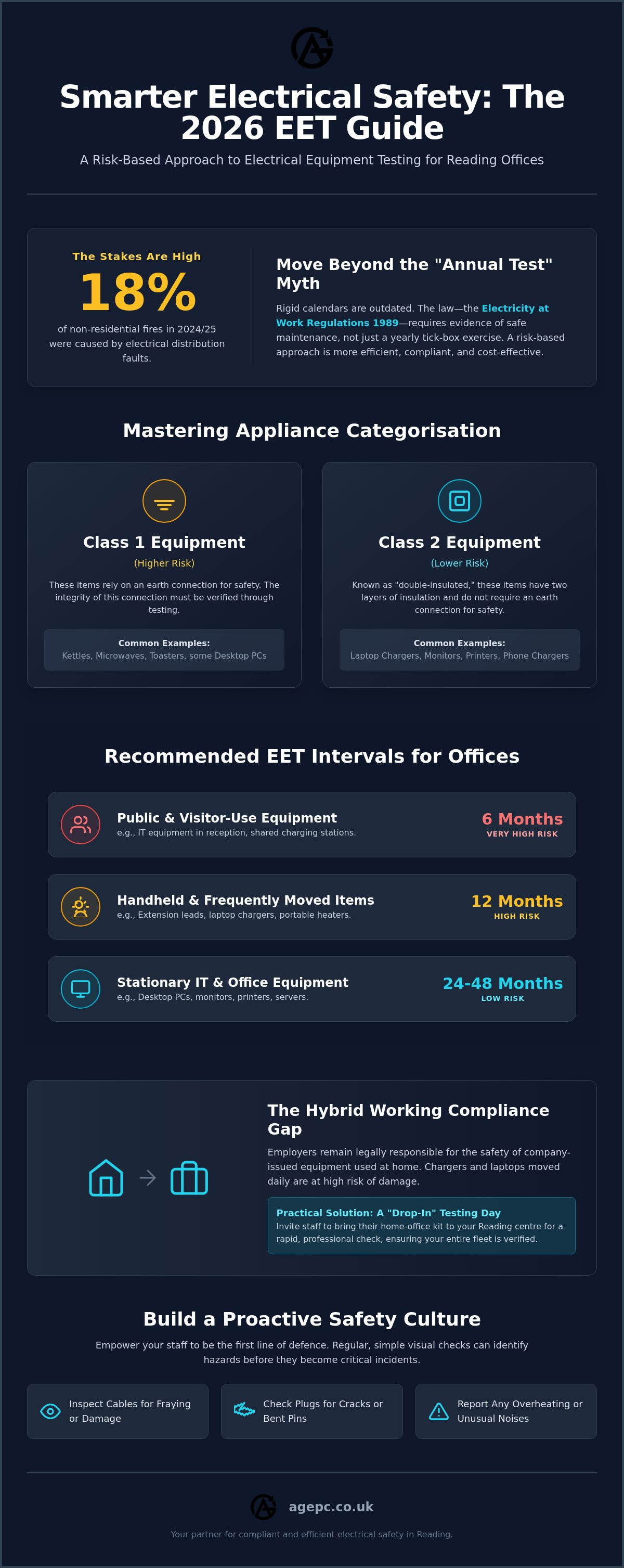
Electrical distribution faults caused 18% of non-residential fires in 2024/25, so the stakes remain high. However, legal compliance with the Electricity at Work Regulations 1989 doesn't require a rigid calendar. It requires evidence of safe maintenance. This guide provides a clear, 2026-ready schedule to help you navigate the shift towards Electrical Equipment Testing (EET). You'll discover exactly how to categorise your gear, manage lithium-ion battery risks, and maintain digital records that satisfy both insurers and the HSE. We've stripped away the confusion to give you a lean, compliant strategy for your Reading workspace.
Key Takeaways
- Move beyond the "annual testing" myth. Align your maintenance with the Electricity at Work Regulations 1989 for smarter, more efficient compliance.
- Optimise your safety schedule. Learn how to apply a risk-based approach to determine the correct PAT testing frequency for offices Reading based on equipment type.
- Master appliance categorisation. Understand the critical differences between Class 1 and Class 2 equipment to ensure every device is tested at the right interval.
- Build a proactive safety culture. Implement simple visual inspection routines that empower your staff to identify hazards like frayed cables before they cause issues.
- Minimise office downtime. Partnering with a local Reading specialist ensures rapid, professional documentation with zero friction for your team.
Understanding PAT Testing Requirements for Reading Offices
Portable appliance testing (PAT) is a systematic safety programme designed to ensure electrical equipment remains fit for purpose. It involves a series of visual inspections and electronic tests to identify defects that aren't visible to the naked eye. For business owners in the Thames Valley, maintaining a safe workspace is a non-negotiable duty of care. You're legally responsible for the safety of every person who plugs in a device on your premises.
A common misconception in Reading business circles is that every piece of equipment requires an annual test. This is a myth. The law is intentionally flexible. It requires you to maintain equipment in a safe condition, but it doesn't dictate a specific calendar interval. This flexibility allows you to tailor your PAT testing frequency for offices Reading based on actual risk rather than arbitrary dates. This approach saves you money and reduces unnecessary disruption to your team's workflow.
The Legal Framework: Electricity at Work Regulations 1989
The primary benchmark for office safety is the Electricity at Work Regulations 1989. These regulations mandate that all electrical systems and equipment are maintained to prevent danger. Whilst the Health and Safety at Work Act 1974 sets the broad standard for employee welfare, the 1989 regulations provide the specific technical requirements. PAT testing serves as your documented proof of compliance. If an incident occurs, these records demonstrate that you took reasonable steps to ensure safety. It's your primary line of defence against liability claims and regulatory fines.
Why Reading Offices Require a Bespoke Approach
Reading is a hub for high-density IT environments, particularly across Thames Valley Park and Green Park. These offices often house hundreds of monitors, servers, and laptop docks that remain stationary for years. Testing these as frequently as a high-use kitchen kettle is inefficient. However, you must also consider your insurance policy. Many providers in the UK require up-to-date testing records to validate your coverage. A bespoke approach balances these external pressures with the actual wear and tear of your equipment. For a deeper dive into the technical side of the process, see our guide on PAT testing essentials. We help you align your safety checks with the specific operational reality of your Reading office.
Determining Your Office PAT Testing Frequency
Setting a schedule based on actual risk is the most efficient way to manage workplace safety. The HSE guidance on PAT testing confirms that intervals aren't set in stone. You must evaluate the environment and usage patterns of your specific site. For instance, the PAT testing frequency for offices Reading businesses adopt should differ between a static server room and a high-traffic reception desk. Documenting this logic in a "Written Scheme of Investigation" provides a robust audit trail, proving you've considered the risks carefully.
Understanding the internal structure of your appliances is also vital. Class 1 items, such as kettles and some desktop PCs, rely on an earth connection for safety. These typically require more frequent testing than Class 2 items, like double-insulated laptop chargers, which have two layers of insulation. By categorising your inventory this way, you avoid over-testing low-risk items whilst ensuring high-risk gear remains safe.
Suggested Intervals for Common Office Equipment
Stationary equipment like PCs and monitors rarely move. Because the risk of cable damage is low, a 24 to 48-month cycle is often sufficient for these items. Conversely, IT equipment used by the public or visitors faces much higher wear. These should be checked more frequently, perhaps every six months. Handheld and frequently moved items, such as extension leads and phone chargers, are the most vulnerable. We recommend targeting 12-month intervals for these high-mobility devices to catch frayed wires early.
Hybrid Working and the "Home-Office" Compliance Gap
The rise of hybrid working has created a significant compliance gap. Employers remain legally responsible for the safety of any company-issued equipment used at home. Laptop chargers moving daily between a Reading office and a home lounge are at high risk of physical damage. A practical solution is to set up a "Drop-in" testing day. Staff bring their home-office kit into your Reading centre for a rapid, professional check. This removes friction and ensures your entire fleet is verified. If you need to organise a compliance review for your hybrid team, a local specialist can streamline the entire process without stalling your operations.
Best Practices for Maintaining Electrical Safety in the Workplace
Visual inspections are your most effective tool for preventing accidents. Research from the HSE suggests that up to 90% of electrical faults are detectable through a simple visual check. In the high-density tech hubs of Reading, where workstations are packed with monitors and daisy-chained extension leads, these checks are vital. You don't need to be an electrician to spot a hazard. Training your staff to recognise the early warning signs of wear and tear creates a continuous safety net between formal testing dates.
Adhering to The Electricity at Work Regulations 1989 requires active maintenance. This is especially true for second-hand equipment. Whilst new gear from reputable UK suppliers is typically safe to use immediately, any "pre-loved" monitors or printers must be tested before they enter your office ecosystem. This proactive stance protects your team and maintains the integrity of your PAT testing frequency for offices Reading strategy. It ensures that every device, whether a desktop PC or a communal microwave, is verified for safety before it's ever plugged in.
The Visual Inspection Checklist for Office Managers
- Socket health: Look for brown scorch marks or "arcing" signs on outlets. This indicates a loose connection or dangerous overloading.
- Cable integrity: Check that the outer insulation isn't pulled away from the plug. The coloured internal wires should never be visible to the user.
- Fuse ratings: Verify that high-draw appliances like kettles have a 13A fuse, whilst lower-power IT gear uses a 3A or 5A fuse as appropriate.
Maintaining a Compliance Log: What to Include
Digital record-keeping is the modern standard for Thames Valley businesses. If an insurer requests proof of maintenance, a simple spreadsheet might not suffice. You need a comprehensive asset register. This should track every serial number, the specific test result, and the date of the next scheduled check. If an item fails, decommission it immediately. Cut the plug off to ensure it cannot be accidentally re-used by a colleague. For those managing mixed-use premises or residential components, our guide on PAT testing for landlords in Reading offers specific advice for domestic settings within a commercial context.
Ready to secure your workspace? You can book a professional PAT test today to ensure your office meets every 2026 safety standard with zero friction.
Streamlining Compliance with Professional PAT Testing in Reading
Professional testing removes the friction from your health and safety obligations. Whilst a risk-based assessment helps you determine the ideal PAT testing frequency for offices Reading managers should adopt, executing that plan requires precision. Professional engineers use smart testing equipment with cloud connectivity to ensure your data is stored securely and accessible for any future audit. This modern, tech-enabled approach eliminates the need for bulky paper files and provides instant verification of your compliance status.
Minimising disruption is a priority for any productive workspace. Expert testers work around your team; they often test equipment in batches to ensure your staff can continue their work with minimal downtime. Beyond the test itself, you receive a professional Certificate of Compliance. This document is your gold standard for insurers and local authorities. For those looking to maximise efficiency, combining your electrical checks with other requirements like Commercial EPCs or floor plans creates a streamlined "one-stop" solution for your property management needs.
Why a Local Reading Specialist Wins
- Local Knowledge: We understand the specific access requirements and security protocols of major hubs like Green Park and Suttons Business Park.
- Rapid Response: Proximity means faster turnaround times for urgent checks; especially when new equipment arrives or after an office relocation.
- Reduced Costs: Lower travel requirements for local engineers translate into more competitive rates for your business.
- Thames Valley Expertise: Supporting a local provider strengthens the regional economy whilst ensuring you have a partner who can be on-site quickly if issues arise.
Next Steps: Booking Your 2026 Office Safety Audit
Preparation is the key to a rapid and successful audit. Before your engineer arrives, try to organise a basic asset list of your equipment. Ensure that our team has clear access to restricted areas, such as server rooms or basement plant rooms, to avoid delays. Modern office equipment often features sensitive electronics; professional testers use specific low-current tests to ensure your IT gear remains undamaged during the process. Once the audit is complete, you'll receive a detailed report highlighting any failures and a clear schedule for your next visit.
Don't let compliance become a bottleneck for your business. You can book your professional PAT testing in Reading today to secure your workspace and protect your team with absolute confidence.
Future-Proof Your Reading Office Safety
Managing electrical safety in 2026 is about intelligence, not just checklists. By shifting to a risk-based model, you protect your team and your budget. Remember that stationary IT gear often requires less frequent testing; whilst mobile equipment for hybrid workers needs closer attention. Combining regular visual inspections with a robust asset register keeps you ahead of regulatory changes and insurance requirements. This proactive approach turns a complex administrative task into a streamlined part of your business operations.
Optimising your PAT testing frequency for offices Reading ensures you stay compliant without overspending on low-risk assets. You don't have to navigate these regulations alone. Our accredited Thames Valley specialists provide a rapid, no-nonsense service designed for busy professional environments. We deliver comprehensive compliance documentation that gives you total peace of mind and keeps your focus on growth.
Secure your Reading office compliance with AG Property Services today. Let's make your workspace a safer, more efficient place to work.
Frequently Asked Questions
Is PAT testing a legal requirement for small offices in Reading?
PAT testing isn't a specific legal mandate, but maintaining safe electrical equipment is a strict requirement under the Electricity at Work Regulations 1989. For small businesses, performing these tests is the most reliable way to demonstrate compliance. It provides the documented evidence needed to satisfy health and safety inspectors and insurance providers that you've met your duty of care.
How much does PAT testing for a typical office cost in 2026?
Total costs depend on your equipment volume and the complexity of your office layout. Most providers in the Thames Valley apply a minimum call-out fee that covers an initial batch of appliances, with a tiered rate for additional items. To get an accurate figure for your PAT testing frequency for offices Reading plan, it's best to request a bespoke quote based on your specific inventory and location.
Do brand new office computers need to be PAT tested immediately?
New equipment from a reputable UK supplier shouldn't require a formal portable appliance test immediately. A thorough visual inspection is usually sufficient to ensure there's no transit damage. You should record the item in your asset register and schedule its first formal test according to the risk-based interval you've established for IT equipment in your workspace.
What happens if an item fails its PAT test in my office?
Any item that fails must be removed from service immediately. Your engineer will label the appliance as "FAILED" and provide a report detailing the specific defect. You should decommission the item by removing the plug or securing it in a locked area to prevent accidental use. You can then decide whether to have the item professionally repaired or replaced to maintain your safety standards.
Can I perform PAT testing myself if I work in an office?
You can only perform these tests if you're deemed a "competent person" with the necessary training, knowledge, and equipment. Whilst some office managers take short courses, most Reading businesses outsource the task to accredited specialists. This ensures the use of calibrated diagnostic tools and provides independent verification that holds more weight with insurers and regulatory bodies.
Does hybrid working equipment need to be brought into the office for testing?
Yes, employers are legally responsible for the safety of company equipment used at home. Chargers and laptops used in a hybrid capacity often face more physical wear than stationary office gear. Bringing these items into your central Reading location for a scheduled "drop-in" testing day is the most efficient way to maintain your safety records without the need for individual home visits.
Important Information
The information provided in this article is for general guidance and informational purposes only and does not constitute legal, financial, or professional property advice. Whilst AG Site Solutions aims to keep all content accurate and up to date, property regulations, landlord obligations, EPC requirements, and housing legislation may change over time. Readers should always seek professional advice or consult the relevant authorities before making decisions relating to property compliance, tenancy matters, Energy Performance Certificates (EPCs), landlord responsibilities, or legal obligations. Some articles may be created or assisted using AI-supported content tools and are reviewed and enhanced using real industry experience and property compliance knowledge. For professional assistance, quotations, or compliance support, please contact AG Site Solutions directly via agepc.co.uk