
What Do EPC Assessors Look For? The 2026 UK Property Guide
In the eyes of an energy audit, if an assessor cannot see your insulation, it simply does not exist. It's a frustrating reality for many UK landlords who find their modern-looking properties slapped with a disappointing 'E' or 'F' grade. You might worry about a messy inspection or feel confused about what do epc assessors look for when they arrive at your door. The truth is that an EPC assessment is a visual evidence audit. If a feature isn't visible or documented, it won't count towards your final score.
We know the stakes are high. With penalties for non-compliance now reaching up to £30,000, getting your rating right is essential for your peace of mind. This guide provides the exact checklist assessors use to grade your property in 2026. You'll discover how to prepare your home to secure higher SAP points and ensure you're ready for the mandatory 'C' rating for new tenancies in 2028. We'll walk through every inspection area, from heating systems to building fabric, so you can achieve the best possible result with zero friction.
Key Takeaways
- Master the "envelope" audit. Understand how walls, roofs, and glazing are measured to calculate your property’s 1-100 SAP score.
- Identify the specifics. Learn exactly what do epc assessors look for regarding boiler models and heating controls to maximise efficiency points.
- Avoid the "unknown" trap. Discover why missing documentation for hidden insulation often results in the most pessimistic default grades.
- Prepare for 2026 standards. Get ahead of the mandatory 'C' rating requirements for new tenancies and avoid potential £30,000 fines.
- Streamline your compliance. See how professional assessments in Slough, Windsor, and Reading remove the friction from property management.
The Building Fabric: Inspecting Walls, Roofs, and Glazing
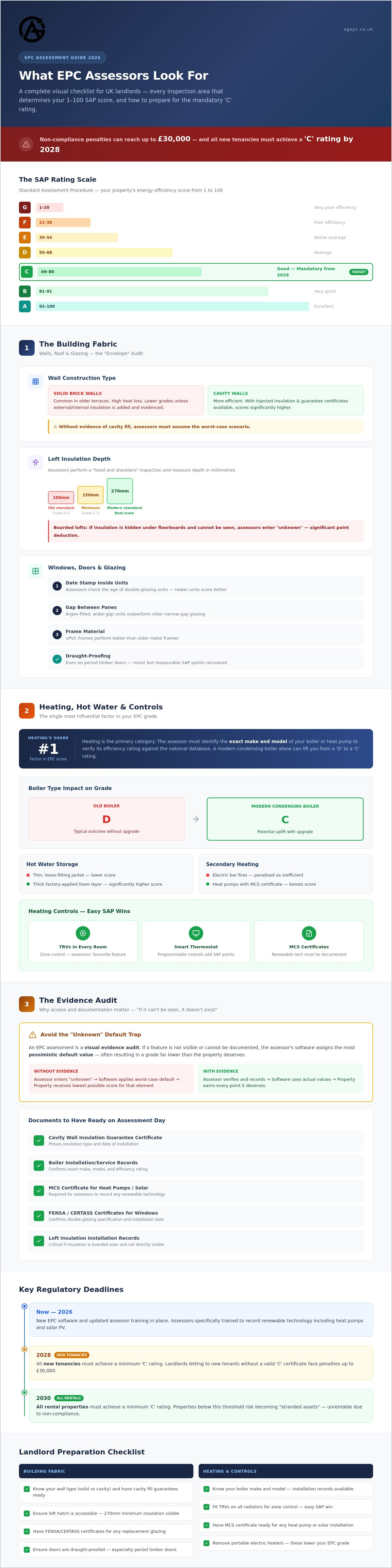
The assessment starts with the "envelope" of your property. This includes the walls, roof, and floor. It's the primary barrier between your living space and the elements. When considering what do epc assessors look for, they focus on how well this envelope retains heat. Every measurement contributes to your score on the Standard Assessment Procedure (SAP) scale. This is a 1-100 rating that dictates your final grade on Energy Performance Certificates (EPCs). A higher SAP score means a more efficient home and lower running costs.
Wall construction is a critical factor. Assessors measure the thickness of your walls to determine if they are solid brick or cavity construction. Solid walls, common in older Berkshire terraces, lose heat quickly and often receive lower grades. Cavity walls are more efficient, especially if they've been injected with insulation. If you've had cavity wall insulation installed, keep your guarantee certificates ready. Without evidence, the assessor must assume the worst-case scenario. This often results in a lower grade than the property deserves.
Loft Insulation and Roof Construction
Assessors perform a "head and shoulders" inspection of the loft. They aren't just checking for clutter; they are measuring the depth of mineral wool or foam insulation in millimetres. To achieve a modern standard, you typically need 270mm of insulation. Boarded lofts present a specific challenge. If the insulation is hidden beneath floorboards and cannot be seen, the assessor may have to enter "unknown" defaults. This often results in a significant point deduction. In semi-detached or terraced homes in Maidenhead, identifying party walls is also vital. Heat loss through these shared walls is calculated differently than external ones.
Windows, Doors, and Glazing Standards
Your windows and doors are the most obvious points of heat escape. Assessors look for the date stamp inside the double-glazing units to determine their efficiency. The gap between the panes matters. Older units with narrow gaps are less effective than modern, argon-filled windows. The frame material also plays a role. uPVC typically performs better than older metal frames. For period properties in Windsor, simple draught-proofing on original timber doors can actually claw back minor SAP points. Every small improvement counts towards reaching that essential 'C' rating. Ensure what do epc assessors look for is clearly visible to avoid being penalised by default software values.
The Heart of the Home: Heating, Hot Water, and Controls
Heating accounts for the largest portion of the EPC score. It is the single most influential factor in determining whether your property reaches a passing grade or falls into the 'E' or 'F' danger zone. When homeowners ask what do epc assessors look for, the primary heating system is the priority. The assessor must identify the exact make and model of your boiler or heat pump to verify its efficiency rating against the national database. A modern, condensing boiler can be the difference between a 'D' and a 'C' rating.
Hot water storage is equally significant. The efficiency of your water cylinder jacket impacts the "Hot Water" category of your report. A thick, factory-applied foam layer is far superior to a thin, loose-fitting jacket. This level of detail is becoming critical as we approach the 2030 roadmap. By 2030, all rental properties must meet a 'C' rating. Achieving this now prevents "stranded asset" syndrome, where a property becomes unrentable due to non-compliance. Knowing what happens during the EPC assessment allows you to make these small, high-impact changes before the inspector arrives.
Primary and Secondary Heating Sources
Your choice of secondary heating can yield surprising results. That "cosy" electric fire in the lounge might actually be lowering your EPC grade. Because electricity is often more expensive than gas per unit, the software may penalise additional electric heaters as inefficient. Conversely, the transition to heat pumps is gaining momentum. In 2026, assessors are specifically trained to record renewable technology. Ensure you have your MCS certificates available for any air-source or ground-source systems. For a deeper look at these regulations, read The Definitive Guide to Domestic EPCs.
The Power of Heating Controls
Smart controls are an easy win for SAP points. Having Thermostatic Radiator Valves (TRVs) in every room provides a significant benefit. This allows for "zone control," which is a favourite feature for assessors looking for high efficiency. Smart meters and programmable thermostats also boost the final score by proving the system isn't running unnecessarily. These small upgrades are cost-effective ways to climb the rating scale. If you are unsure about your current controls, you can arrange a domestic EPC to identify your best upgrade path.
The Evidence Audit: Why Access and Documentation Matter
Missing evidence is the single biggest cause of poor ratings. When considering what do epc assessors look for, remember that they are auditors first. If insulation is hidden behind plasterboard or under floorboards, they cannot simply take your word for it. They must enter "as built" or "unknown" defaults into the SAP software. These default values are intentionally pessimistic. They assume the worst possible efficiency for the age of the property. This often drops a home by an entire grade, turning a potential 'C' into a disappointing 'D'.
Assessors must document every claim with photographic evidence. They aren't being intrusive; they are fulfilling a regulatory requirement to prove why they assigned specific points. To avoid friction, organise a "property passport" before the visit. This is especially helpful for landlords in Slough or Reading where older properties often have undocumented upgrades. Having your paperwork ready ensures the assessor can use accurate data instead of software guesses. Ready to secure an accurate rating? Book your professional EPC assessment today to ensure your property's efficiency is fully documented.
Essential Documents for the Assessor
Having the right paperwork can significantly boost your SAP score. If you have made improvements that are no longer visible, these documents are your only way to claim those points. Ensure you have the following ready:
- Building regulations completion certificates for extensions or loft conversions.
- Invoices and warranties for cavity wall or internal wall insulation.
- MCS certificates for solar panels or heat pump installations.
- FENSA or CERTASS certificates for glazing installed after 2002.
Preparing the Property for a Smooth Inspection
Clear access is non-negotiable. The assessor needs to see the boiler, hot water cylinder, and the loft hatch. If the loft hatch is blocked by a heavy wardrobe, the insulation remains unverified. Every room must be accessible to count "fixed lighting" and heaters. If a room is locked, the software defaults to inefficient lighting for that floor area. Follow this 5-step checklist 24 hours before the visit:
- Clear all items blocking the loft hatch and boiler cupboard.
- Gather all insulation warranties and building regulation certificates in one folder.
- Ensure every room, including basements and conservatories, is unlocked.
- Replace any remaining halogen bulbs with LEDs to maximise lighting points.
- Locate the serial number on your boiler or heat pump for quick identification.
Professional EPC Assessments with AG Property Services
Accuracy matters. A rushed or inaccurate inspection can lead to a lower grade, affecting your property's value and rental potential. Our local expertise in Slough, Windsor, and Reading ensures a fair and precise assessment every time. Our team understands exactly what do epc assessors look for across various property ages, ensuring no points are left on the table. We handle everything from the physical inspection to lodging your certificate on the central government register. This end-to-end service removes the friction from your administrative tasks.
Efficiency is at our core. We offer a streamlined approach to property compliance designed for busy landlords and homeowners. In fast-moving markets like Maidenhead, time is money. By combining an EPC with professional photography and 2D or 3D floor plans, you can prepare your property for the market in a single visit. This integrated service speeds up sales and ensures your listing stands out with high-quality visuals and verified energy data.
Local Market Expertise Across the Home Counties
Property types vary significantly across the region. We provide tailored assessments for the unique build styles found in Watford, High Wycombe, and St Albans. Whether it's a period terrace or a modern apartment, we know the specific nuances of each construction method. We offer fast turnaround times to keep your property transaction on track. Beyond the certificate, we provide expert advice on the most cost-effective upgrades for your specific property type. This helps you reach a 'C' rating without unnecessary spending.
The One-Stop Compliance Solution
Compliance shouldn't be a headache. We provide a comprehensive suite of services to meet all your legal requirements. This includes integrating EPCs with PAT testing for landlords in Reading. Managing multiple contractors is time-consuming; we act as your single point of contact for energy reports, safety testing, and property marketing materials. Our professional floor plans and photography complement your energy report to provide a complete property profile. Book your assessment today to secure your 2026 compliance status and gain total peace of mind.
Secure Your Property’s Future Rating Today
Understanding what do epc assessors look for is the first step toward a compliant, efficient property. Your final grade depends on visible, verifiable evidence. If an assessor cannot see your insulation or identify your heating controls, you will lose valuable SAP points to pessimistic software defaults. By organising your property "passport" and prioritising high-impact upgrades like smart controls, you protect your investment against the tightening MEES regulations of 2028 and 2030.
Don’t leave your compliance to chance. We’ve been accredited domestic and commercial assessors since 2012, providing a fast, tech-enabled service across Slough, Reading, and the Home Counties. Whether you need a standalone report or a comprehensive compliance package including PAT testing and professional floor plans, we remove the friction from the process. Book your professional EPC assessment with AG Property Services today to ensure your property is graded accurately and fairly. It’s time to move forward with confidence and total peace of mind.
Frequently Asked Questions
How long does an EPC assessment actually take?
An average domestic EPC assessment takes between 30 and 60 minutes to complete on-site. The exact duration depends on the size and complexity of your property. A studio flat might take less time, whilst a large detached house with multiple extensions requires a more detailed walk-through. The assessor must measure every room and photograph key features, so ensuring clear access helps speed up the process.
Do I need to be present during the EPC inspection?
You don't need to be present as long as the assessor can access all areas of the property. Many landlords arrange for an agent to provide keys or leave them in a secure lockbox. However, being available can be helpful if the assessor has questions about what do epc assessors look for regarding hidden insulation or recent boiler upgrades. Providing a folder of documents beforehand is a great alternative to being there in person.
What is the most common thing that lowers an EPC rating?
A lack of documentary evidence for "invisible" improvements is the most common reason for a lower rating. If an assessor cannot see cavity wall insulation or loft lagging, they must use "unknown" software defaults. These defaults assume the lowest possible efficiency for the property's age. Old, non-condensing boilers and a high number of halogen light bulbs also frequently drag down the final SAP score.
Can an EPC assessor fail my property?
An assessor cannot "fail" a property; they simply provide a rating from A to G. However, your property may fail to meet the Minimum Energy Efficiency Standards (MEES) required for renting. Currently, a property must be rated 'E' or above to be legally let. By 2028, this requirement rises to a 'C' for new tenancies. If your rating falls below these thresholds, you must make improvements to remain compliant.
Does the assessor need to look in every room?
Yes, the assessor must enter every room in the property to ensure an accurate calculation. They need to count the number of fixed light fittings and identify the type of heaters in each space. Accessing every area, including conservatories and utility rooms, prevents the software from applying pessimistic default values. If a room is locked, the assessor may have to assume it contains inefficient heating or lighting, which lowers your score.
How long is the EPC certificate valid for after the assessment?
An EPC certificate is valid for 10 years from the date of issue. You can use the same certificate for multiple tenancies or sales during this period. However, if you make significant energy improvements, such as installing a heat pump or new glazing, it's wise to commission a new assessment. A fresh certificate reflects the current efficiency of your home and can help secure a higher market value or better mortgage rates.
Important Information
The information provided in this article is for general guidance and informational purposes only and does not constitute legal, financial, or professional property advice. While AG Site Solutions aims to keep all content accurate and up to date, property regulations, landlord obligations, EPC requirements, and housing legislation may change over time.
Readers should always seek professional advice or consult the relevant authorities before making decisions relating to property compliance, tenancy matters, Energy Performance Certificates (EPCs), landlord responsibilities, or legal obligations.
Some articles may be created or assisted using AI-supported content tools and are reviewed and enhanced using real industry experience and property compliance knowledge.
For professional assistance, quotations, or compliance support, please contact AG Site Solutions directly via agepc.co.uk