
What Lowers an EPC Rating? 7 Critical Factors Dragging Down Your Property Score in 2026
What if your property is actually more efficient than its certificate claims? Many landlords and homeowners are shocked to find their scores plummeting because of missing paperwork rather than poor insulation. Understanding what lowers an EPC rating is no longer optional. It's a financial necessity. With the 2030 EPC C requirement for rental properties fast approaching, you can't afford to be penalised by "assumed" failures. Often, you lose points simply because an assessor couldn't verify your cavity wall insulation or your boiler's exact model.
It's frustrating to face property devaluation or potential MEES fines when you've already invested in your building. We understand the anxiety of navigating the new 2026 EPC methodology and the pressure to remain compliant. This guide promises to reveal the specific inefficiencies and documentation gaps that actively drag down your score. You'll learn how to bridge these gaps and prepare for your next assessment with confidence. We’ll preview the seven critical factors you need to address, from fabric performance to the smart readiness metrics that now dictate your property's market value.
Key Takeaways
- Learn why missing documentation often triggers an "assumed" penalty, forcing assessors to record the worst possible performance for your property.
- Identify the structural inefficiencies, such as old G-rated boilers and uninsulated walls, that represent exactly what lowers an EPC rating most significantly.
- Discover how to prepare for the 2030 EPC C requirement by tackling high-impact upgrades like smart heating controls and draught-proofing.
- Gain a clear checklist of "quick wins," including LED lighting and cylinder insulation, to boost your score with minimal upfront investment.
- Understand how the 2026 EPC methodology shift prioritises fabric performance, making wall and loft insulation more critical than ever for compliance.
Understanding the EPC Scale: Why Your Property Score Might Be Dropping
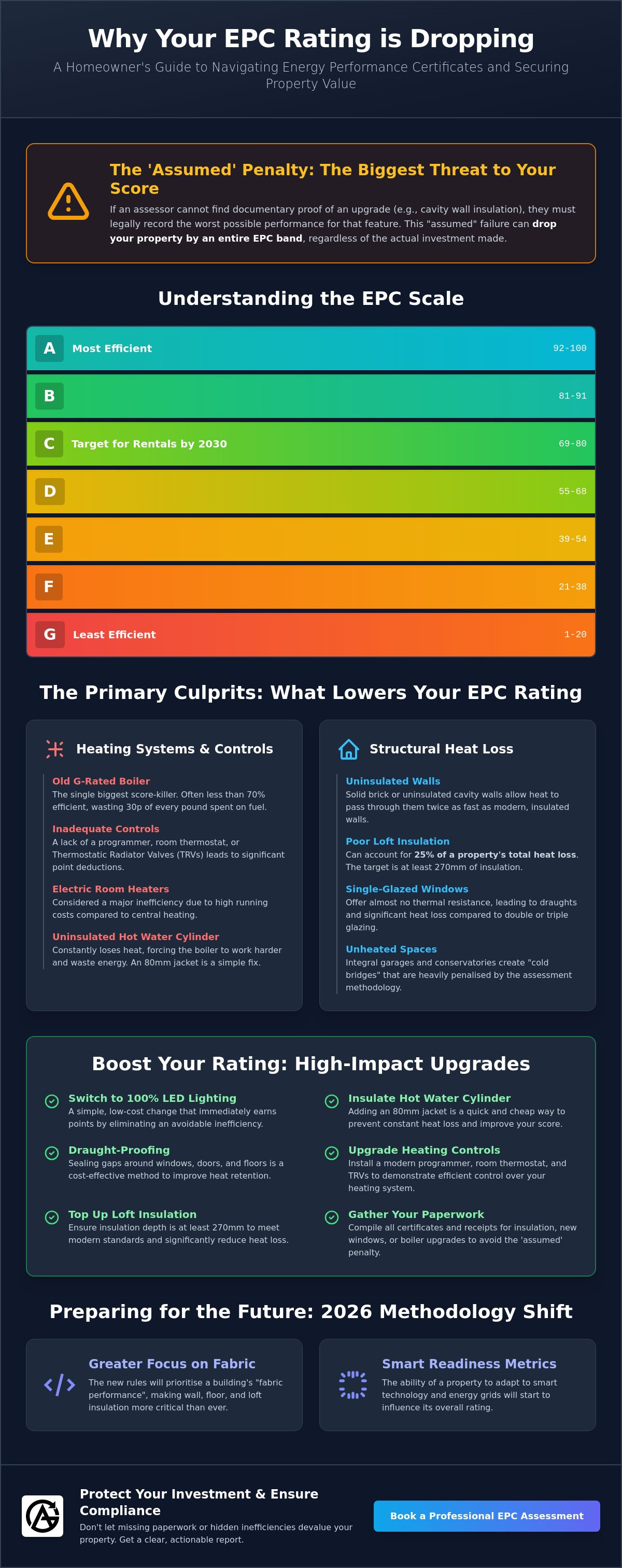
The Energy Performance Certificate (EPC) operates on a strict A to G scale. An 'A' rating signifies peak efficiency whilst a 'G' rating indicates a property is haemorrhaging heat and money. Points are weighted heavily towards your building's fabric and heating systems. If your loft insulation is thin or your windows are draughty, your score will suffer. A high Environmental Impact Rating is also vital. This metric tracks carbon dioxide emissions. It works alongside the energy efficiency score to determine your final grade. High emissions often lead to a lower overall band, even if your bills are relatively low.
What lowers an EPC rating most often is a lack of transparency. The methodology is designed to be cautious. If an assessor cannot visually verify a feature, they must assume the worst-case scenario. This "assumed" penalty can drop a property by an entire band. By October 2026, these criteria will tighten further. The focus will shift heavily towards fabric performance and smart readiness. Older properties that rely on outdated tech will find it harder to stay amongst the higher bands without significant intervention.
The Role of SAP and RdSAP in Your Rating
SAP methodology is the government-approved system for energy audits. For existing homes, assessors use RdSAP. This is a "reduced data" version that relies on the property's age and type to make inferences. The software algorithms often penalise older dwellings that haven't been retrofitted. Without proof of upgrades, the system defaults to the lowest efficiency standards of the era the house was built. This makes documentation your best defence against a failing score.
Why a Low Rating Matters in the 2026 Market
A poor score is a direct threat to your income. Under the latest Minimum Energy Efficiency Standards (MEES), rental eligibility is tied to hitting specific targets. Properties in high-demand areas like Beaconsfield or Slough face lower valuations if they fall below the expected threshold. Buyers and tenants now prioritise low running costs. For a deeper look at these shifting requirements, read The Ultimate UK Property Compliance Roadmap 2026: A Landlord’s Guide. It outlines the path to total compliance and protects your investment value.
The Primary Culprits: Structural and Systemic Factors That Lower EPC Ratings
Identifying what lowers an EPC rating often starts with your primary heating source. An old G-rated boiler is the single biggest score-killer. These units are often less than 70% efficient. This means 30p of every pound spent on gas is wasted. Modern A-rated condensing boilers or heat pumps are now the benchmark. If you're still using traditional incandescent bulbs, you're also losing easy points. Even in 2026, the official government guidance on EPCs penalises high-energy lighting because it's an avoidable inefficiency.
Heating Systems and Inadequate Controls
Electric room heaters are a major red flag for assessors. They are far more expensive and less efficient than central heating. Lack of control is another issue. If your home doesn't have a programmer, room thermostat, or Thermostatic Radiator Valves (TRVs), your score will drop. Knowing what lowers an EPC rating helps you avoid the hot water cylinder trap. An uninsulated tank loses heat constantly. This forces your boiler to work harder than necessary. Adding a simple 80mm jacket is a quick way to stop this drain.
Structural Heat Loss: Walls and Roofs
Your property's "envelope" determines how well it retains heat. Older Slough terraces with solid stone or brick walls struggle significantly compared to modern cavity wall builds. Solid walls allow heat to pass through twice as fast. Heat loss through the roof can account for 25% of a property’s total energy waste. If your loft has less than 270mm of insulation, you're effectively throwing money away. Unheated spaces like integral garages or conservatories also drag down the score. These areas create cold bridges that the SAP methodology penalises heavily. Single-glazed windows are equally problematic. They offer almost no thermal resistance compared to modern double or triple glazing.
If you aren't sure where your property stands, booking a professional EPC assessment is the first step toward a better rating.
The 'Assumed' Penalty: How Missing Evidence Ruins EPC Scores
A primary driver of what lowers an EPC rating isn't just poor infrastructure. It's lack of proof. EPC assessors operate under strict auditing rules. If they cannot see an improvement or verify it with paperwork, they must record the worst possible performance. This is the 'Assumed' rule. It often results in modernised properties receiving the same low score as a house that hasn't been touched in forty years. Concealed improvements are particularly vulnerable. Internal wall insulation or underfloor insulation is often invisible once completed. Without a certificate or invoice, it simply doesn't exist in the eyes of the SAP software.
Preparing Your Compliance Folder
Efficiency requires organisation. To avoid default penalties, keep a dedicated folder of evidence. You should include:
- MCS Certificates: Essential for solar panels or heat pumps.
- FENSA or Certass: Proof of window thermal performance.
- Invoices and Building Regs: Vital for proving the age of extensions or roof upgrades.
Proving the exact age of a property extension is crucial. Without proof, the software assigns a default age-band that assumes lower building standards. For a complete breakdown of how to manage these details, see The Definitive Guide to Domestic EPCs. Having this data ready ensures your rating reflects reality whilst protecting your asset's value.
Physical Access Issues During Assessment
Speed and transparency are key to a successful audit. A locked loft hatch or a crawl space blocked by heavy furniture triggers an automatic "no access" result. This leads to a default "uninsulated" rating. Ensure your assessor has a clear line of sight to the boiler, hot water cylinders, and all utility meters. If they can't see the thickness of your loft insulation, they can't award you the points for it. Don't let a simple padlock drag down your score. Book your EPC assessment today and ensure your property gets the credit it deserves.
Reversing the Slide: Strategic Steps to Raise Your Rating Before 2030
Stopping the points drain requires a tactical approach. You don't always need a five-figure renovation to see results. Start with the "quick wins" that assessors look for first. Switching to 100% LED lighting is the easiest way to gain points. It's cheap, fast, and immediately visible. Insulating your hot water tank is another high-impact move. A thick jacket prevents heat loss whilst signalling to the assessor that you're managing energy waste actively. Understanding what lowers an EPC rating allows you to target these specific vulnerabilities before they become financial liabilities.
Medium-term upgrades should focus on precision. Installing smart heating controls and draught-proofing doors stops heat escaping. These measures improve the "fabric performance" metric that the 2026 methodology prizes. Whilst some competitors focus solely on expensive windows, knowing what lowers an EPC rating helps you see that insulation and controls are often more vital for a 'C' grade. For long-term security, consider renewable energy. Solar PV panels or air-source heat pumps significantly reduce carbon emissions. Once your upgrades are complete, use professional floor plans and photography to ensure your improved rating translates into a higher market value.
Prioritising High-Impact Improvements
Check the "Recommendations" section of your current certificate. This list identifies the cheapest points-per-pound upgrades specific to your home. Loft insulation is a frequent winner. Aim for a thickness of 270mm to achieve maximum points. If you're unsure where to begin, organise a professional Domestic EPC assessment. This benchmarks your progress and prevents you from spending money on upgrades that don't shift your score.
The Road to EPC C for Landlords
Landlords in Reading and Windsor face a hard deadline. By 2030, all rental properties must hit a minimum 'C' rating. Achieving this requires a joined-up strategy. Combine your energy check with PAT testing to create a comprehensive compliance audit in a single visit. This efficiency saves time and ensures your property is both safe and energy-efficient. Ready to secure your property's future? Book your Domestic EPC with AG Property Services today and stay ahead of the regulations.
Secure Your Property’s Future with a Compliance Audit
A low score is often a symptom of missing information rather than just old brickwork. We’ve explored how the 'Assumed' rule and inefficient heating systems represent exactly what lowers an EPC rating in the current market. By October 2026, the criteria for compliance will only get stricter. You need an accurate benchmark now to prepare for the 2030 EPC C target. Documentation is no longer optional; it's your most effective tool for protecting your property's value.
Don't let missing certificates or inaccessible loft hatches devalue your asset. Our accredited assessors serve Slough and Reading with over 14 years of property compliance expertise. We provide transparency and speed, offering same-day certificate options to keep your transactions moving. Take control of your rating today. Book your professional Domestic EPC assessment with AG Property Services to identify your score-killers and start your path to a more efficient property. You've got the knowledge; now it's time for action. Your property's potential is within reach.
Frequently Asked Questions
Can a messy house lower my EPC rating?
No, a messy house does not directly affect your score. EPC assessors focus on the building's fabric and fixed heating systems rather than your furniture or cleanliness. However, extreme clutter can block access to key areas like the loft hatch, boiler, or hot water cylinder. If the assessor cannot inspect these features, they must record "no access," which triggers the worst-case "assumed" penalty and drags down your rating.
Does having a smart meter improve my EPC score?
Having a smart meter does not improve your EPC score. The assessment measures the energy potential of the property's physical infrastructure, not your actual energy consumption or monitoring habits. Whilst smart meters are excellent for tracking usage, they don't change how your home retains heat. To gain points, you should focus on smart heating controls, such as thermostats and Thermostatic Radiator Valves (TRVs), which actively manage the building's efficiency.
Will an old boiler always result in a failing EPC grade?
An old boiler is a primary example of what lowers an EPC rating, but it doesn't guarantee a failing grade. A property with an inefficient heating system can still achieve a passing score if it has exceptional insulation and modern double glazing. However, the boiler's inefficiency acts as a significant handicap. You’ll often need to over-compensate with other high-impact upgrades to reach the desired band whilst keeping the old unit in place.
What is the quickest way to improve a property rating from D to C?
The fastest route is usually a combination of low-cost "quick wins." Topping up loft insulation to the recommended 270mm is often the most effective points-per-pound upgrade. Combine this with switching 100% of your bulbs to LEDs and adding a thick insulation jacket to your hot water cylinder. These three steps are relatively inexpensive and can often provide the final points needed to bridge the gap between a high D and a low C.
Do I need a new EPC if I have only made small changes like LED bulbs?
You aren't legally required to get a new EPC for small changes, as certificates remain valid for 10 years. However, if you are a landlord aiming to meet the 2030 MEES requirements, commissioning a new assessment is vital. A fresh audit officially records your improvements, ensuring your property's rating is accurate for the latest regulations. This protects your rental eligibility and ensures your market valuation reflects the property's true efficiency.
Important Information
The information provided in this article is for general guidance and informational purposes only and does not constitute legal, financial, or professional property advice. While AG Site Solutions aims to keep all content accurate and up to date, property regulations, landlord obligations, EPC requirements, and housing legislation may change over time.
Readers should always seek professional advice or consult the relevant authorities before making decisions relating to property compliance, tenancy matters, Energy Performance Certificates (EPCs), landlord responsibilities, or legal obligations.
Some articles may be created or assisted using AI-supported content tools and are reviewed and enhanced using real industry experience and property compliance knowledge.
For professional assistance, quotations, or compliance support, please contact AG Site Solutions directly via agepc.co.uk