

Understanding EPC Recommendations UK: A Strategic Guide to Improving Your Rating
What if your property’s most expensive upgrade is actually the one you don’t need? With the government mandating a move to EPC Band C by October 2030, many landlords feel trapped between technical jargon and the fear of overspending. Understanding EPC recommendations UK is no longer a luxury; it’s a vital commercial strategy. You need clarity on which fabric-first improvements actually move the needle on your SAP score without draining your bank account.
We agree that the constant shift in government regulations feels overwhelming and confusing. This guide promises to strip away that friction and provide a cost-optimised roadmap for your property. You’ll learn how to prioritise your improvements, navigate the £10,000 investment cap, and master the new smart readiness metrics to ensure your certificate is both valid and competitive.
Key Takeaways
- Prepare for the 2030 Roadmap by learning why an EPC Band C is the new essential standard for all UK landlords.
- Gain a strategic edge by understanding EPC recommendations UK to bridge the gap between your current score and your property's maximum potential.
- Pinpoint high-impact "quick wins" that deliver significant rating improvements for a minimal financial investment.
- Protect your rating by organising an "Evidence Pack" of warranties and invoices to ensure your assessor doesn't rely on restrictive default values.
- Streamline your compliance by integrating professional EPC assessments with PAT testing and high-quality floor plans.
Navigating the 2030 Roadmap: Why EPC Recommendations Matter Now
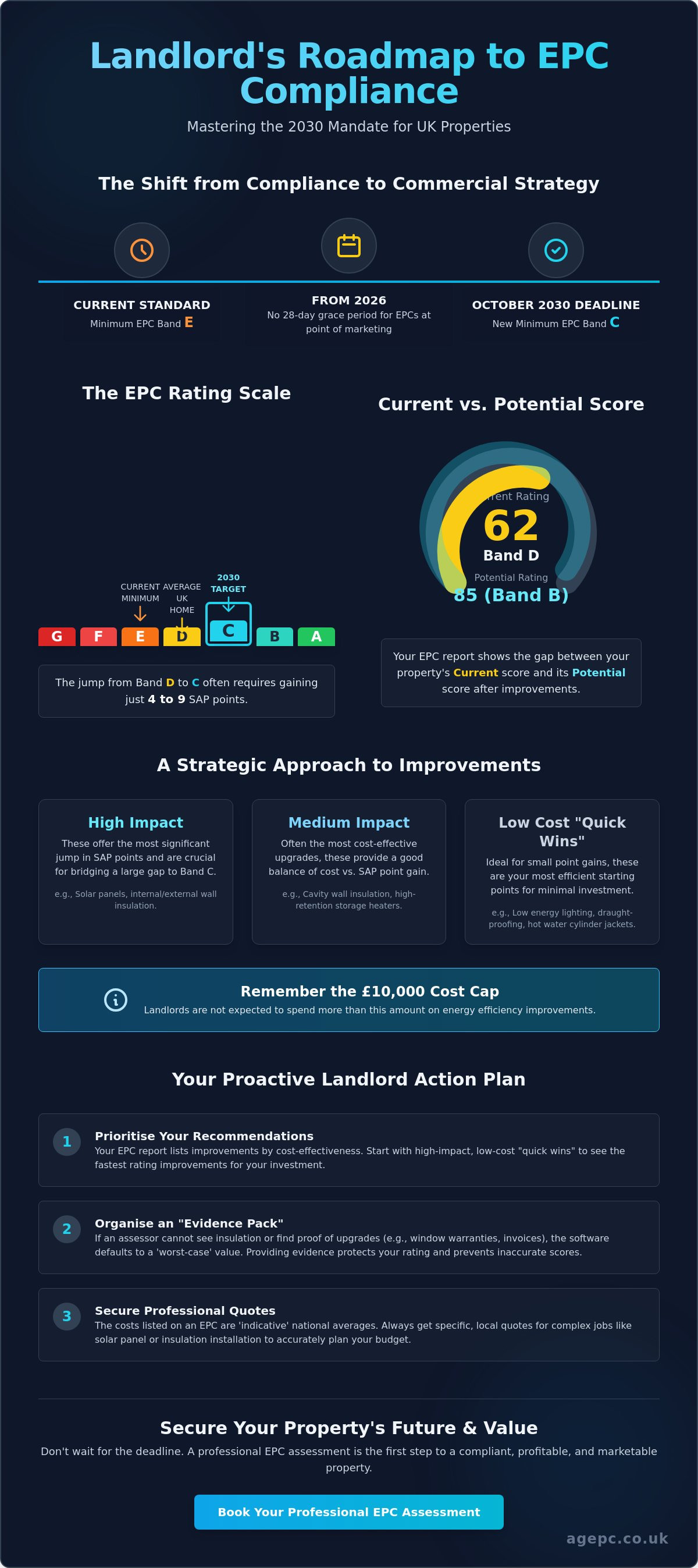
The UK's energy landscape is shifting rapidly. For property owners, understanding EPC recommendations UK is no longer a minor administrative task; it is a critical commercial strategy. Currently, the Minimum Energy Efficiency Standard (MEES) for privately rented properties in England and Wales is an EPC rating of E. However, the government's 2030 Roadmap has fundamentally changed the horizon. By October 2030, all privately rented homes must reach EPC Band C. This transition effectively makes "C" the new "D." It is the new baseline for a viable, legal, and profitable property asset.
Ignoring these recommendations carries significant financial risk. Local authorities can issue substantial fines for MEES non-compliance. Beyond legal penalties, a poor rating turns your property into an unrentable asset as deadlines approach. In competitive markets like Reading, Slough, and High Wycombe, energy performance is now a major factor in property valuation. An Energy Performance Certificate (EPC) provides the specific roadmap you need to protect your investment. Following these steps ensures your property remains marketable whilst avoiding the stress of last-minute, expensive retrofits.
The Shift from Compliance to Value
Energy efficiency is now a primary filter for modern buyers and tenants. High energy bills are a deterrent; a high EPC score is an attraction. This demand directly influences property value. Proactive improvements also unlock financial benefits like "Green Mortgages." These products offer lower interest rates for properties with high ratings, reducing your long-term debt costs. Investing in efficiency now is far more cost-effective than emergency repairs. It allows you to plan your budget and take advantage of the £10,000 cost cap for landlords.
Understanding the MEES Regulations in 2026
The rules are tightening well before the 2030 deadline. As of 2026, the government has eliminated the 28-day grace period for certificates. You must have a valid EPC at the exact point of marketing your property for sale or rent. Whilst some exemptions exist, they are becoming harder to justify and often only provide temporary relief. The Renters Reform Bill also reinforces the push for higher living standards, making energy performance a central pillar of property quality. To stay ahead of these legislative changes, consult The Ultimate UK Property Compliance Roadmap 2026 for a comprehensive breakdown of your obligations.
Decoding the Recommendations Report: SAP Scores and Impact Ratings
Your certificate is more than a simple letter grade. It is a data-driven output of the Standard Assessment Procedure (SAP). This is the UK's official methodology for measuring energy performance. It uses a mathematical model to assess how much energy your property consumes. By understanding EPC recommendations UK, you can see exactly how the software calculated your current score. The report highlights two figures: your 'Current' rating and your 'Potential' rating. The current score reflects your property’s status today. The potential score shows what you can achieve if you implement every suggested improvement.
Assessors categorise these suggestions as 'Low', 'Medium', or 'High' impact. High-impact recommendations offer the most significant jump in SAP points. It's vital to note that the costs listed are 'indicative.' They represent national averages rather than specific local quotes. For complex installations like solar panels or internal wall insulation, always seek professional prices. If you need an accurate baseline for your property, a professional domestic EPC provides the expert data you need to move forward with confidence.
The EPC Rating Scale Explained
The rating scale operates on a 1 to 100-point system. These points are divided into letter bands from A to G. Most existing dwellings in England and Wales currently sit in Band D, typically scoring between 60 and 65. To meet the 2030 Roadmap requirements, you must reach Band C, which starts at 69 points. Moving from a D to a C often requires gaining just 4 to 9 points. You will also notice a 'Primary Energy Indicator.' This metric calculates the energy used to produce the power for your home, providing a deeper look at your carbon footprint beyond just your utility bills.
Prioritising the Recommendations List
The report typically lists improvements in order of cost-effectiveness. The top item is usually your most efficient starting point. A common pitfall for owners is the 'Assumed' status. If an assessor cannot physically verify insulation or find a warranty for your glazing, the SAP software defaults to a 'worst-case' value based on the property's age. This is why official government guidance on EPCs highlights the necessity of having your documentation ready. Finally, review the 'Estimated energy costs' section. It forecasts your potential savings over three years, allowing you to calculate the real-world return on investment for each upgrade.
High-Impact vs. Low-Cost: A Strategic Approach to Improvements
Improving your rating doesn't always require a massive budget. When you are understanding EPC recommendations UK, the first step is separating theoretical SAP gains from your actual bank balance. Some upgrades offer a high point-to-pound ratio, whilst others are long-term investments in the property's fabric. You need to identify which "Quick Wins" can move your score closer to a C rating for less than £500. This strategic approach prevents wasted capital on unnecessary renovations and ensures your property remains compliant with the 2030 roadmap.
The distinction between theoretical gains and real-world savings is vital. For instance, SAP software heavily rewards the presence of modern heating controls. Even if you don't replace the boiler, adding a simple room thermostat can boost your score. Similarly, draught-proofing is often overlooked but provides an immediate increase in the "Fabric Performance" metric introduced in the 2026 EPC updates. It's about being surgical with your upgrades rather than taking a scattergun approach.
The "Quick Win" Checklist
- 100% LED Lighting: Replace every bulb with a low-energy alternative. It's the cheapest way to gain points instantly.
- Hot Water Cylinder Insulation: A thick 80mm jacket costs very little but stops significant heat loss.
- Thermostatic Radiator Valves (TRVs): These allow for room-by-room control, which the SAP model rewards as a more efficient heating behaviour.
- Professional Draught-Proofing: Seal gaps around older timber windows and doors, particularly in period properties across Windsor and Maidenhead.
Structural Upgrades for Maximum Gains
If quick wins aren't enough to reach Band C, you must look at structural fabric improvements. The hierarchy of insulation is clear: start with the loft. Increasing loft insulation to at least 270mm is the most effective way to trap heat. Cavity wall insulation follows as a secondary priority. If your property uses a gas boiler, ensure it is paired with "Load Compensating" or "Weather Compensating" controls to receive full credit on your certificate.
In 2026, Solar PV has a massive impact on scores due to the new "Smart Readiness" metric. Whilst the upfront cost is higher, the SAP points gained are substantial. For those considering heat pumps, the government's Boiler Upgrade Scheme now provides grants of £7,500. This makes the transition to electric heating more viable. Always remember that the maximum required investment for landlords is capped at £10,000, ensuring your path to compliance is financially managed and predictable.
Preparing for Success: How to Organise Your Property for the Assessor
An assessment is only as accurate as the data provided. If an assessor cannot physically verify an upgrade, the SAP software triggers "Default" values based on the building's age. These defaults are almost always less efficient than the actual performance of a modernised home. By understanding EPC recommendations UK, you realise that preparation is the difference between a Band D and a Band C. You must prove the presence of every improvement to ensure your score reflects reality. This is particularly urgent now that the 28-day grace period for marketing has been removed; your property must be compliant the moment it hits the market.
Documenting hidden works is your biggest priority. If you have installed internal wall insulation or underfloor insulation, it is now invisible to the naked eye. The assessor cannot take your word for it. They require high-quality photographs of the installation process or signed invoices from the contractor. Without this evidence, the property is treated as having uninsulated walls, which severely penalises your final rating. Gathering these details beforehand removes friction and ensures a rapid, accurate assessment. To get started with a precise evaluation, you can book your domestic EPC through our streamlined platform.
The Documentary Evidence Pack
Create a physical or digital folder containing every relevant certificate and invoice. If your loft is boarded over, the assessor cannot measure the insulation thickness. An invoice stating the depth and type of material used allows them to override the default settings. You should also include:
- MCS Certificates: Essential for solar PV, battery storage, or heat pump installations.
- FENSA or CERTASS: Required for all window and door upgrades to prove U-values.
- Boiler Commissions: Documentation confirming the exact model and the presence of advanced controls.
- Warranties: Any paperwork for recent structural energy improvements.
Assessment Day Logistics
Efficiency on the day helps the assessor focus on the technical details. Ensure the gas and electricity meters are easily accessible and not blocked by storage. You must also provide safe access to the loft hatch. If the hatch is located in a cupboard or behind furniture, clear the area before the appointment. Mention any "unusual" features early, such as underfloor heating or high-heat retention storage heaters. These systems require specific data entries to be credited correctly. A well-prepared property leads to a faster turnaround and a more favourable, compliant certificate.
Securing Compliance: Professional EPC Assessments in the Thames Valley
Local expertise is the final piece of the puzzle. In the Thames Valley, property archetypes vary significantly from one street to the next. You might be managing a period cottage in Windsor, a Victorian terrace in Reading, or a modern high-rise apartment in Slough. Each building style presents unique challenges for energy efficiency. Understanding EPC recommendations UK within this regional context ensures your improvements are both practical and cost-effective. AG Property Services provides the grounded, authoritative expertise needed to navigate these differences. We don't just provide a certificate; we offer a clear path to compliance and long-term asset value.
Our process is built for speed and transparency. We remove the friction of complex administrative tasks by acting as your modern, tech-enabled partner. By booking a professional assessment now, you benchmark your starting point and gain a clear priority list for the 2030 roadmap. This proactive approach is the most efficient way to protect your property’s marketability. By understanding EPC recommendations UK, you can transform a technical report into a strategic asset that attracts better tenants and secures higher valuations. We pride ourselves on being the most convenient and reliable option in a crowded market.
Why Choose AG Property Services?
We understand the pressure of tight listing deadlines. Whether you are prepping a traditional home in High Wycombe or a commercial unit in Slough, our team delivers fast turnaround times. This keeps your property schedule on track and reduces the anxiety caused by changing regulations. Our assessors are deeply knowledgeable about the local housing stock and the specific requirements of the Thames Valley market. For a deeper dive into how these ratings impact your bottom line, see The Definitive Guide to Domestic EPCs: Compliance, Ratings, and Value in 2026.
Beyond the Certificate: Integrated Compliance
Efficiency is at the heart of our service. Why manage multiple contractors when you can use a "one-stop" solution? We offer a comprehensive suite of services designed to get your property ready for market in the shortest amount of time. This integrated approach ensures consistency across your compliance documents and property marketing materials.
- Combine your EPC with Professional Property Photography to attract high-quality tenants instantly.
- Ensure your electrical safety is fully documented with PAT Testing for all provided appliances.
- Include 2D and 3D Floor Plans to provide a complete, modern view of the property layout.
- Request Property Inventory Reports to protect your investment from the start of a tenancy.
Contact our Slough-based team today for a comprehensive quote. We are ready to help you master your EPC recommendations and ensure your property is fully compliant and market-ready.
Future-Proof Your Property Portfolio Today
The 2030 roadmap is no longer a distant target. Reaching EPC Band C is now a commercial necessity for landlords and sellers across the Thames Valley. Success hinges on two vital factors: prioritising high-impact, low-cost "quick wins" and providing clear documentary evidence to your assessor on the day. By understanding EPC recommendations UK, you eliminate the guesswork and avoid the financial trap of expensive, unnecessary renovations.
AG Property Services provides the professional expertise you need to navigate these regulatory changes with confidence. We have been serving Slough, Reading, and Windsor since 2012. Our accredited domestic and commercial assessors deliver rapid turnaround times to ensure your property listing stays on schedule. Our tech-enabled approach removes the friction from complex compliance tasks, letting you focus on your next property investment.
Book your accredited EPC assessment with AG Property Services today to secure an accurate, compliant benchmark for your property. Take the first step toward a higher-value, energy-efficient asset with a partner who values your time.
Frequently Asked Questions
How long does an EPC assessment take for a typical 3-bed house?
An assessment for a standard three-bedroom house usually takes between 45 and 60 minutes. The exact duration depends on the complexity of the property and the ease of access to the loft and heating systems. Our assessors work efficiently to minimise disruption whilst ensuring every data point is accurately captured for your report.
Can I fail an EPC assessment?
You cannot technically fail an assessment, but your property can fail to meet legal standards. Every property receives a rating from A down to G. If you are a landlord and your property scores an F or G, you are currently in breach of MEES regulations and must improve the rating to at least an E to let the property legally.
Do I need a new EPC if I install a new boiler?
You aren't legally required to get a new certificate until your current 10-year EPC expires. However, commissioning a new assessment is highly recommended after major upgrades. A modern boiler significantly boosts your SAP score. Updating your certificate is a key part of understanding EPC recommendations UK and ensuring your property's market value is fully realised.
How much does it cost to improve an EPC rating from D to C?
The cost depends entirely on your property's specific fabric and existing systems. Many owners reach Band C by focusing on "quick wins" like LED lighting and loft insulation, which are relatively inexpensive. For more extensive works, the government has set a maximum investment cap of £10,000 for landlords to reach the required standards.
What is the most important recommendation on an EPC?
Insulation is almost always the most critical recommendation for any UK property. Specifically, increasing loft insulation to 270mm and installing cavity wall insulation provide the highest point gains for the lowest cost. These "fabric-first" improvements create a solid foundation for all other energy-saving technologies like heat pumps or solar panels.
Can I challenge an EPC rating if I think it is wrong?
Yes, you can challenge a rating by first contacting the assessor who issued the certificate. If you have evidence that an improvement was missed, such as a FENSA certificate for windows, the assessor can often update the report. If the dispute continues, you can escalate the matter to the accreditation scheme listed on the certificate's last page.
Are EPC recommendations legally binding for homeowners?
Homeowners who live in their own properties are not legally required to implement any recommendations. You only need a valid certificate to market the property for sale. However, for landlords, the 2030 roadmap makes reaching at least a Band C a mandatory legal requirement for all tenancies. Proactive improvements now avoid the stress of future deadlines.
What happens if I rent out a property with an EPC rating of F or G?
Renting out a property with a rating below E is currently illegal and can result in fines of up to £5,000 per property. Understanding EPC recommendations UK is the most effective way to identify the necessary upgrades to move out of these non-compliant bands. Always check for valid exemptions if your property cannot reach the minimum standard despite maximum investment.
Important Information
The information provided in this article is for general guidance and informational purposes only and does not constitute legal, financial, or professional property advice. While AG Site Solutions aims to keep all content accurate and up to date, property regulations, landlord obligations, EPC requirements, and housing legislation may change over time. Readers should always seek professional advice or consult the relevant authorities before making decisions relating to property compliance, tenancy matters, Energy Performance Certificates (EPCs), landlord responsibilities, or legal obligations. Some articles may be created or assisted using AI-supported content tools and are reviewed and enhanced using real industry experience and property compliance knowledge. For professional assistance, quotations, or compliance support, please contact AG Site Solutions directly via agepc.co.uk