
What is Fair Wear and Tear in a Rental Property? The Reading Landlord Guide 2026
What if the difference between a profitable tenancy and a costly legal battle came down to a single scuff on a skirting board? Understanding what is fair wear and tear in a rental property Reading landlords encounter is the most effective way to safeguard your Berkshire portfolio. You’ve likely felt the frustration of navigating the subjective line between natural ageing and tenant damage, especially with the rapid turnover in the local market. It is stressful to manage complex administrative tasks when the definition of "reasonable" feels so fluid.
This guide ensures you master the legal distinctions required to protect your investment and maintain total transparency during check-outs. We know you want to avoid the friction of the TDS dispute process and achieve fair financial outcomes without the headache of litigation. We will provide a definitive framework for inspections, offer a clear checklist for identifying damage, and preview how professional documentation removes the stress from the end-of-tenancy transition. Gain the peace of mind that comes from being a grounded, authoritative expert in your field.
Key Takeaways
- Distinguish between natural deterioration and tenant negligence to ensure compliance with the latest 2026 rental regulations.
- Master exactly what is fair wear and tear in a rental property Reading landlords oversee by applying specific life expectancy standards to fixtures.
- Identify the "grey areas" of cleaning and minor scuffs to avoid lengthy and expensive deposit dispute processes.
- Secure an indisputable evidence base with professional Property Inventory Reports that provide rapid, verifiable proof of condition.
- Reduce friction and protect your investment by combining safety compliance, such as PAT, with high-quality property photography.
Defining Fair Wear and Tear in Reading Rental Properties
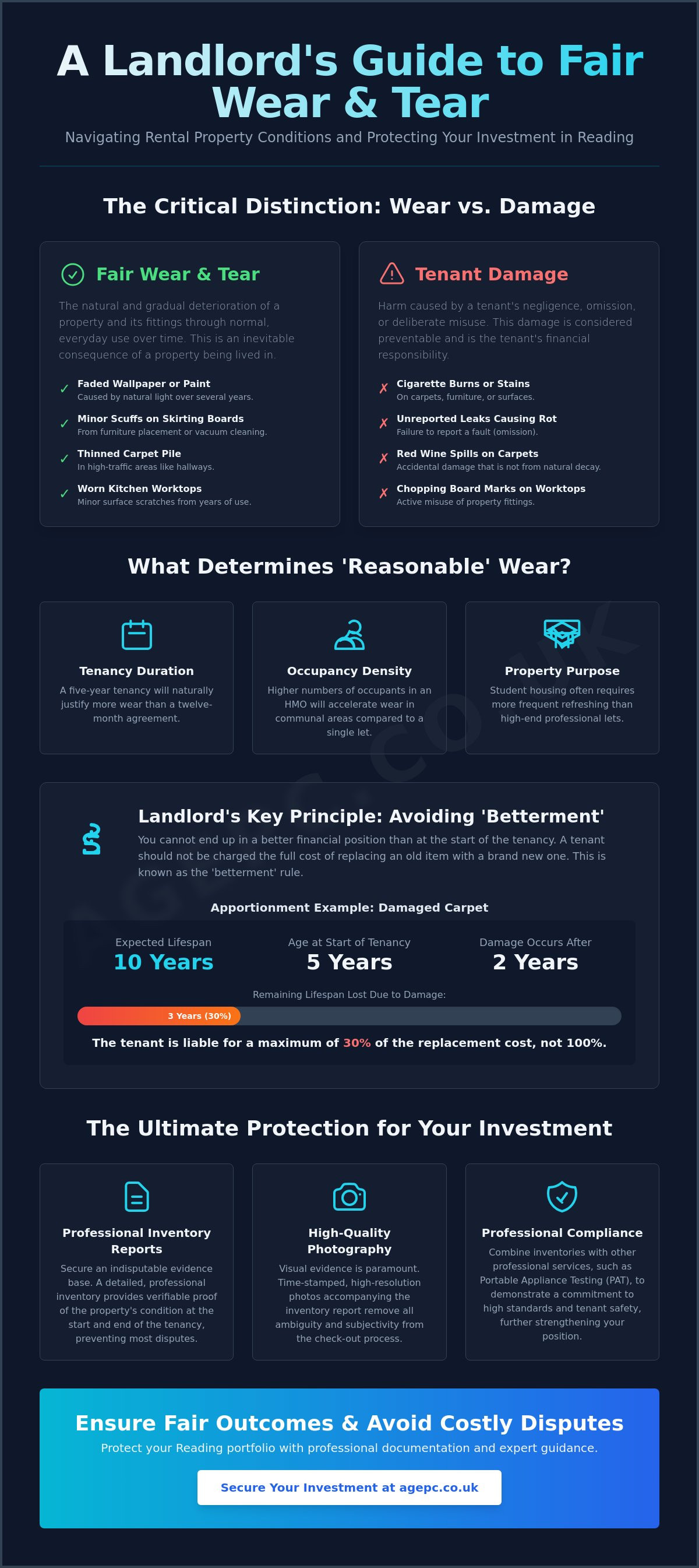
The core principle of fair wear and tear is simple: it is the natural deterioration of a property that occurs through ordinary, everyday use. Under the Renters' Rights Act 2025, defining what is fair wear and tear in a rental property Reading landlords manage is no longer a matter of guesswork. It is a legal distinction between decay caused by the passage of time and damage caused by a tenant's actions or omissions. Whilst tenants are required to act in a "tenant-like manner" by performing basic maintenance, they are not responsible for the ordinary operation of natural forces on your building's fabric.
In the high-demand Reading market, "reasonable" wear is often dictated by the intensity of the property's use. A family home in Caversham will age differently than a professional flat in the town centre. This "lapse of time" factor is the primary metric used by adjudicators to determine liability. Understanding this baseline is the first step toward removing friction from the check-out process and ensuring your investment remains protected against unfair claims.
The Legal Foundation: Lord Denning's Principle
Modern tenancies still rely on the classic legal definition provided by Lord Denning, which states that tenants are not liable for the natural decay of the premises. This principle is built into standard UK tenancy agreements to ensure that landlords do not profit from the inevitable ageing of their property. It means you cannot charge a tenant for the fading of wallpaper or the slight thinning of a carpet pile over several years. These are considered expected outcomes of a property being lived in rather than neglected.
Why 'Reasonable' Depends on the Reading Market
Reading's diverse rental landscape means that "reasonable" is a relative term. Following the introduction of the Reading Borough Council Additional HMO Licensing Scheme in March 2026, many properties now face higher occupancy levels. A property housing four sharers will naturally experience more communal degradation than a single-occupancy unit. Consider these local factors:
- Tenancy Duration: A five-year rolling tenancy justifies significantly more wear than a twelve-month stay.
- Property Purpose: Student housing near the University often requires more frequent refreshing than high-end professional lets.
- Occupancy Density: Higher numbers of occupants accelerate the wear on high-traffic areas like staircases and kitchens.
The Critical Difference: Wear and Tear vs. Tenant Damage
Damage is a result of a specific action or a failure to act. It differs from what is fair wear and tear in a rental property Reading landlords encounter because it involves negligence, omission, or deliberate misuse. Whilst wear is inevitable, damage is avoidable. For instance, a carpet with a heavy "tracking" line from five years of walking is wear; a carpet with a cigarette burn is damage. Cleaning remains the most contentious "grey area" between these two categories. Since cleaning is the number one cause of tenancy deposit deductions in the UK, having a precise baseline is essential to prove that a property’s hygiene has declined beyond natural use.
Reading’s specific demographics, from the high student population near the University to the corporate professionals in the town centre, create different "usage profiles." However, the legal standard for damage remains consistent across all property types. If a tenant’s lifestyle causes preventable harm to the property, it falls outside the scope of fair wear and tear. This is why documenting the condition at the start and end of every tenancy is the only way to remove friction during the deposit return process.
Identifying Negligence and Omission
Negligence is often an active misuse, such as using a kitchen worktop as a chopping board. Omission, however, is a failure to report an issue. If a tenant in a Woodley terrace ignores a leaking pipe under the bath, and that leak eventually rots the floorboards, the tenant is liable for the resulting damage. They had a duty to report the fault. Even "accidental" damage, like a knocked-over iron or a red wine spill, is the tenant's financial responsibility, as these are not the results of natural forces.
The Betterment and Apportionment Formula
The "Betterment" rule is a common pitfall for landlords. Under UK law, you cannot end up in a better financial position than when the tenancy began. You cannot replace a five-year-old damaged carpet with a brand-new one at the tenant's full expense. This "new for old" approach is strictly prohibited. Instead, you must use apportionment to calculate a fair deduction based on the item's remaining lifespan.
If a mid-grade carpet has an eight-year life expectancy and is ruined in its fourth year, the tenant is only liable for 50% of the replacement cost. This calculation accounts for the four years of use you have already received. To ensure these figures are accurate and indisputable, many local landlords rely on professional Property Inventory Reports to record the age and quality of all fixtures. This methodical approach ensures transparency and protects your yield from being drained by avoidable disputes.
Common Examples and Life Expectancy Standards
Determining what is fair wear and tear in a rental property Reading landlords manage requires a firm grasp of industry lifespans. It's not just about what looks old. It's about what has reached its natural expiry date. High-end Reading apartments often feature designer finishes that show wear differently than standard materials. You must adjust your expectations based on the quality of the original installation. A premium wool carpet in a luxury flat might show tracking within eighteen months. Tracking is the natural flattening of fibres in walkways. This is wear, not damage. Conversely, a synthetic carpet with an iron burn is clear damage, regardless of its age.
Fixtures and fittings also follow this logic. A loose door handle or a dripping tap after a three-year tenancy is usually natural deterioration. Components simply wear out with frequent use. However, snapped hinges on a kitchen cupboard or a cracked ceramic basin suggest excessive force. These instances move beyond natural decay and into the category of tenant liability. Providing a clear baseline via Property Inventory Reports at the start of a tenancy is the only way to prove when a fixture has been mistreated rather than just used.
Decorating and Walls: What is Acceptable?
Walls are a frequent battleground during check-outs. Minor scuffs from furniture or small marks near light switches are standard. Many industry benchmarks suggest a two-year lifespan for paintwork in high-traffic areas like hallways. If you haven't repainted in that time, you'll find it difficult to claim for minor scuffs. Fading caused by sunlight is a classic example of natural forces at work. Picture hooks are a common query. A few neatly placed hooks are usually acceptable whilst a wall riddled with holes or oily stains from blue-tack often constitutes damage. For a definitive view on these distinctions, consult Shelter England's guidance on fair wear and tear.
Kitchens and Bathrooms: High-Value Risk Areas
These rooms are high-value risk zones. Reading is a hard water area, making limescale build-up a recurring issue. If a tenant has cleaned regularly but scale still accumulates on showerheads, it's often seen as fair wear. Total neglect that leads to seized valves is a different story. Consider these common kitchen and bathroom scenarios:
- Worktops: Natural dulling of laminate is wear; deep knife gouges or circular heat burns are damage.
- Tiling: Grout discolouration over five years is natural; a cracked tile from a dropped heavy object is damage.
- Flooring: Minor scuffs on lino are expected; deep tears or permanent stains are tenant responsibilities.
Consistency is key. Use the same standards for every inspection to maintain transparency. This professional approach reduces friction and ensures your Reading property investment remains profitable and well-maintained.
How to Prevent Deposit Disputes in Berkshire
Prevention is the most efficient way to protect your yield. With the Renters' Rights Act 2025 making periodic tenancies the standard, your properties will likely see longer, continuous occupation. This shift makes understanding what is fair wear and tear in a rental property Reading landlords manage more vital than ever. Disputes usually stem from ambiguity. You can remove this friction by establishing a clear, evidence-based baseline from day one. Clear documentation protects both parties and ensures a rapid, fair check-out process.
The Power of the Independent Inventory
DIY inventories often fail when challenged in the Property Redress Scheme. They frequently lack the neutrality and granular detail required to uphold a claim. A professional report provides date-stamped, high-resolution photography that captures the exact state of every fixture. This level of verification is a core part of the Ultimate UK Property Compliance Roadmap 2026. It ensures that any claim for damage is backed by indisputable proof. Professional reports provide the legitimacy needed to avoid the TDS dispute process entirely.
Mid-term Inspections: The Early Warning System
Don't wait until the final check-out to identify issues. Mid-term inspections allow you to spot "lifestyle" behaviours that could lead to damage. For example, drying laundry on radiators is a primary cause of condensation and damp in older Reading terraces. You can organise these visits with 24 hours' notice, ensuring you respect tenant privacy whilst protecting your asset. For those managing HMOs under the March 2026 licensing rules, these inspections are also critical for maintaining safety standards. Documenting "fair" usage during the tenancy helps manage tenant expectations before they move out.
Cleaning remains the primary cause of deposit friction. If you hand over a professionally cleaned property, you have the right to expect the same standard upon return. Communicate this clearly. Discussing the property's condition whilst tenants are still in situ allows them to rectify minor issues themselves. This proactive approach saves time and avoids the stress of administrative disputes. For total peace of mind, ensure your documentation is handled by experts. You can order a professional Property Inventory Report today to secure your Reading investment.
Professional Compliance: Protecting Your Investment in Reading
Protecting your Reading investment requires more than just a basic understanding of the law. It requires a robust, tech-enabled evidence trail that leaves no room for ambiguity. AG Property Services streamlines this entire process. We combine local expertise with high-speed delivery to remove the friction from property management. By integrating Property Inventory Reports with essential safety testing, we ensure you have a bulletproof record of your property's condition from day one. Verification creates trust. Trust prevents disputes.
Professional documentation is the only way to effectively manage what is fair wear and tear in a rental property Reading landlords oversee. High-quality photography and 360-degree views capture the baseline state of every skirting board, appliance, and carpet pile. This level of detail is essential in a market where high tenant turnover is common. It provides the grounded, authoritative proof needed to justify deductions when actual damage occurs.
Comprehensive Inventory and Check-out Services
Using an unbiased third-party clerk in Reading is a strategic advantage. It removes the "landlord versus tenant" bias that often complicates deposit negotiations. Our reports are specifically designed to stand up to the toughest scrutiny from the TDS and DPS. We provide rapid digital delivery, allowing you to review findings and finalise check-outs in record time. This efficiency reduces void periods. It keeps your investment profitable and your administrative burden low.
Beyond the Inventory: Total Safety Compliance
Safety testing provides a vital dual benefit. PAT testing documents the functional condition of provided appliances at the start of a term. If a microwave is returned with a cracked door, your PAT record proves it was handed over in safe, working order. Similarly, an up-to-date Domestic EPC reflects the overall maintenance and thermal efficiency of the property. These certifications work together to create a comprehensive profile of your asset's health. Use this final checklist for a smooth check-out in Reading:
- Commission professional reports: Secure date-stamped evidence before the new periodic tenancy begins.
- Sync your testing: Align PAT and EPC renewals to ensure continuous compliance.
- Verify the baseline: Use professional photography to distinguish new scuffs from pre-existing wear.
- Meet the deadlines: Ensure all tenants receive the "Renters' Rights Act Information Sheet" by the 31 May 2026 deadline.
Mastering what is fair wear and tear in a rental property Reading landlords manage is simplified with a "one-stop" compliance partner. We provide the legitimacy and speed you need to navigate the 2026 rental landscape. Secure your property. Protect your yield. Achieve total peace of mind today.
Secure Your Reading Property Investment for 2026
Mastering what is fair wear and tear in a rental property Reading landlords must navigate is about evidence, not guesswork. You've seen how the Renters' Rights Act 2025 and new HMO licensing rules have tightened the requirements for transparency. Distinguishing between natural ageing and tenant damage is no longer just a recommendation; it's a financial necessity. By applying life expectancy standards and avoiding the "betterment" trap, you protect your yield and maintain professional relationships with your tenants.
Success in the Reading market depends on speed and accuracy. Combining professional Property Inventory Reports with accredited EPC and PAT testing creates a comprehensive compliance shield. Since 2012, we've served the Thames Valley as independent, unbiased specialists. We remove the friction from administrative tasks so you can focus on growing your portfolio. Don't leave your deposit outcomes to chance. Book your professional Reading property inventory report today and ensure your property documentation is bulletproof. We're here to help you achieve total peace of mind in a changing market.
Frequently Asked Questions
Is professional cleaning considered part of fair wear and tear?
Professional cleaning is never considered fair wear and tear. Dirt, grease, and grime are not the result of natural ageing; they are the result of a lack of maintenance. If you documented a professional clean at the start of the tenancy, the tenant must return the property to that same standard. Cleaning remains the primary cause of deposit deductions in the UK, and failure to meet this standard allows for a deduction based on the actual cost of restoring hygiene.
Can a landlord charge for repainting a whole room if there is one small scuff?
No, you cannot charge for a full room repaint due to a single scuff. Doing so constitutes "betterment," which is prohibited under UK law. You're only entitled to the cost of a localised repair or a compensatory amount that reflects the reduced lifespan of the decor. Adjudicators look for proportional solutions. If the scuff is minor, it's often dismissed as a natural result of living in the property.
How long should a carpet last in a Reading rental property?
A standard rental carpet typically has a life expectancy of five to eight years. In a high-occupancy Reading HMO, this might lean towards the shorter end of the scale due to increased footfall. Adjudicators use these timelines to determine what is fair wear and tear in a rental property Reading tenants have occupied. If a carpet is seven years old, its remaining financial value is negligible, making damage claims difficult to justify.
What happens if there is no inventory report at the start of the tenancy?
Without a professional inventory report, your chances of winning a deposit dispute are slim. Adjudication schemes like the TDS or DPS require a clear baseline to compare the property's condition at the start and end of the term. In the absence of date-stamped evidence and high-quality photography, the burden of proof rests on the landlord. The adjudicator will almost always favour the tenant's account if no independent verification exists.
Can I charge for damage caused by a tenant's pet in Reading?
Yes, you can charge for pet-related damage. Whilst the Renters' Rights Act 2025 gives tenants the right to request a pet, they remain fully liable for any destruction caused. Scratched doors, chewed skirting boards, or urine-stained carpets are never considered fair wear. These issues fall under negligence or misuse. You should use professional Property Inventory Reports to document the specific condition of woodwork and flooring before the pet moves in.
Is limescale build-up in a bathroom considered wear and tear?
Limescale is a nuanced issue in Reading's hard water area. Regular cleaning to prevent build-up is a tenant's responsibility. However, if the scale is internal or has accumulated over a very long tenancy despite regular cleaning, it may be viewed as wear. Total neglect that leads to seized taps or damaged showerheads is usually classified as damage. Consistency in mid-term inspections helps identify these issues before they become permanent.
How do I calculate the cost of a damaged item that is five years old?
You must use the apportionment formula to calculate the cost. Divide the replacement price by the item's expected lifespan, then multiply by the years of "useful life" remaining. For example, if a five-year-old appliance with a ten-year lifespan is ruined, you can only claim 50% of its value. You cannot charge for a brand-new replacement as this would leave you in a better position than when the tenancy started.
Can a tenant be charged for 'light' scuffs on the walls after a 3-year tenancy?
No, light scuffs after a three-year tenancy are almost always classified as fair wear. Paintwork in high-traffic areas is expected to show signs of use after 24 to 36 months. If you haven't refreshed the decor in that time, an adjudicator will likely view minor marks as the natural result of a long-term let. This is particularly true in the busy Reading market where properties face constant, heavy use.
Important Information
The information provided in this article is for general guidance and informational purposes only and does not constitute legal, financial, or professional property advice. While AG Site Solutions aims to keep all content accurate and up to date, property regulations, landlord obligations, EPC requirements, and housing legislation may change over time. Readers should always seek professional advice or consult the relevant authorities before making decisions relating to property compliance, tenancy matters, Energy Performance Certificates (EPCs), landlord responsibilities, or legal obligations. Some articles may be created or assisted using AI-supported content tools and are reviewed and enhanced using real industry experience and property compliance knowledge. For professional assistance, quotations, or compliance support, please contact AG Site Solutions directly via agepc.co.uk