
How to Get an EPC Certificate: A Step-by-Step Guide for 2026
Could a single rating of 'F' or 'G' suddenly make your rental property illegal to let? With the government’s Warm Homes Plan now in full swing, the pressure to maintain a compliant Energy Performance Certificate has never been higher. Mastering how to get an epc certificate is no longer just a tick-box exercise. It is a vital step in protecting your investment and avoiding immediate fines of up to £5,000.
We know the confusion between checking an old record and booking a new assessment is exhausting. You need a valid certificate recorded on the central register without the friction of a long, invasive home visit. This guide provides an expert-led roadmap to secure your certificate rapidly. We will walk through the current MEES standards, the inspection process, and how to achieve a rating that boosts your property’s market value. Get the peace of mind that comes with a professional, streamlined assessment.
Key Takeaways
- Check the official GOV.UK register first to see if your property already holds a valid, ten-year certificate.
- Master how to get an epc certificate by selecting an accredited local assessor for a rapid, legally compliant result.
- Ensure a stress-free assessment by providing clear access to all rooms, lofts, and boiler cupboards for the 30-60 minute visit.
- Receive your digital certificate almost immediately after data upload for instant sharing with solicitors and estate agents.
- Streamline your property marketing by bundling your EPC with professional photography and floor plans to attract better tenants.
Step 1: Checking if Your Property Already Has a Valid EPC
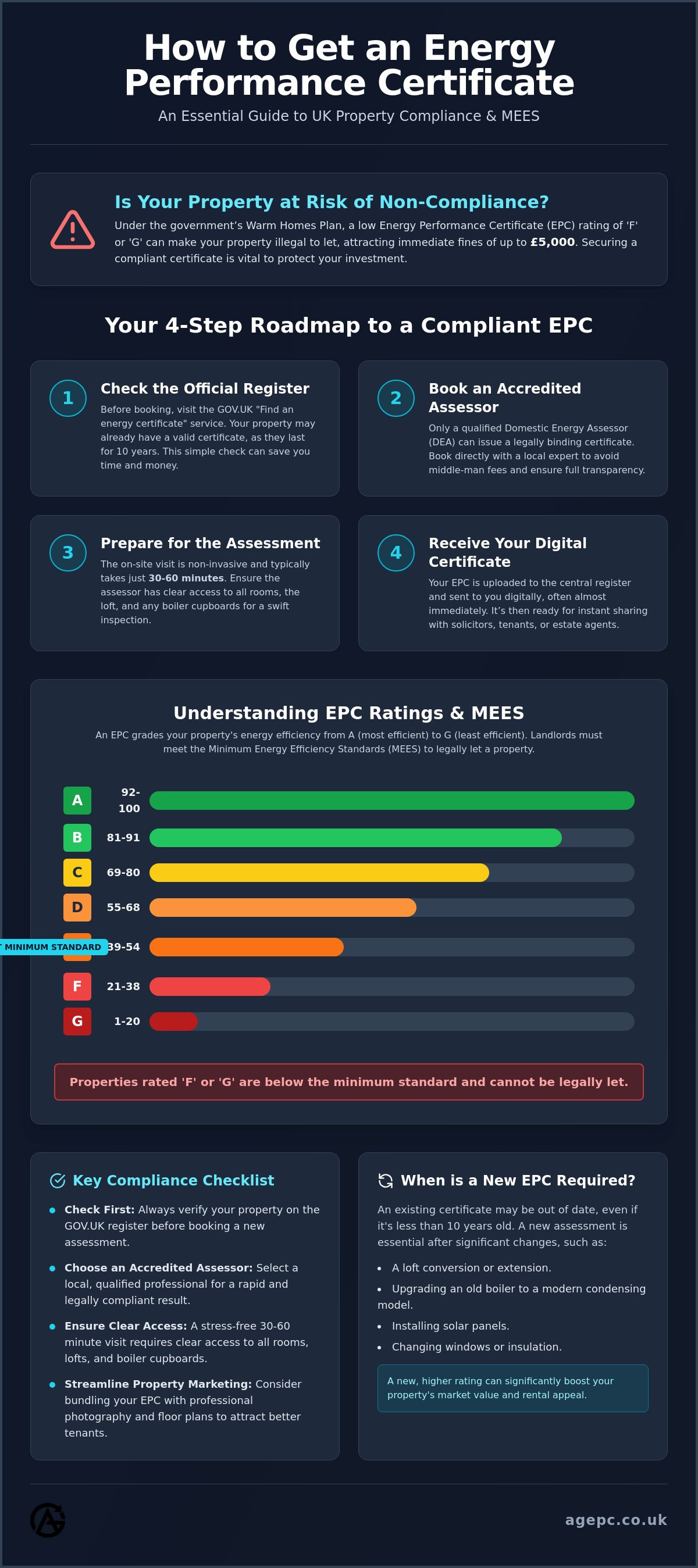
An Energy Performance Certificate is a legal requirement for anyone selling or renting a property in the UK. This document grades a property’s energy efficiency on a scale from A to G, where A represents the most efficient homes and G the least. Before you start researching how to get an epc certificate, verify whether a valid one is already linked to your address. EPCs remain valid for 10 years from the date of issue. You don't need a new assessment every time a tenancy changes unless the previous certificate has expired.
How to Use the Official GOV.UK EPC Register
Checking your status is a straightforward, digital process. Navigate to the "Find an energy certificate" service on the official government website. You can search using your property postcode or the unique 24-digit Report Reference Number (RRN) if you have previous paperwork. The register provides an instant digital summary of the current rating and the expiry date. If your certificate has lapsed, you must commission a new assessment before you can legally market the property to buyers or tenants. It is a quick check that could save you time and unnecessary expense.
When an Existing EPC is No Longer Sufficient
A certificate might be technically "in date" but practically obsolete. Significant structural changes often render old data inaccurate. If you have completed a loft conversion, added a rear extension, or changed the thermal envelope of the building, the old certificate won't reflect the current performance. Similarly, installing solar panels or upgrading an old G-rated boiler to a modern condensing model warrants a fresh assessment. For those looking to maximise their solar efficiency, companies like G-Solar & Electrical highlight the importance of regular maintenance in preserving energy performance. A higher rating makes your property more attractive to energy-conscious buyers and can increase the final sale price.
Landlords face even stricter requirements. You must ensure your property meets the Minimum Energy Efficiency Standards (MEES) to remain compliant. Currently, this requires a minimum rating of 'E'. If your property is currently underperforming, understanding how to get an epc certificate after making energy-saving improvements is essential. Renewing your EPC early is a strategic move to prove your property is fit for the modern rental market and compliant with evolving 2026 regulations.
Step 2: Booking an Accredited Energy Assessor
Once you check the EPC register and confirm a new assessment is necessary, the next priority is finding a qualified professional. You cannot perform this assessment yourself. Only a qualified Domestic Energy Assessor (DEA) can produce a legally binding certificate recorded on the central database. Choosing the right professional is the most critical part of understanding how to get an epc certificate without facing delays or hidden costs.
Many property owners fall into the trap of using "middle-man" booking sites. These platforms often add unnecessary fees and lack direct communication with the person actually visiting your home. Booking directly with an accredited provider like AG Property Services removes this friction. It ensures transparency and allows you to discuss specific property details before the visit. Always verify that your assessor is a member of an approved accreditation scheme, such as Elmhurst or Quidos. These bodies ensure that every assessment meets strict quality and accuracy standards.
Finding the Right Assessor for Your Property Type
Different buildings require specific qualifications. You must ensure your assessor is qualified for your specific property category:
- Domestic Energy Assessors (DEA): These professionals handle standard residential homes, flats, and bungalows.
- Non-Domestic Energy Assessors (NDEA): You must hire an NDEA for commercial premises, such as shops, warehouses, or offices.
If you are a landlord managing a residential portfolio, it is often best to book a Domestic EPC as part of a wider compliance package. This approach ensures all legal bases are covered simultaneously and reduces the administrative burden of managing multiple contractors.
The Benefits of Local Expertise in the Thames Valley
Speed and accuracy are the primary advantages of going local. Assessors based in Slough, Reading, or St Albans understand the specific build types common to the Thames Valley and West London. They are familiar with the regional nuances of Victorian terraces in Windsor or modern apartment blocks in Maidenhead. This regional knowledge leads to more accurate data entry and faster results.
Direct booking also offers superior flexibility. You can often secure weekend or evening slots that national chains simply cannot provide. For landlords, professional firms can even bundle the EPC visit with PAT testing to streamline your maintenance schedule in one visit. If you want a rapid, stress-free experience, booking a local expert is the most efficient choice when researching how to get an epc certificate for your property.
What to Expect During the Property Assessment
The site visit is the most critical stage of the entire process. While it might seem daunting, the assessment is typically completed in 30 to 60 minutes. The duration depends entirely on the size and complexity of your building. A standard three-bedroom semi-detached house usually takes less than an hour. If you have already used the official service to Find an accredited assessor, you can expect a professional, high-speed walkthrough of your property.
Preparation is the key to a stress-free experience. Your assessor must have physical access to every room in the house. This includes the loft space, any basement areas, and boiler cupboards. The process is entirely non-invasive; the assessor will take measurements and photographs for their records but they won't lift floorboards or drill into your walls. The assessor uses the Standard Assessment Procedure (SAP) to calculate your score based on the data gathered during this visit.
Key Areas the Assessor Will Inspect
The assessor focuses on the thermal envelope of the building. They will examine insulation levels in the loft and walls, specifically looking for evidence of cavity wall insulation. Your heating system is another major factor; they will record the boiler type, its age, and the efficiency of your heating controls. They also inspect windows and glazing to check for double or triple glazing and the date of installation. Finally, they count the percentage of fixed low-energy light bulbs to determine your lighting efficiency.
Preparing Your Property to Maximise Your Score
Don't let a locked door or a blocked hatch lower your rating. Ensure the loft hatch is easily accessible and that the hot water cylinder is visible. If you have made recent improvements, gather your documentation before the assessor arrives. FENSA certificates for new windows or invoices for solar panel installations provide the concrete evidence needed to secure a higher grade. If you've performed internal wall insulation, photographs or technical specifications are vital because the assessor cannot "see" through the plasterwork.
Understanding how to get an epc certificate with the best possible rating involves showing your property in its best light. Providing clear evidence of energy-saving works ensures your final report is accurate and reflects the true value of your home. Ready to proceed? Book your professional property assessment today to ensure a rapid, compliant turnaround for your property marketing.
Receiving Your Certificate and Next Steps
The hard work is over once the assessor leaves your property. The collected data is uploaded to the central register, and your certificate is generated almost immediately. This official record is stored on the national database, ensuring it is accessible to solicitors and local authorities. You'll receive a digital PDF copy of the document. This file can be shared instantly with your estate agent or solicitor to keep your property transaction on track.
What happens if your rating is lower than expected? Don't worry. Every EPC comes with a "Recommendation Report" that outlines specific, cost-effective improvements. These suggestions are tailored to your building and show exactly how to boost your score. For landlords, this is a critical compliance tool. You must ensure your new rating meets the latest 2026 rental regulations. Failing to maintain these standards can result in heavy fines and prevent you from legally renewing tenancies.
How Long Does the Process Take?
Speed is a priority in a fast-moving market. Most assessments are completed and the certificate issued within 24 to 48 hours of the site visit. In high-demand areas like Reading, we understand that urgent sales require a rapid response. Digital delivery removes the wait for physical post. Your estate agent can begin marketing the property the moment the PDF arrives in your inbox. This efficiency ensures you don't lose potential buyers or tenants to unnecessary administrative delays.
Beyond Compliance: Marketing Your Property
A high EPC rating is a powerful marketing asset. In 2026, energy-conscious buyers and tenants actively look for properties with lower running costs and better environmental credentials. You can maximise this interest by presenting a complete property package. Many owners choose to combine their EPC visit with professional real estate photos to save time and reduce disruption.
Accurate floor plans and high-quality imagery work alongside your energy certificate to create a professional, trustworthy listing. This streamlined approach is the most effective way to handle how to get an epc certificate whilst simultaneously preparing your home for a successful sale or let. By bundling these essential services, you ensure your property stands out in a crowded market from day one.
Secure Your Property’s Compliance Today
Securing a valid Energy Performance Certificate is the first step toward a successful sale or letting in 2026. By checking the official register first and booking directly with a local expert, you eliminate the friction of modern property administration. A high rating does more than meet legal standards; it validates your property’s value and attracts energy-conscious tenants. Preparation is your best tool to ensure the non-invasive site visit results in the highest possible score for your home or commercial premises.
Mastering how to get an epc certificate is simple when you partner with accredited Domestic and Commercial Assessors. We offer a rapid turnaround across Slough, Reading, and London, ensuring your certificate is live on the national database without delay. Beyond compliance, our expertise in high-quality property marketing assets like professional photography and floor plans helps your listing stand out from the competition. Book your professional EPC assessment with AG Property Services today and take the stress out of property compliance. Your roadmap to a valid, high-performing certificate starts here.
Frequently Asked Questions
How much does an EPC certificate cost in 2026?
The cost of an EPC varies depending on the size, location, and complexity of your property. Larger commercial buildings or complex residential homes require more time on-site, which influences the final fee. Booking directly with a local assessor in Slough or Reading is often more cost-effective than using agency-led platforms that add commission fees to the total.
How long is an EPC certificate valid for in the UK?
An Energy Performance Certificate is valid for 10 years from the date of issue. Once this decade-long period expires, you must commission a new assessment before you can sell or rent the property. Many owners choose to renew early after making energy-efficiency upgrades to reflect a better rating on the national register and attract premium buyers.
Can I sell my house if the EPC has expired?
You cannot legally market or sell your home if the EPC has expired. A valid certificate must be available to potential buyers from the moment the property is listed for sale. If your current certificate has lapsed, understanding how to get an epc certificate quickly is vital to avoid delays in your property transaction and potential legal issues.
What is the minimum EPC rating for renting out a property?
As of July 2026, all privately rented properties in England and Wales must have a minimum EPC rating of 'E' to be legally let. Landlords who fail to meet this standard face fines of up to £5,000 per property. Under the "Warm Homes Plan," this requirement will rise to a 'C' rating by October 2030, so proactive upgrades are highly recommended now.
Do I need a new EPC if I have installed a new boiler?
You aren't legally required to get a new EPC immediately after a boiler installation, but it is a strategic move. A modern, efficient boiler can significantly improve your property's score and lower estimated energy costs. Updating your certificate ensures these improvements are officially recorded, making the property more attractive to energy-conscious tenants and buyers.
To ensure your new heating system meets all efficiency and safety standards, it is always wise to work with qualified professionals. For instance, companies like CQR Plumbing provide expert gas fitting and drainage solutions that help maintain the long-term integrity and performance of your property's infrastructure.
How can I find out if my property already has an EPC?
You can find out if your property has a valid certificate by searching the official GOV.UK register. Simply enter your postcode to view any active or expired certificates linked to your address. If no record exists or the expiry date has passed, you will need to follow the professional steps on how to get an epc certificate to remain compliant with current regulations.
Important Information
The information provided in this article is for general guidance and informational purposes only and does not constitute legal, financial, or professional property advice. While AG Site Solutions aims to keep all content accurate and up to date, property regulations, landlord obligations, EPC requirements, and housing legislation may change over time. Readers should always seek professional advice or consult the relevant authorities before making decisions relating to property compliance, tenancy matters, Energy Performance Certificates (EPCs), landlord responsibilities, or legal obligations. Some articles may be created or assisted using AI-supported content tools and are reviewed and enhanced using real industry experience and property compliance knowledge. For professional assistance, quotations, or compliance support, please contact AG Site Solutions directly via agepc.co.uk