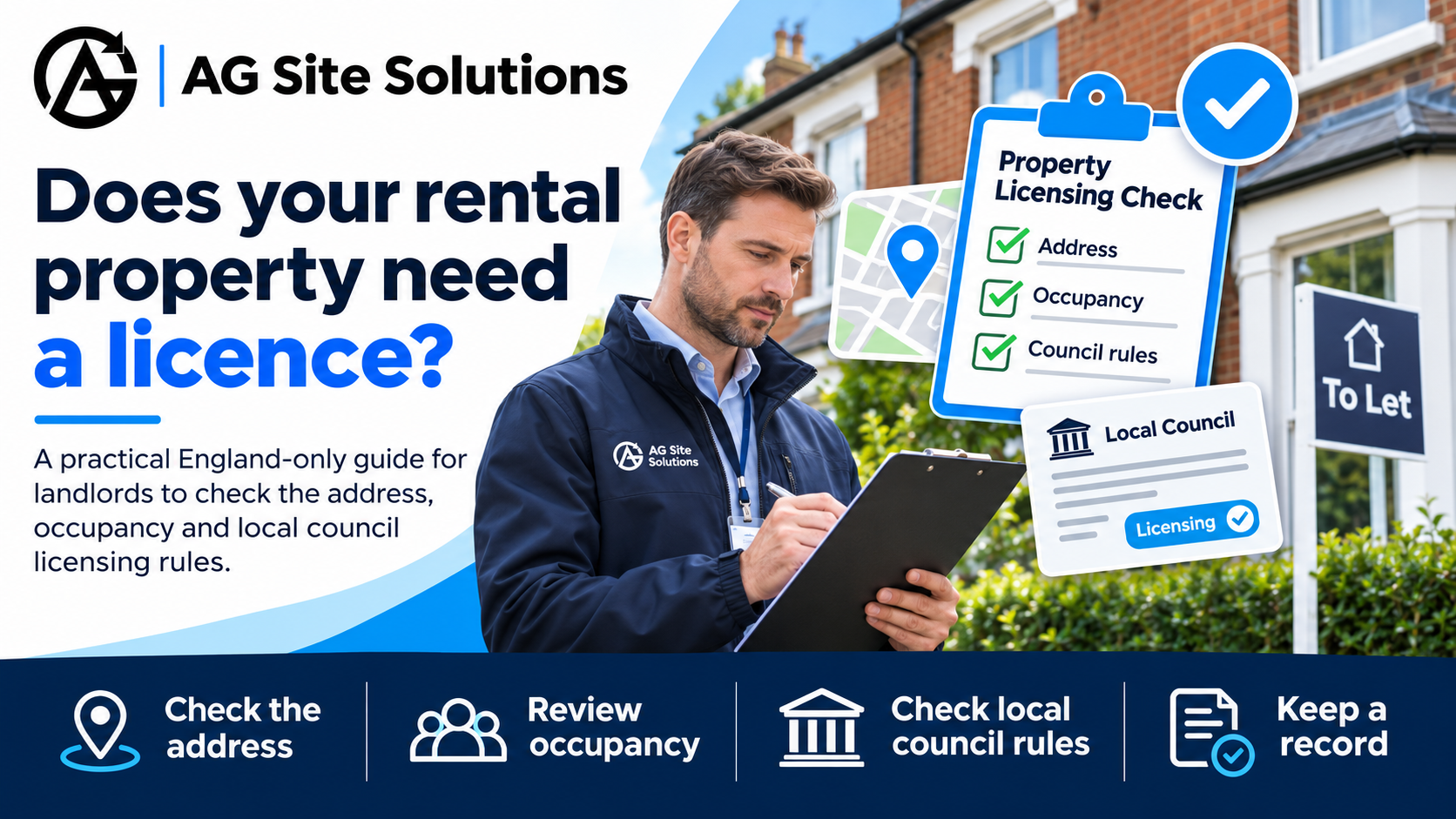
How can landlords check whether a rental property in England needs a licence?
To check whether your rental property needs a licence in England, compare its full address, occupancy and living arrangements with current GOV.UK guidance and the relevant council’s licensing schemes. Check mandatory HMO licensing, additional HMO licensing and selective licensing separately. If the position is unclear, ask the council’s licensing team for written clarification rather than assuming the property is exempt.
Key takeaways
- An address check alone is not enough: the number of occupants, households and shared facilities also matters.
- Not every rental property or every HMO needs a licence, but smaller properties can fall within local schemes.
- Check scheme boundaries, operative dates, exemptions and any existing licence against official council information.
- Keep a dated record of your checks and revisit them when occupancy, ownership or local schemes change.
Does my property need a licence in England?
Treat each property as a separate enquiry, even if you own several nearby.
Begin with the GOV.UK council finder, then open the council’s official private rented housing or property licensing pages. Read these alongside GOV.UK guidance on houses in multiple occupation. A neighbouring landlord’s answer may not apply to your address or letting arrangement.
> REVIEW STATUS AND CURRENT LOCAL SCHEMES — Last-reviewed date: unavailable. Live council schemes and current guidance have not been independently verified for this article. No claim is made that any named area currently operates a particular local scheme; confirm the position using official guidance before relying on it.
Which types of rental property licensing apply in England?
There are three routes to consider. Do not stop after checking just one.
A starting point for an England landlord licensing check; exemptions and the precise scheme scope still need checking.
| Licensing route | What to check |
| --- | --- |
| Mandatory HMO licensing | GOV.UK describes a large HMO as a property rented to five or more people forming more than one household, with shared toilet, bathroom or kitchen facilities. Check whether the property falls within mandatory licensing and whether an exclusion applies. |
| Additional HMO licensing | Councils can require other HMOs to be licensed through a local scheme. Check which HMO types and geographical areas the designation covers. |
| Selective licensing | A local scheme can require privately rented homes within a designated area to be licensed, subject to its scope and exemptions. Do not rule it out because the property is occupied by one household. |
GOV.UK’s general HMO guidance describes an HMO as accommodation rented to at least three people forming more than one household who share facilities such as a bathroom or kitchen. A family can form one household; unrelated sharers can form separate households. Being an HMO and needing an HMO licence are therefore different questions.
Use the GOV.UK HMO licence guidance and the government’s selective licensing guidance alongside the council’s designation documents. Converted buildings and unusual occupation arrangements warrant a specific enquiry.
What information should you gather about the property?
Prepare the facts before using a council checker or contacting its licensing team.
Your property licensing enquiry pack
- [ ] Full address and postcode, including the flat number or unit designation.
- [ ] Current and proposed occupant numbers, including children, with relationships between occupants.
- [ ] Which kitchen, bathroom and toilet facilities are shared, and by whom.
- [ ] Whether the owner lives there and how the accommodation is let.
- [ ] How the building is divided: individual rooms, self-contained flats, shared accommodation or a mixture.
- [ ] Any existing licence, application reference, exemption correspondence and proposed changes.
Describe the actual living arrangements, not just the tenancy document. If you are unsure how many households there are, explain the relationships rather than guessing. For a converted house, include a simple description of each unit and any shared facilities.
How can you check the council’s licensing rules for your address?
A selective licensing postcode check is a useful starting point, not always a complete answer.
Make an address-specific check
1. Find the official scheme pages — Look for mandatory HMO, additional HMO and selective licensing information. Separate consultations and proposed schemes from schemes already operating.
2. Confirm exact coverage — Use the council’s address checker, map or street list. Read the designation documents where available; if the address or boundary is ambiguous, ask the council.
3. Read dates, scope and exemptions — Check when the scheme takes effect and ends, which properties it covers, and the published exemptions. Record which document you relied on.
4. Check any existing licence — Use the council’s register where available and obtain the licence itself. Compare the address, licence holder, expiry, authorised occupancy and conditions with the present situation.
Save the relevant pages or documents with the date you checked them. If a checker produces no result, do not treat that alone as confirmation that no licence is needed.
What should landlords around Slough check locally?
Use the property’s local authority, not the letting agent’s office address or a broad area label.
For a Slough property, establish the responsible council from the full address. Repeat that exercise for properties in Windsor, Maidenhead, Reading, Bracknell, High Wycombe or Uxbridge. A West London portfolio may involve several councils, so one borough’s answer should not be applied across the portfolio.
Keep a separate record for each property: council, occupancy, schemes checked, outcome, supporting correspondence and next review trigger. This is more useful than a single portfolio-wide note saying “licensing checked”.
What if the licensing position is still unclear?
Ask a precise question and give the council enough information to answer it.
Email the licensing team with your enquiry pack. Ask whether the described property and occupation require mandatory HMO, additional HMO or selective licensing, which scheme or exemption applies, and what further information they need.
> MAKE THE ANSWER TRACEABLE — Request written clarification tied to the full address and stated occupancy. Keep the response and attachments together. Recheck before changing the letting arrangement, increasing occupancy or relying on an answer following a scheme change.
Does a property licence cover every landlord obligation?
No. Licensing is one part of landlord compliance, not a complete compliance assessment.
GOV.UK sets out separate landlord safety responsibilities. Check the duties relevant to your property independently. A licence, EPC, PAT test or inspection report should not be treated as proof that every applicable obligation has been met.
At AG Site Solutions, we provide EPCs, floor plans, inventories, check-in and check-out reports, mid-term inspections and PAT testing. We do not determine licensing requirements or provide legal advice. Once you have established the relevant requirements, we can discuss the property services you need.
- <a href="/articles/mid-term-tenancy-inspection-tenant-privacy">What Should Landlords Check During a Mid-Term Tenancy Inspection Without Overstepping Tenants’ Privacy?</a>
- <a href="/articles/pat-testing-rented-properties-communal-areas-responsibility">Who is Responsible for PAT Testing in Rented Properties and Communal Areas — and How Often Should It Be Done?</a>
Your property licensing check
AG Site Solutions • An England-only checking framework
- IdentifyAddress and councilUse the exact property or flat address.
- DescribePeople and facilitiesRecord households, sharing and building layout.
- CompareAll three licensing routesCheck scope, boundaries, dates and exemptions.
- ConfirmKeep written evidenceResolve uncertainty with the council.
Rental licensing: checks before you rely on an answer
- Identify the responsible council using the property’s full address, including any flat or unit number.
- Note current and planned occupancy, occupants’ relationships, shared facilities, building layout and whether the owner lives there.
- Check mandatory HMO, additional HMO and selective licensing separately using GOV.UK guidance and official council information.
- Confirm the exact scheme boundary, operating dates, property types covered and exemptions; distinguish active schemes from proposals.
- Compare any existing licence with the current address, holder, occupancy, conditions and expiry date. Do not assume a seller’s HMO licence transfers to you.
- If coverage or eligibility is uncertain, request a written council response linked to the address and living arrangements. A blank checker result is not confirmation of exemption.
- Keep dated guidance, scheme documents and correspondence in a separate record for each property.
- Revisit the checks when occupancy, letting arrangements, ownership or local schemes change, and assess other landlord duties separately.
Booking an EPC or organising reports for a tenancy? Contact AG Site Solutions to discuss your property, access arrangements and appointment availability.
Frequently asked questions
Can I take over the seller’s HMO licence?
GOV.UK states that an HMO licence cannot be transferred to another person. Contact the council about the application arrangements before relying on the seller’s paperwork.
Does planning permission settle the licensing question?
Do not use a planning decision as your licensing answer. Ask the licensing team about licensing and the planning team about any separate planning questions.
Can my letting agent carry out the checks?
You can ask your agent to carry out and document the checks. Agree who will obtain council clarification and keep copies of the evidence yourself.
What if the property is currently empty?
Give the council the proposed occupation and letting arrangements as well as its current vacant status. Ask how the relevant scheme applies before the next tenancy begins.
Does paying an application fee mean a licence has been granted?
Do not treat a payment receipt as the licence itself. Ask the council to confirm the application’s status and what documentation you should expect.
Is an HMO licence check also a check on bedroom suitability?
Ask the council specifically about the proposed room use and permitted occupancy. Identifying the licensing route is not a room-by-room suitability assessment.
Should I send tenants’ personal documents with my first enquiry?
Start with the property facts and relationships needed to explain occupancy. Ask the council what supporting documents it requires and how to submit them securely.
Where should I turn if I disagree with the council’s interpretation?
Ask for the reasoning and relevant scheme provisions in writing. If the disagreement remains material, seek independent legal advice rather than relying on a general online guide.