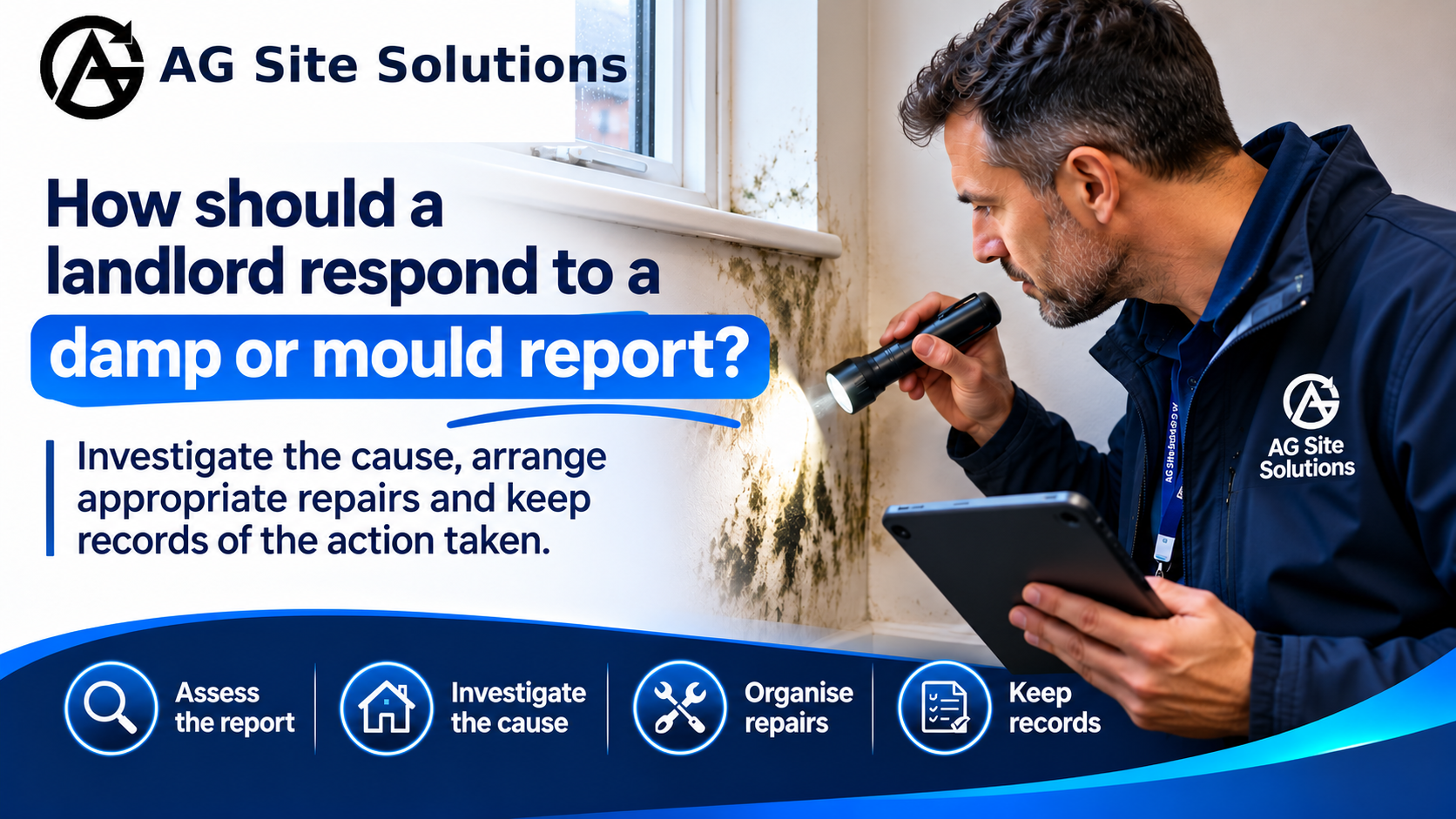
What should landlords do when a tenant reports damp or mould?
Take the report seriously, acknowledge it promptly and assess whether urgent action is needed. Investigate the cause rather than blaming the tenant, arrange appropriate repairs and keep in contact until the outcome has been checked. Cleaning visible mould alone is not a complete response where the underlying moisture problem remains.
Key takeaways
- Photographs help record a report, but should not become a condition for investigating it.
- Consider health concerns and household circumstances when deciding how urgently to act.
- Give the tenant a named contact, a clear action plan and updates when arrangements change.
- Keep the case open until repairs and their effectiveness have been checked.
How landlords should respond to tenant reports of damp and mould
- Photographs help record a report, but should not become a condition for investigating it.
- Consider health concerns and household circumstances when deciding how urgently to act.
- Give the tenant a named contact, a clear action plan and updates when arrangements change.
- Keep the case open until repairs and their effectiveness have been checked.
1. Acknowledge the report and assess urgency
Start with action, not an argument about responsibility.
Your first-response checklist
- [ ] Acknowledge the report and name the person handling it.
- [ ] Ask where the damp or mould is, whether it is spreading and whether there is an active leak.
- [ ] Ask sensitively about health concerns or household circumstances that could increase urgency.
- [ ] Arrange an appropriate investigation and explain the next contact point.
- [ ] Record actions, appointments and updates through to a checked outcome.
Government damp and mould health guidance advises landlords to take reports seriously and respond with urgency. Ask whether bedrooms or other essential living spaces are affected. Do not require medical evidence before taking the report seriously, or suggest that a tenant must prove the cause.
Request photographs if practical, but offer an alternative if the tenant cannot provide them. If the report suggests an immediate safety risk, use the appropriate emergency response rather than waiting for a routine inspection. Applicable statutory deadlines take priority over your normal booking process.
2. Investigate the underlying cause
Describe what you find before deciding why it happened.
Arrange access with the tenant and choose someone with the competence needed to investigate the problem. Record the affected rooms, surfaces, extent of growth, staining and any previous repairs. Ask when the problem appeared, whether it changes after rain and whether it has returned after cleaning.
- Check possible water sources, including plumbing leaks, roofs, gutters and external defects.
- Examine ventilation provision and whether extractor fans actually work.
- Consider heating, insulation and cold surfaces alongside moisture sources.
- Review earlier complaints and works rather than treating each recurrence as a new isolated issue.
The government guidance warns against attributing damp and mould to tenants’ lifestyle. Several factors may interact. Advice about ventilation should be realistic for the home and household, not a substitute for investigating defects. Where the cause remains unclear, arrange further specialist investigation rather than guessing.
3. Agree the plan and complete the work
Turn the findings into a written plan that the tenant can follow.
Explain what has been found, what remains uncertain and what will happen next. Identify who is arranging each task, the agreed appointments and when the tenant will receive another update. Separate immediate protective measures from work needed to resolve the cause.
Arrange appropriate mould removal alongside action on the underlying problem. Government guidance makes clear that addressing surface mould without tackling its cause will not prevent recurrence. Do not simply instruct the tenant to clean it and close the report.
> A DELAY NEEDS A RESPONSE, NOT SILENCE — If access, parts, contractor availability or responsibility for a shared building element complicates the work, tell the tenant what is happening. Reassess the risk and any interim protection needed. An operational delay does not remove an applicable legal deadline.
Keep records of access attempts and offer workable alternatives where an appointment fails. Avoid treating one missed visit as evidence that the tenant no longer wants help.
4. Check the outcome before closing the case
A completed contractor visit is not the same as a resolved damp problem.
Check that the specified work was completed and ask the tenant whether dampness, visible mould or musty smells remain. Keep the contractor’s findings and completion evidence with the original report. Where necessary, revisit rather than relying only on an invoice or a photograph of fresh paint.
Agree a follow-up appropriate to the cause, drying needs and household risk. Government guidance recommends checking whether the problem has been resolved; this should not replace any earlier statutory action. If symptoms return, reopen the investigation and reconsider the diagnosis instead of repeating cosmetic treatment.
Send a closing summary explaining the work, checks undertaken and how to report recurrence. Record any outstanding monitoring separately so it does not disappear when the repair job is marked complete.
Legal distinctions and publication-date checks
Keep the practical response consistent, but check the rules for the property’s jurisdiction and tenure.
- England — private residential landlords: existing repair and fitness duties can apply to damp and mould. Responsibility depends on the circumstances; do not assume a report can wait because a particular social-housing timetable does not apply.
- England — social landlords: Awaab’s Law has specific requirements for hazards within its scope. Follow the applicable investigation, communication, safety-work and alternative-accommodation requirements rather than substituting general guidance about acting promptly.
- Wales, Scotland and Northern Ireland: check the applicable national framework and tenancy circumstances. Do not transplant England’s social-housing requirements into another jurisdiction.
For England, consult the government’s private renting repair guidance and Awaab’s Law guidance for social landlords. General damp and mould guidance does not override applicable legislation.
> PUBLICATION-DATE LEGAL CHECK: 1 NOVEMBER 2026 — The referenced evidence pack was not supplied, so legal status on 1 November 2026 has not been verified. Before publication, check commencement and scope, especially any extension to England’s private rented sector, changes to social-housing requirements and newer Welsh or Northern Irish provisions. Do not present a proposal as an operative duty.
Use inspections to support ongoing property care
Routine records support a response; they do not replace one.
Link inspection observations, tenant reports and repair records so recurring problems are visible. Never ask a tenant to wait until the next routine inspection to report damp or mould.
At AG Site Solutions, we offer mid-term property inspections, inventories, check-in and check-out reports for landlords and agents in Slough and surrounding areas, including Windsor, Maidenhead, Reading, Bracknell, High Wycombe and Uxbridge. These services can support property records; they are not a substitute for specialist damp investigation.
Related articles
- <a href="/articles/mid-term-tenancy-inspection-tenant-privacy">What Should Landlords Check During a Mid-Term Tenancy Inspection Without Overstepping Tenants’ Privacy?</a>
- <a href="/articles/bracknell-inventory-check-in-check-out-reports">Inventory, Check-In and Check-Out Reports in Bracknell: Which Do Landlords Need?</a>
Speak to AG Site Solutions about mid-term inspections and property reports around Slough. For an active damp problem, arrange the appropriate investigation without waiting for a routine visit.
Frequently asked questions
Should the tenant buy a mould-testing kit?
Do not make a home testing kit a prerequisite for action. Start with the reported conditions and arrange an appropriate investigation.
What if the tenant has already cleaned the mould?
Record their account and any earlier photographs. A clean surface does not establish that the moisture source has gone.
What should I do about damaged belongings?
Record the items and evidence separately from the repair investigation. Consider responsibility and any insurance questions without promising or refusing compensation before reviewing the circumstances.
Can I ask the tenant to use a dehumidifier?
Discuss whether it is an appropriate temporary measure, including practical arrangements. Do not treat it as proof that the underlying issue has been fixed.
What if several flats report similar problems?
Look for a shared cause and involve whoever manages the relevant building elements. Keep each household informed rather than assuming one building-wide update reaches everyone.
Does an EPC diagnose damp?
No. Do not use an EPC as a damp diagnosis or as evidence that a reported moisture problem has been resolved.
What if the tenant is moving out soon?
Continue responding while they remain in the property. Use the change of tenancy to review unresolved findings, not to erase the original report.
How should an agent handle limits on repair authority?
Escalate the report to the landlord with findings and recommended action. Make responsibility for instructions and tenant updates explicit so the report is not lost between organisations.