
What Happens During an EPC Assessment? A 2026 Guide for UK Landlords
Could a 60-minute inspection really be the difference between a thriving rental business and a £30,000 fine? With the UK government targeting a minimum EPC C rating for all tenancies by 2030, many landlords are asking what happens during an epc assessment and how it will affect their portfolio. It's natural to feel anxious about the 2026 MEES requirements or the prospect of an assessor scrutinising your property. You need a fast, professional result without the disruption, and you certainly don't want any legal surprises.
This guide explains the entire process so you can prepare with confidence and secure the best possible rating. We've simplified the inspection into a clear, actionable roadmap that removes the guesswork. You'll learn exactly what the assessor looks for, how to avoid common pitfalls, and the most efficient steps to reach that vital 2030 target. We'll help you turn a mandatory check into a strategic advantage that keeps your property compliant, attractive to tenants, and fully certified for the years ahead.
Key Takeaways
- Understand the role of an accredited Domestic Energy Assessor and why this visual inspection is now a critical roadmap for the 2030 EPC C mandate.
- Discover exactly what happens during an epc assessment, including the specific documentation required for your boiler, heating controls, and insulation.
- Learn how simple preparation, such as installing LED bulbs and ensuring clear loft access, can streamline the visit and support a higher rating.
- Maximise efficiency by bundling mandatory energy checks with PAT testing and floor plans to minimise tenant disruption and reduce admin time.
- Gain professional insight into upcoming fabric performance standards to future-proof your rental portfolio against rising non-compliance penalties.
Understanding the EPC Assessment Process in 2026
An Energy Performance Certificate (United Kingdom) is a legal requirement for almost every property transaction. It is a mandatory visual inspection conducted by an accredited Domestic Energy Assessor (DEA). The assessor's role is to record the energy efficiency features of your home, from the insulation in your loft to the age of your boiler. In 2026, this assessment is more than a certificate. It is a roadmap. With the government mandate requiring all rental properties to reach a 'C' rating by 2030, your current assessment identifies exactly where your property stands today and what is required to reach future compliance.
A common concern for homeowners is the level of disruption involved. Rest assured that what happens during an epc assessment is entirely non-intrusive. The DEA will not drill into walls, lift floorboards, or move heavy furniture. They rely on visual evidence and standardised data to calculate your score. Using a local expert is vital. Berkshire property archetypes vary significantly, from Victorian terraces in Reading to modern developments in Slough. An assessor who understands these local building styles can more accurately identify heat loss patterns and construction materials, ensuring your rating is as precise as possible.
The Legal Necessity for Landlords and Sellers
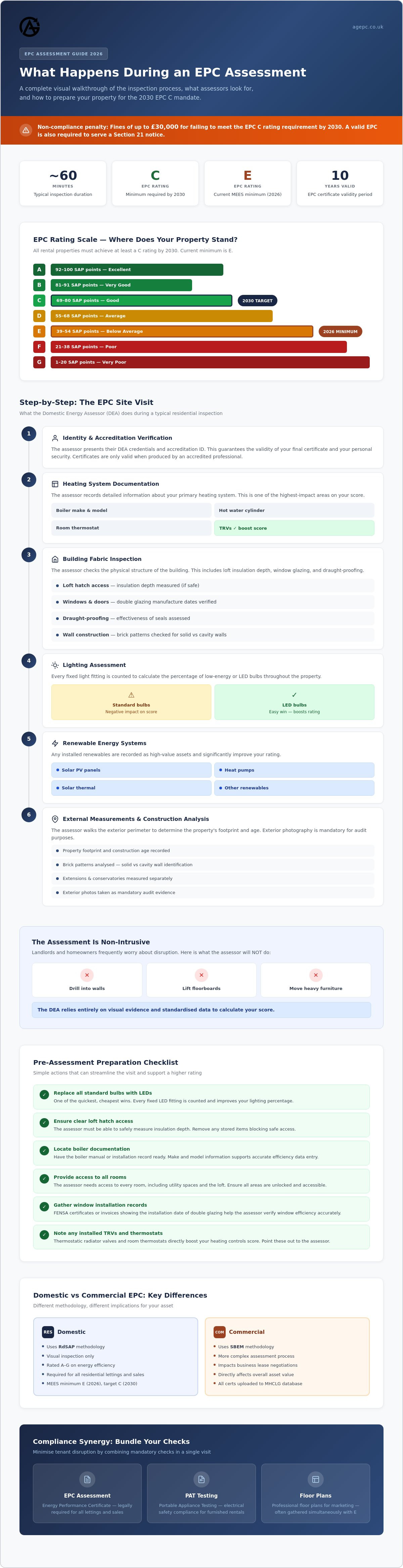
The regulatory environment in 2026 is strict. Current Minimum Energy Efficiency Standards (MEES) require a minimum 'E' rating to let a property in Slough or Windsor. However, the financial risks of non-compliance are rising. Marketing a property without a valid certificate is illegal and can lead to fines of up to £30,000 for failing to meet future 'C' requirements. A valid EPC is also a prerequisite for serving a Section 21 notice. For a deeper look at how these ratings impact your property's market worth, see the definitive guide to domestic EPCs.
Domestic vs Commercial Assessments: Key Differences
If you own commercial units in Reading, the process changes. Commercial EPCs use a different SBEM methodology rather than the RdSAP system used for homes. These assessments are more complex and directly impact business lease negotiations and overall asset value. Once completed, all certificates are uploaded to the Ministry of Housing, Communities and Local Government (MHCLG) database for public verification. This transparency ensures that prospective tenants or buyers can instantly verify the energy performance of any property on the market.
A Step-by-Step Walkthrough of the EPC Site Visit
The site visit is a methodical data-gathering exercise. It begins with the assessor verifying their identity and professional accreditation. This ensures your security and guarantees the validity of the final report. Once inside, the assessor will explain their planned route through the property. They need access to every room, including the loft and any utility spaces. Understanding what happens during an epc assessment helps you facilitate a faster visit. The assessor will start by documenting your primary heating system. They record the boiler's make and model, the presence of a hot water cylinder, and the efficiency of your heating controls. Thermostatic radiator valves (TRVs) and room thermostats are key features that boost your score.
The inspection then moves to the building's fabric. The assessor will check the loft hatch to measure insulation depth, provided it is safe to do so. They also examine windows and doors to identify double glazing manufacture dates and the effectiveness of draught-proofing. Lighting is equally important. The assessor counts every fixed light fitting to determine the percentage of low-energy or LED bulbs. If you have invested in renewables like solar PV or heat pumps, these are recorded as high-value assets. For a detailed breakdown of the data points collected, you can refer to the official government guidance on the EPC assessment process. If you want to ensure your property is ready for inspection, you can book a professional assessment with a local expert today.
External Measurements and Construction Analysis
The assessor will walk the exterior perimeter to determine the property's footprint and age. They analyse construction materials, such as brick patterns, to identify whether walls are solid or cavity. Exterior photography is a mandatory part of the evidence-gathering process for audit purposes. Extensions or conservatories are measured separately. These additions often have different thermal properties than the main building and significantly impact the overall energy calculation.
The Role of Documentation and Evidence
Paperwork can drastically improve your rating. Installation certificates for cavity wall insulation or underfloor heating are vital if these features are hidden from view. Physical evidence allows the assessor to record higher performance values rather than relying on estimates. Assessors must use 'default' values, which are often the lowest possible scores, if they cannot physically see an upgrade or verify it through valid documentation.
Preparing Your Property: How to Improve Your Rating Whilst Saving Time
Preparation is the foundation of a successful energy audit. Understanding what happens during an epc assessment allows you to remove friction before the assessor even arrives. Start by ensuring clear, unobstructed access to the loft hatch, the boiler, and any hot water cylinders. If these areas are blocked by storage or furniture, the assessor cannot verify their efficiency. This often results in a lower "default" score that doesn't reflect the property's true performance. To get the most accurate results, book your EPC assessment with a provider who values your time.
Efficiency is about more than just access. You should gather all relevant paperwork beforehand. This includes FENSA certificates for double glazing, warranties for solar panels, and invoices for recent renovations. On the day of the visit, keep pets and children in separate rooms. This allows the assessor to move freely and safely through the property, completing the inspection in the shortest possible timeframe. A focused assessor is an accurate assessor.
Quick Wins to Boost Your EPC Score Before the Visit
Small changes yield significant results. Upgrading to 100% LED lighting is the most cost-effective way to push a borderline 'D' rating into the 'C' category. It is a simple swap that assessors record instantly. Similarly, check your loft insulation. The current standard for maximum points is a depth of 270mm. If yours is thinner, a quick top-up before the visit can dramatically improve your heat retention score. Finally, ensure every radiator has a modern thermostatic radiator valve (TRV). These small devices prove to the assessor that the heating system is highly controllable and energy efficient.
Common Obstacles That Delay EPC Certificates
Locked rooms are a frequent cause of frustration. If an assessor cannot enter a space, they must assume the worst-case energy scenario for that area. This leads to a lower overall rating or a costly re-visit. Missing documentation is another hurdle. In Maidenhead or Southall, many older homes have newer windows, but without a FENSA certificate or proof of installation date, the assessor must use the building's default (and less efficient) age. Maintaining a comprehensive property file is essential for smooth management, much like the record-keeping required for avoiding tenancy deposit disputes in Windsor. Clear evidence always beats assumptions.
Compliance Synergy: Streamlining Your EPC, PAT, and Marketing
Managing a rental portfolio in 2026 requires more than just knowing what happens during an epc assessment. It requires a strategy that values your time and your tenants' privacy. Scheduling separate contractors for energy checks, safety tests, and marketing photos is a logistical headache that creates unnecessary friction. AG Property Services offers a streamlined, "one-stop" approach. We combine these essential tasks into a single, efficient visit. This no-nonsense method ensures your property is market-ready in as little as 24-48 hours. One visit. Multiple certificates. Complete peace of mind.
For landlords in Reading and Slough, tenant satisfaction is a priority. Minimising the number of times a contractor enters a home reduces disruption and maintains positive relationships. By booking your EPC alongside other mandatory checks, you eliminate the need for repeated appointments. Our assessors are trained to handle multiple data-gathering tasks simultaneously, ensuring that every legal requirement is met with precision and speed. We focus on results so you can focus on your investment.
The Landlord’s Compliance Bundle
Efficiency is the core of our service. Combining your energy assessment with other safety checks ensures you meet all PAT testing essentials in one go. Managing one appointment instead of three separate contractors simplifies your diary and reduces admin costs. Local landlords in High Wycombe and Watford prefer this single point of contact. It provides a clear, transparent trail of compliance that is easy to track and renew. We handle the complexity; you get the certificates.
Elevating Your Listing with Professional Marketing
A high EPC rating is a powerful selling point, but it needs to be presented correctly. There is a clear synergy between energy efficiency and professional real estate photos in Reading. High-quality imagery captures the aesthetic appeal, whilst accurate 2D and 3D floor plans provide the technical detail prospective tenants crave. Together, these elements create a comprehensive property profile that stands out on portals. Don't leave your compliance to chance. You can secure your compliance package with AG Property Services today and get your property moving faster.
Future-Proof Your Portfolio Today
Securing a valid EPC is no longer just a box-ticking exercise. It's a strategic move to protect your investment and ensure long-term rental legality. By addressing quick wins like LED lighting and providing clear documentation, you guarantee the most accurate reflection of your property's efficiency. Now that you've discovered what happens during an epc assessment, you can approach your next inspection with total confidence. Compliance doesn't have to be a hurdle. It's an opportunity to elevate your property's market value and meet the 2030 mandate head-on.
AG Property Services brings over 10 years of local expertise to every visit. Our accredited assessors specialise in both Domestic and Commercial EPCs, providing the grounded authority you need. Why deal with multiple contractors? We offer comprehensive bundles that include PAT testing, professional photography, and floor plans in a single, high-speed visit. This integrated approach removes friction and gets your property listed faster. Book your professional EPC assessment with AG Property Services today and experience a truly seamless compliance journey. Your property is in expert hands.
Frequently Asked Questions
How long does a standard domestic EPC assessment take?
A standard domestic EPC assessment typically takes between 45 and 60 minutes. The exact duration depends on the size and complexity of your property. Larger detached houses with multiple extensions or complex heating systems may require slightly more time to ensure every data point is recorded accurately. Small flats can often be completed in around 30 minutes.
Do I need to be present for the EPC assessment?
You don't need to be present personally as long as the assessor has full access to the property. Many landlords arrange for a tenant, letting agent, or neighbour to provide entry. However, it's vital that the person on-site can provide access to the loft hatch, boiler, and any utility cupboards. This ensures the assessor doesn't have to use lower default values for inaccessible areas.
Can a property 'fail' an EPC assessment?
A property cannot "fail" the assessment itself; it simply receives a rating on a scale from A to G. However, it can fail to meet legal Minimum Energy Efficiency Standards (MEES). Currently, rental properties in England and Wales must reach at least an 'E' rating. If your property falls below this, the report will provide a list of recommended improvements to reach the required legal standard.
Will the assessor need to move my furniture or look under floorboards?
No, the inspection is entirely non-intrusive. Assessors are not permitted to move your furniture, lift floorboards, or drill into your walls. They rely on visual evidence and standardised software calculations to determine efficiency. This is why having your paperwork ready is so important. If an upgrade like underfloor insulation isn't visible, your documentation serves as the necessary proof for a higher rating.
How long after the visit will I receive my digital EPC certificate?
You will typically receive your digital EPC certificate within 24 to 48 hours of the site visit. Once the assessor has processed the data and uploaded it to the central register, we'll send you a link to download the final document. This rapid turnaround ensures you can proceed with your sale or let without unnecessary administrative delays.
What happens if I don't have access to my loft during the check?
If the assessor cannot access the loft, they must record the insulation levels as "unknown." The software then applies a "default" value based on the age of the property, which is almost always lower than the actual performance. Ensuring the loft hatch is clear and accessible is one of the most important parts of what happens during an epc assessment to avoid an unfairly low score.
Important Information
The information provided in this article is for general guidance and informational purposes only and does not constitute legal, financial, or professional property advice. While AG Site Solutions aims to keep all content accurate and up to date, property regulations, landlord obligations, EPC requirements, and housing legislation may change over time.
Readers should always seek professional advice or consult the relevant authorities before making decisions relating to property compliance, tenancy matters, Energy Performance Certificates (EPCs), landlord responsibilities, or legal obligations.
Some articles may be created or assisted using AI-supported content tools and are reviewed and enhanced using real industry experience and property compliance knowledge.
For professional assistance, quotations, or compliance support, please contact AG Site Solutions directly via agepc.co.uk